Home
Class 12
PHYSICS
(Figure 3.78) shows three thin concentri...

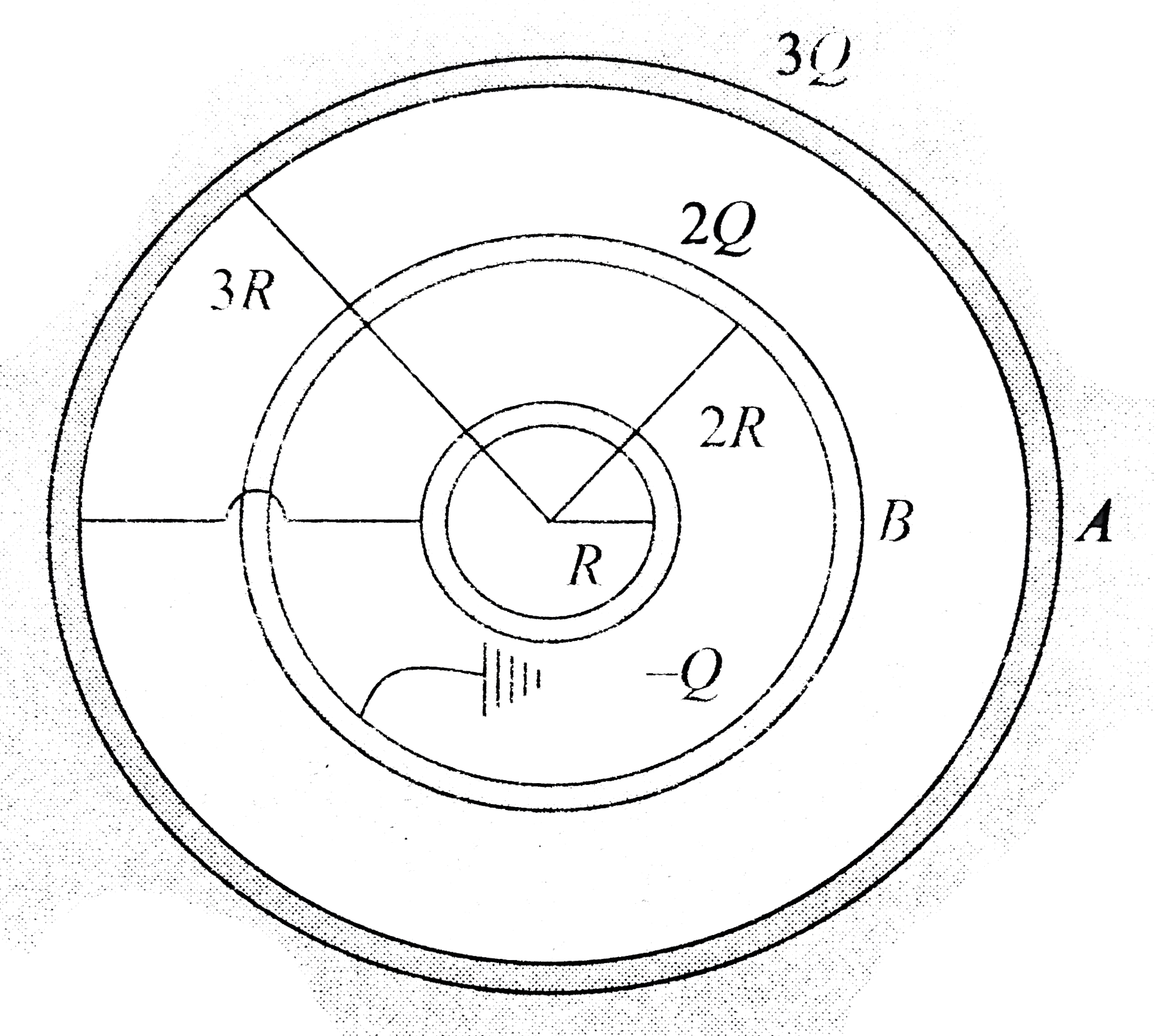
(Figure 3.78) shows three thin concentric spherical shells A, B and C with initial charges on A , B, and C as 3 Q, 2Q, and -Q, respectively. The shells A amd C are connected by a wire such that it does not touch B. Shell B is earthed. Determine the final charges `q_A, q_B, "and" q_C`.
.

Text Solution

Verified by Experts

The first equation holds for conservation of charge on A and C
`q_A + q_C = 3Q - Q = 2Q` ...(i)
The second equation holds for zero potential of earthed surface
`(V_B)_("surface") + (V_C)_("out") + (V_A)_("in") = 0`
or `(K q_B)/(2) + (K q_C)/(2 R) + (K q_A)/(3 R)= 0`
or `(q_B)/(2) + (q _C)/(2) + (q_A)/(3) = 0` ...(ii)
Also the third equation holds for potential of A and C being equal `V_A = V_C`.
`V_A = (V_A)_("surface") + (V_B)_("out") + (V_C)_("out")`
`V_C = (V_A)_("in") + (V_B)_("in") + (V_C)_("surface")`
`:. (K q _A)/(3 R) + (K q_B)/(3 R) + (k q_C)/(3 R) = (K q_C)/(R) + (K q_B)/(2 R) + (K q _A)/(3 R)`
or `(q_A)/(3) + (q_B)/(3) + (q_C)/(3)= q_C + (q_B)/(2) + (q_A)/(3)` ...(iii)
Now on solving for `q_A, q_B`, and `q_C`, we get
`q_C = Q/(2) , q_A = (3 Q)/(2)`, and `q_B= (-3 Q)/(2)`.
Promotional Banner

Topper's Solved these Questions

  • ELECTRIC POTENTIAL

    CENGAGE PHYSICS|Exercise Examples|9 Videos
  • ELECTRIC POTENTIAL

    CENGAGE PHYSICS|Exercise Exercise 3.1|23 Videos
  • ELECTRIC FLUX AND GAUSS LAW

    CENGAGE PHYSICS|Exercise MCQ s|38 Videos
  • ELECTRICAL MEASURING INSTRUMENTS

    CENGAGE PHYSICS|Exercise M.C.Q|2 Videos

Similar Questions

Explore conceptually related problems

Figure shows three concentric thin spherical shells A, B and C of radii a, b and c respectively. The shells A and C are given charges q and -q respectively and the shell B is earthed. Find the charges appearing on the surfaces of B and C.

Three concentric spherical shells A, B and C having uniformly distributed total charges +Q, -2Q and +Q respectively are placed as shown. The potential at the centre will be -

Three spherical shells have radii R,2R and 3R respectively. Total charge on A nd C is 3q . Find the charges on different surface of A, B and C. The connecting wire does not touch the shell B.

(Figure 3.114) shows three concentric spherical conductors A, B, and C with radii R, 2R , and 4R , respectively. A and C are connected by a conducting wire, and B is uniformly charged ("charge" = +Q) . Find . a. charges on conductors A and C, and b. potentials of A and B.

Figure shows a system of three concentric metal shells, A, B and C with radii a, 2a and 3a respectively. Shell B is earthed and shell C is given a charge Q. Now if shell C is connected to shell A, then find the final charge on the shell B

A and B are two concentric spherical shells. If A is given a charge +q while B is earthed as shown in figure then

The figure shows three concentric , conducting ,spherical shells X,Y and Z with radii r, 2r and 3r respectively . X and Z are connected by a conducting wire and Y is uniformly charged to charge Q . Find: (a) charges on shells X and Z , (b) potentials of X and Y .

Three concentric spherical conducting shells A, B and C of radii a, 2a and 4a are initially given charges +Q, -2Q and +Q respectively. The charge on the middle spherical shell B after switches S_(1) and S_(2) are simultaneously closed, will be

Two concentric spherical conducting shells of radii R and 2R are carrying charges q and 2q, respectively. Both are now connected by a conducting wire. Find the change in electric potential (inV) on the outer shell.

