Home
Class 12
PHYSICS
Consider an infinita ladder of network s...

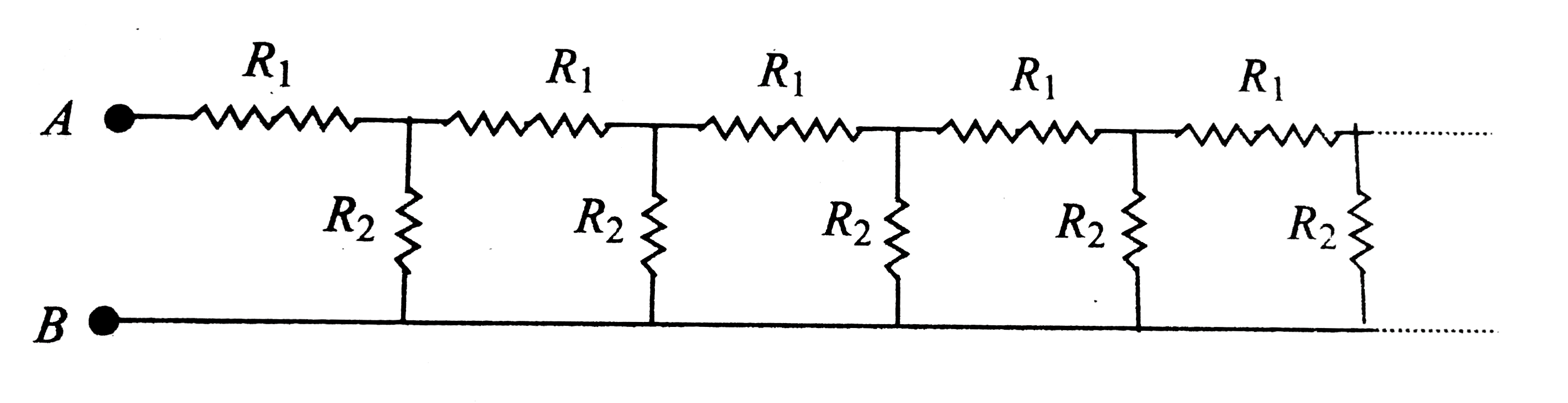
Consider an infinita ladder of network shown In fig 5.223A voltage is applied between points A and B. If the voltage is havled after each seciton, find the raito of `R_1//R_2`

Suggest a method to terminate it after a few sections without introducing much error in its attenuation.

Text Solution

Verified by Experts
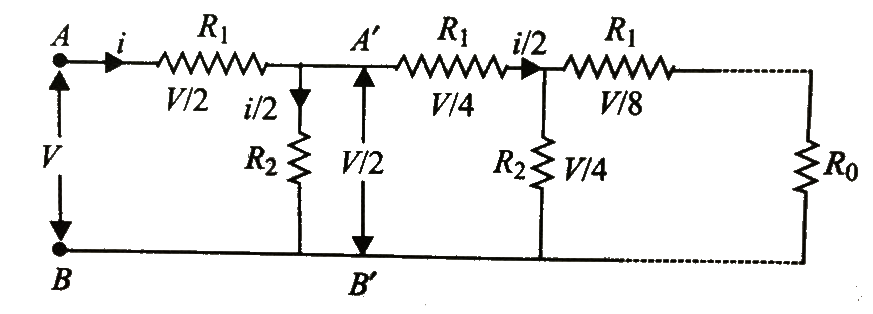
Voltage across AB is v, voltage acrpss A'B' os V/2
i.e., voltage across `R_(2)` is `V//2`

Now from Kirchhoff's law, it is obvious that voltge across `R_(1)` is
`V-(V)/(2) = (V)/(2)`
`R_(1)i = R_(2) (i)/(2) or (R_(1))/(R_(2)) = (1)/(2)`
Resistance will not be affected if equivalent resistance R
becomes independent of number of sections in the circuit. This is only possible if the terminating resistance `R_(0)` is it self equal to equivalent resistance the equivalnet resistance
of `R_(0)` and `R_(2)` is
`R' = R_(0) = R_(1) +(R_(0)R_(2))/(R_(0) + R_(2))`
`R_(1)` is in series with it, so equivalent resistance between A and B is
`R_(0) = R_(1) +(R_(0)R_(2))/(R_(0)+R_(2))`
According to proposition `R_(0) = R_(1) +(R_(0)R_(2))/(R-0 +R_(2))`
Solving for `R_(0)` we get `R_(0) = (R_(1))/(R_(2)) [+sqrt(1+(4R_(1))/(R_(1)))]`
Thus, the circuit may be terminated after a few section if
resistance `R_0` is connected in parallel as shown in fig
Promotional Banner

Topper's Solved these Questions

  • ELECTRIC CURRENT AND CIRCUIT

    CENGAGE PHYSICS|Exercise Single Correct|72 Videos
  • ELECTRIC CURRENT AND CIRCUIT

    CENGAGE PHYSICS|Exercise Multiple Correct|16 Videos
  • ELECTRIC CURRENT AND CIRCUIT

    CENGAGE PHYSICS|Exercise Exercise 5.2|50 Videos
  • ELECTRIC CURRENT & CIRCUITS

    CENGAGE PHYSICS|Exercise Kirchhoff s law and simple circuits|15 Videos
  • ELECTRIC FLUX AND GAUSS LAW

    CENGAGE PHYSICS|Exercise MCQ s|38 Videos

Similar Questions

Explore conceptually related problems

Consider an infinte ladder network shown in figure. A voltage V is applied between the points A and B. This applied value of voltage is halved after each section.

In the network as shown in figure. Each resistance r is of 2Omega find the effective resistance between points A and B.

In the circuit shown in fig. 5.265, E_1 = E_2 = E_3 = 2V and R_1 = R_2 = 4Omega. The current flowing between points A and B through battery E_2 is

Find the resistance of a wire frame shaped as cube (Fig) when measured between points (a) 1.7, (b) 1.2, (c) 1.3. The resitance of each edge of the frame is R

If each resistance R = 1 ohm then the equivalent resistance (in ohm) between the terminal points A and B in the network shown in figure is

Four resistors R_(1),R_(2),R_(3) and R_(4) are connected between two terminals A and B iin a network as shown in the diagram. A key K can connect the two points (see diagram) C and D. A constant potential difference (V_(A)-V_(B))=V is maintained between thhe points A and B Q. In on connecting the key K, no current flows through the segment CD, whatever potential difference V exists between A and B which of the following cases will satisfy this condition?

Shown in the figure is a semi - circular metallic strip that has thickness t and resistivity rho its inner radius is R_(1) and outer radius is R_(2) . It a voltage V_(0) is applied between its two ends , a current I floes in it . In addition , it is observed that a transverse voltage DeltaV develops between its inner and outer surfaces due to puerly kinetic effects of moving electrons (ignore any role of the magnetic field due to the current). Then (figure is schematic and not drawn to scale

Two metallic wires A and B are made using copper. The radius of wire A is r while its length is l. A dc voltage V is applied across the wire A, causing power dissipation, P. The radius of wire B is 2r, and its length is 2l and the same de voltage V is appoied across it causing power dissipation P_(1). Which one of the following is the correct relationship between P and P_(1) ?

CENGAGE PHYSICS-ELECTRIC CURRENT AND CIRCUIT-Subjective
  1. In the circuit diagram shown in find the current through the 1Omega re...

    Text Solution

    |

  2. The circuit shown in fig 5.223 is in steady state. find the charges ...

    Text Solution

    |

  3. Consider an infinita ladder of network shown In fig 5.223A voltage is ...

    Text Solution

    |

  4. For a cicuit shown in fing 5.235 swhitch S1 is closed at t= 0, then at...

    Text Solution

    |

  5. Find the potential difference between the plates of the capactior C in...

    Text Solution

    |

  6. Analyze the given circuit in the steady state condition. Charge on the...

    Text Solution

    |

  7. (a) What is the potential of point a with respect to point b in figure...

    Text Solution

    |

  8. In the cicuit shown in fig. C is a parallel plate air capacitor having...

    Text Solution

    |

  9. The circuit shown in fig. Is in steady state. i. Find the energy...

    Text Solution

    |

  10. The given R-C circuit has two swithes S1 and S2 Swithc S2 is clsoed a...

    Text Solution

    |

  11. For the circuit arrangement shown in fig. a. Find the potentail d...

    Text Solution

    |

  12. The plates of a capacitor of capacitance C are given the charges Q1 an...

    Text Solution

    |

  13. Consider a parallel pate capacitor of capactance C with partially cond...

    Text Solution

    |

  14. The switch S is closed aty t = 0. the capacitor C is uncharged but C0 ...

    Text Solution

    |

  15. Only switch S1 closed in fig. a. what is the steady-state reading of...

    Text Solution

    |

  16. A point charge +q is moved with a constant velocity v toward a solid c...

    Text Solution

    |

  17. Calculate equivalent resistance between A and B of the circuit shown i...

    Text Solution

    |

  18. In the circuit shown in fig. calculate the following: a. Potential d...

    Text Solution

    |

  19. In the given cirucit, determine current through branch having indicate...

    Text Solution

    |

  20. Determine current through batteries epsilon(1) and epsilon(2)

    Text Solution

    |

