Home
Class 12
PHYSICS
In the cicuit shown in fig. C is a paral...

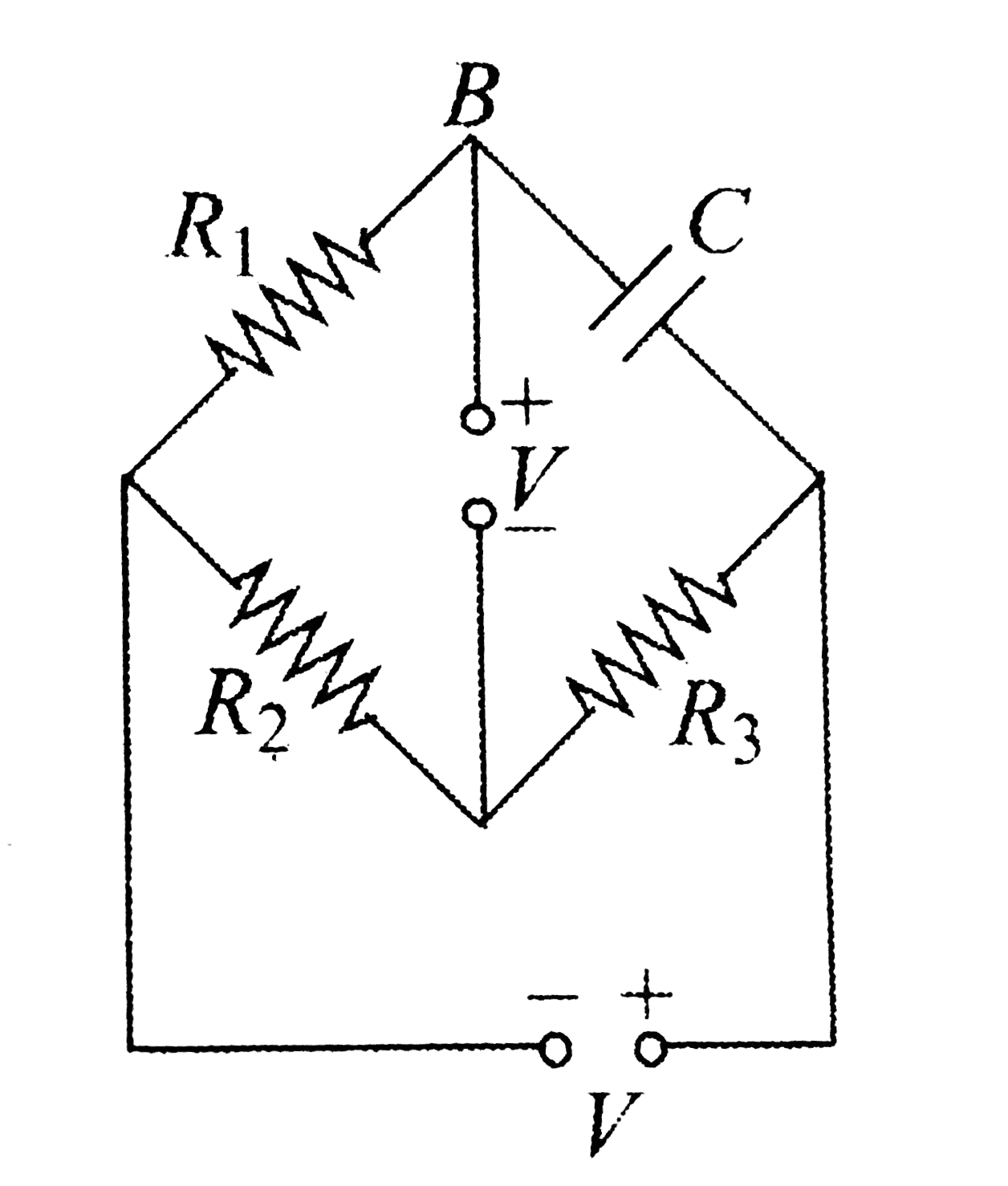
In the cicuit shown in fig. C is a parallel plate air capacitor having plate of area `A = 50cm^2` each and distance d = 1mm apart. `R_1 R_2, and R_3` are resistors having resistance `3Omega, 2Omega, and 1Omega` respectively. Two identical sources each of emf V and of emf V and of negligible internal resistance are connected as shown in fig. if a dielectric strength of are is `E_0 = 3xx10^6Vm^(-10)`, calculate the maximum safe value of V.

Text Solution

Verified by Experts
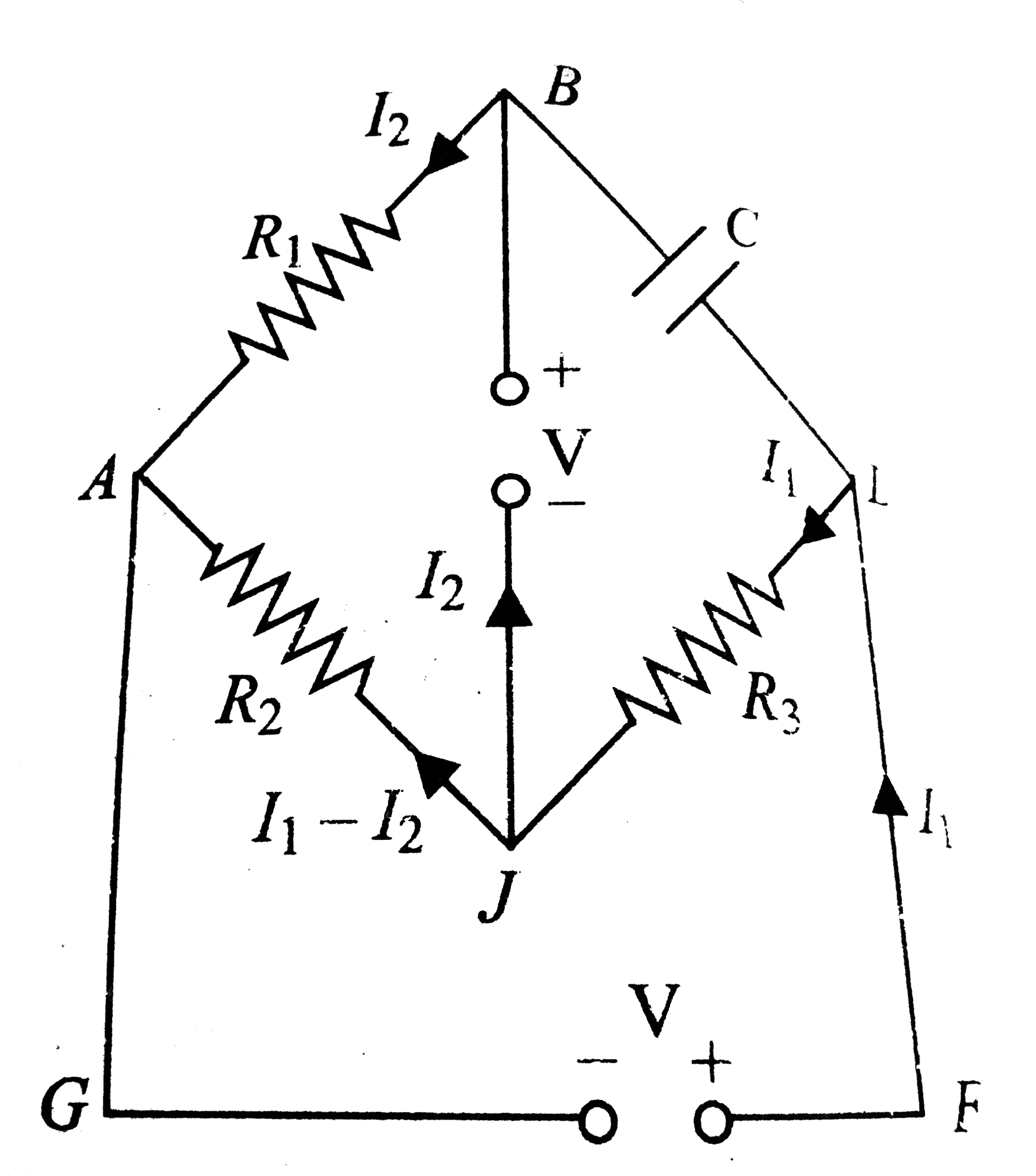
Due to sources, currents flow
through resistance `R_(1),R_(2)` and
`R_(3)` and capacitor gets charged.
Due to charge, an electic field
is established in the capacitor
whose magnitude cannot
exceed dielectric strength `E_(0)`
of air. Maximum safe value of
V corresponds to the maximum
possible charge on capacitor.
Let the Maximum
possibel charge on capacitor be `q_(0)` then the electic field inside
the capacitor is `E_(0) = q_(0)//A epsilon_(0),`
Then the electirc field inside
the capacitor is `E_(0) = q_(0)//A epsilon_(0),`
where `q_(0) A epsilon_(0)E_(0) = 15,000 epsilon_(0) and C = epsilon_(0) A//d = 5epilon_(0)` farad
Since, in steady state, no current flows through the capacitor

current through various parts of the circuit will be as sown in
fig. Now we analyze the cirucit in a steady state. First applying Kirchhoff's voltage law on mesh ABJA, we get
`I_(2)R_(1) + V +R_(2)(I_(1) - I_(2)) = 0 or 2I_(1) -5I_(2) = -V` (i)
For mesh AJDFGA,
`-R_(2)(I_(1) - I_(2))-R_(3)I_(1) +V = 0 or eI_(1) - 2I_(2) = V` (ii)
From Eqs. (i) and (ii): `I_(1) = (7V)/(11)` and `I_(2) = (%V)/(11)`
Now applying Kirchhoff's voltage law on mesh BDJB, we get
`(q)/(C) +I_(1) R_(3) - V = 0 or or q= (4CV)/(11) = (20)/(11) epsilon_(0)V`
But the maximum possible value of q is `q_(0) = 15,000 epsilon_(0).` Therefore, the maximum safe value of V is `11q_(0)//20epsilon_(0) = 8250V = 8.25kV.`
Promotional Banner

Topper's Solved these Questions

  • ELECTRIC CURRENT AND CIRCUIT

    CENGAGE PHYSICS|Exercise Single Correct|72 Videos
  • ELECTRIC CURRENT AND CIRCUIT

    CENGAGE PHYSICS|Exercise Multiple Correct|16 Videos
  • ELECTRIC CURRENT AND CIRCUIT

    CENGAGE PHYSICS|Exercise Exercise 5.2|50 Videos
  • ELECTRIC CURRENT & CIRCUITS

    CENGAGE PHYSICS|Exercise Kirchhoff s law and simple circuits|15 Videos
  • ELECTRIC FLUX AND GAUSS LAW

    CENGAGE PHYSICS|Exercise MCQ s|38 Videos

Similar Questions

Explore conceptually related problems

Three resistors of resistances 3Omega, 4Omega and 5Omega are combined in parallel. This combination is connected to a battery of emf 12V and negligible internal resistance, current through each resistor in ampere is

Two identical batteries, each of EMF 2V and internal resistance r =1Omega are connected as shown. the maximum power that can be developed across R using these batteries is :

Two cells of emf 1.25V,0.75V and each of internal resistance 1Omega are connected in parallel. The effective emf will be

In the circuit shown in fig. the cell has emf 10V and internal resistance 1 Omega

Three batteries of emf 1V and internal resistance 1 Omega each are connected as shown. Effective emf of combination between the points PQ is –

In the circuit shown E, F, G and H are cells of emf 2V, 1V, 3V and 1V respectively and their internal resistance are 2Omega, 1Omega, 3Omega and 1Omega respectively.

Three batteries having emfs and internal resistances as shown in figure are connected across a resistor of 2Omega . The reading of ammeter is

Two resistors of resistances 2Omega and 6Omega are connected in parallel. This combination is then connected to a battery of emf 2 V and internal resistance 0.5 Omega . What is the current flowing thrpough the battery ?

CENGAGE PHYSICS-ELECTRIC CURRENT AND CIRCUIT-Subjective
  1. The circuit shown in fig 5.223 is in steady state. find the charges ...

    Text Solution

    |

  2. Consider an infinita ladder of network shown In fig 5.223A voltage is ...

    Text Solution

    |

  3. For a cicuit shown in fing 5.235 swhitch S1 is closed at t= 0, then at...

    Text Solution

    |

  4. Find the potential difference between the plates of the capactior C in...

    Text Solution

    |

  5. Analyze the given circuit in the steady state condition. Charge on the...

    Text Solution

    |

  6. (a) What is the potential of point a with respect to point b in figure...

    Text Solution

    |

  7. In the cicuit shown in fig. C is a parallel plate air capacitor having...

    Text Solution

    |

  8. The circuit shown in fig. Is in steady state. i. Find the energy...

    Text Solution

    |

  9. The given R-C circuit has two swithes S1 and S2 Swithc S2 is clsoed a...

    Text Solution

    |

  10. For the circuit arrangement shown in fig. a. Find the potentail d...

    Text Solution

    |

  11. The plates of a capacitor of capacitance C are given the charges Q1 an...

    Text Solution

    |

  12. Consider a parallel pate capacitor of capactance C with partially cond...

    Text Solution

    |

  13. The switch S is closed aty t = 0. the capacitor C is uncharged but C0 ...

    Text Solution

    |

  14. Only switch S1 closed in fig. a. what is the steady-state reading of...

    Text Solution

    |

  15. A point charge +q is moved with a constant velocity v toward a solid c...

    Text Solution

    |

  16. Calculate equivalent resistance between A and B of the circuit shown i...

    Text Solution

    |

  17. In the circuit shown in fig. calculate the following: a. Potential d...

    Text Solution

    |

  18. In the given cirucit, determine current through branch having indicate...

    Text Solution

    |

  19. Determine current through batteries epsilon(1) and epsilon(2)

    Text Solution

    |

  20. The cirucit shown in fig. extends to the right into infinity. Each bat...

    Text Solution

    |
