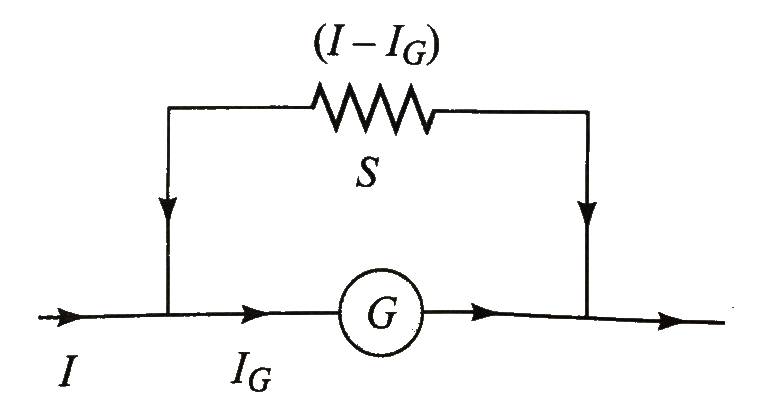
the deflection in a moving coil galvenometre falls from `50` divisions to `10` divisions when a shunt of `12 Omega` is applied. What is the resistance of the galvenometre? Assume the main current to remain same.
Text Solution
Verified by Experts
In case of a galvanometer, `I prop theta`. Given `I_(G)/(I) = (10)/(50) = (1)/(5)` i.e., `I_(G) = (1)/(5)I` Now a sin case of a shunted galvanometer as shows in fig. `(I - I_(G)) S = I_(G)` or `(I - (1)/(5) I) xx 12 = (1)/(5) IG` or `G = 4 xx 12 = 48 Omega`
Topper's Solved these Questions
ELECTRICAL MEASURING INSTRUMENTS
CENGAGE PHYSICS|Exercise Solved Examples|4 Videos
ELECTRICAL MEASURING INSTRUMENTS
CENGAGE PHYSICS|Exercise Exercise 6.1|15 Videos
ELECTRIC POTENTIAL
CENGAGE PHYSICS|Exercise DPP 3.5|14 Videos
ELECTROMAGENTIC INDUCTION
CENGAGE PHYSICS|Exercise QUESTION BANK|40 Videos
Similar Questions
Explore conceptually related problems
The deflection in a moving coil galvanometer falls from 100 divisions to 20 divitation when a shunt of 12 Omega is used. The resistance of the galvanometer coilds is
The deflection in a MCG is reduced from 40 divisions to 10 divisions, when a shunt of 10 Omega is joined across it. What is the resistance of the galvanometer coil ?
The deflection in a galnometer falls from 50 divisions to 20 divisions, when a 12Omega shunt is applied. The galvanometer resistance is
The deflection in a galvanometer fulls from 50 divisions to 20 divisions, when a 12Omega shunt is applied. The galvanometer resistance is
When a 12 Omega resistor is connected with a moving coil galvanometer, then its deflection reduces form 50 divions to 10 divisions. The ressitance of the galvanometer is