Home
Class 12
PHYSICS
(i) In fig. 6.7, find the potential diff...

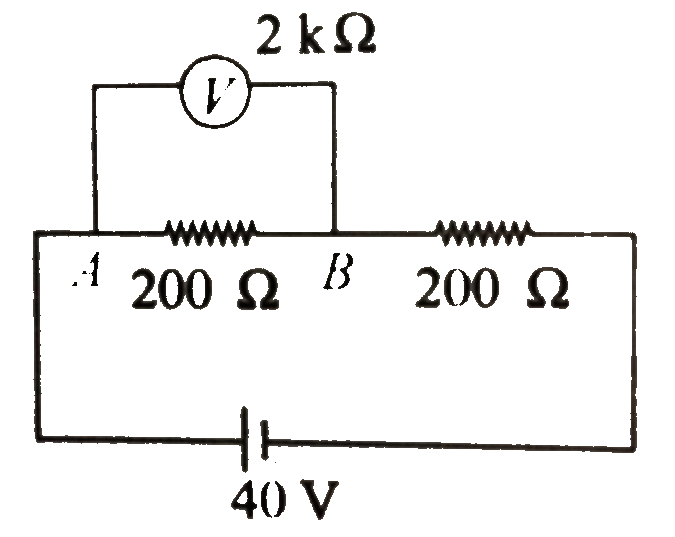
(i) In fig. `6.7`, find the potential difference berween the points `A` and `B`.
(ii) Now we wish to measure this potential difference by using a voltemter of resistance `2 k Omega`. Find the reading of the voltumeter and percentage error.
(ii) Solve part (ii) if the voltumter were of resistance `20 k Omega`. What conculsion do you draw from the results you get in the above parts?

Text Solution

Verified by Experts

As both the resistances are same, `40 V` will be divided equally among both the resistances. Hence, the potential difference across `A` and `B` is `20 V`.
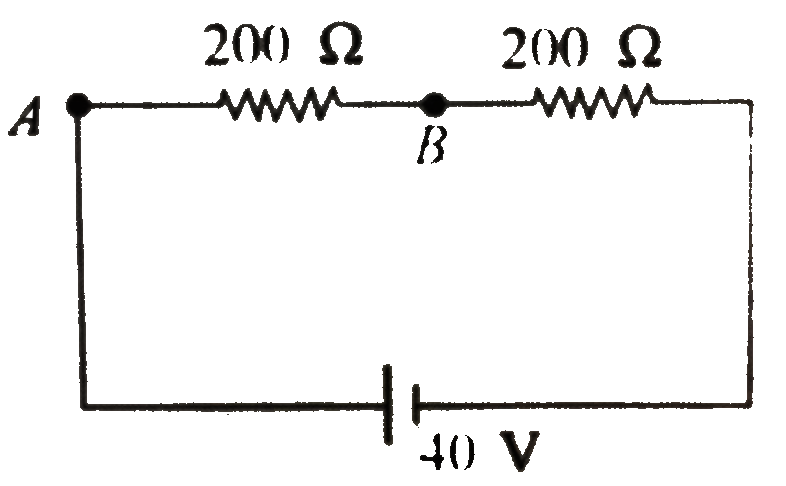
(ii) Equivalent resistance of `200 Omega ` and `2 k Omega` is
`R_(1) = (200 xx 200)/(200 + 200) = (2000)/(11) Omega`
Reading of voltmeter = potential difference across `AB`
`= V_(1) = (2000//(11 xx 40))/(2000//(11 + 200)) = 19.05 V`
Percentage error `= (20 - 19.05)/(20) xx 100 = 4.75%`
(iii) In this case
`R_(1) (200 xx 20,000)/(200 + 20,000) = (20,000)/(101) Omega`
Reading of voltmeter
`=` potential difference across `AB`
`= V_(2) = (20,000//(101 xx 40))/(20,000//(101 + 200)) = 19.90 V`
Percentage error `= (20 - 19.9)/(20) xx 100 = 0.5%`
In case (iii), percentage error is less than that in case (ii). It means the more the resistance of the voltmeter, the more accurate the reading.
Promotional Banner

Topper's Solved these Questions

  • ELECTRICAL MEASURING INSTRUMENTS

    CENGAGE PHYSICS|Exercise Solved Examples|4 Videos
  • ELECTRICAL MEASURING INSTRUMENTS

    CENGAGE PHYSICS|Exercise Exercise 6.1|15 Videos
  • ELECTRIC POTENTIAL

    CENGAGE PHYSICS|Exercise DPP 3.5|14 Videos
  • ELECTROMAGENTIC INDUCTION

    CENGAGE PHYSICS|Exercise QUESTION BANK|40 Videos

Similar Questions

Explore conceptually related problems

Resistances R_(1) and R_(2) , each 600 Omega , are connected in series as shown in figure-3.382. The potential difference between points A and B is 120 V. Find the reading of voltmeter connected between points C and D ifits resistance is 120 Omega

(a) Find the value of i and potential difference across each cell. (b) Find potential difference between A and B . ( c) In the given circuit, find (i) potential difference between terminals 10 V cell (ii) current through 25 V cell (iii) current through 5 Omega (d) Find the current through resistance 5 Omega . .

(a) What do you understand by the term ''potential difference''? (b) What is meant by saying that the potential difference between two points is 1 volt? (c) What is the potential difference between the terminals of a battery if 250 joules of work is required to transfer 20 coulombs of charge from one terminal of battery to the other? (d) What is a voltmeter? How is a voltmeter connected in the circuit to measure the potential difference between two points. Explain with the help of a diagram. (e) State whether a voltmeter has a high resistance or a low resistance. Give reason for your answer.

As shown in figure a variable rheostat of 2kOmega is used to control the potential difference across 500 ohm load. (i) If the resistance AB is 500 Omega , what is the potential difference across the load ? (ii) If the load is removed, what should be the resistance at BC to get 40 volt btween B and C ?

The battery of EMF 5V and internal resistance 20Omega is connected with a resistance R_(1) = 50Omega and a resistance . A voltmeter of resistance 1000Omega is used to measure the potential difference across R1 .What percentage error is made in the reading.

A cell of emf 2V and internal resistance 0.1 Omega supplies a current through a coil of resistance 11.0 Omega . The current is being measured by an ammeter whose resistance is 6 Omega . What reading does it give ? What is the percentage difference from the actual current, when the meter is not used ?

(a) A voltmeter with resistance R_v is connected across the terminals of a battery of emf E and internal resistance r . Find the potential difference measured by the voltmeter. (b) If E = 7.50 V and r = 0.45 Omega , find the minimum value of the voltmeter resistance R_v so that the voltmeter reading is within 1.0% of the emf of the battery. (c) Explain why your answer in part (b) represents a minimum value.

