Home
Class 12
PHYSICS
Cells A and B and a galvanometer G are c...

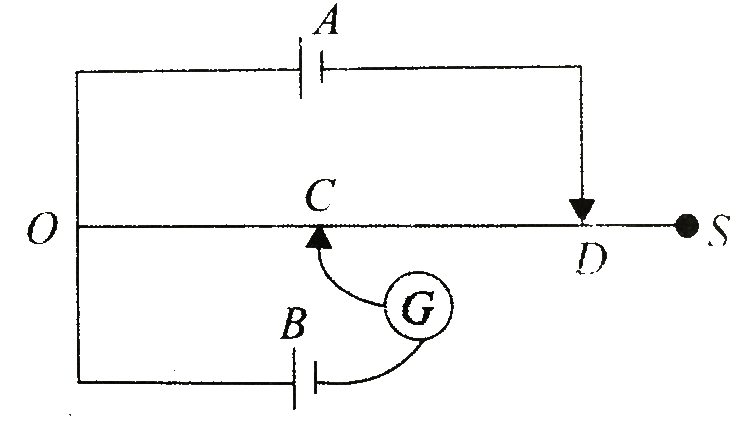
Cells `A` and `B` and a galvanometer `G` are connected to a side wire `OS` by two sliding contacts `C` and `D` as shows in Fig. `6.17`. The slide wire is `100 cm` long and has a resistance of `12 Omega`. With `OD = 75 cm`, the galvanometer gives no deflections when `OC` is `50 cm`. If `D` is moved to touch the end of wire `S`, the value of `OC` for which the galvanometer shows no deflection is `62.5 cm`. The emf of cell `B` is `1.0 V`. Calculate
(i) the potential difference across `O` and `D` when `D` is at `75 cm` mark from `O`
(ii) the potential difference across `OS` when `D` touches `S`
(iii) internal resistance of cell `A`
(iv) the emf of cell `A`

A

3 ohm and 2V

B

4 ohm and 2V

C

3 ohm and 12V

D

13 ohm and 2V

Text Solution

Verified by Experts

The correct Answer is:
A

Resistance of wire `OD` is
`(12)/(100) xx 75 = 9 Omega`
Let `E` and `r` be the emf and internal resistance of cell `E`, respectively.
(i) Since `1 V` is balanced across `50 cm`, so potential gradient of wire is `1//50 V cm^(-1)`. Therefore, voltage drop across wire `OD` of length `67 cm` is `(1//50) xx 75 = 1.5 V`.
(ii) Now potential gradient of wire is `1//62.5 V cm^(-1)` Therefore, voltage drop across wire `OS` of length `100 cm` is `(1//62.5) xx 100 = 1.6 V`.
(iii) For first case
`((E)/(9 + r)) xx 9= 1.5` (i)
For second case
`((E)/(12 + r)) xx 12 = 1.6` (ii)
(iv) On solving Eqs. (i) and (ii), we get `r = 3 Omega` and `E = 2 V`.
Promotional Banner

Topper's Solved these Questions

  • ELECTRICAL MEASURING INSTRUMENTS

    CENGAGE PHYSICS|Exercise Solved Examples|4 Videos
  • ELECTRICAL MEASURING INSTRUMENTS

    CENGAGE PHYSICS|Exercise Exercise 6.1|15 Videos
  • ELECTRIC POTENTIAL

    CENGAGE PHYSICS|Exercise DPP 3.5|14 Videos
  • ELECTROMAGENTIC INDUCTION

    CENGAGE PHYSICS|Exercise QUESTION BANK|40 Videos

Similar Questions

Explore conceptually related problems

A potentiometer wire AB is 100 cm long and has total resistance of 10Omega . If the galvanometer shows zero deflection at the position C , then find value of unknown resistance

For the potentiometer arrangement shown in the figure, length of wire AB is 100 cm and its resistance is 9 Omega . Find the length AC for which the galvanometer G will show zero deflection.

The potentiometer wire AB is 600cm long. At what distance (in cm) from A should the jockey J touch the wire to get zero deflection in the galvanometer?

What is the potential difference between the ends A and B of the given potentiometer wire, in the following circuit ? The galvanometer G shows no deflection.

Figure- 3.287 shows a potentiometer with length of wire Im and resistance 10 Omega . In this system find length PC when galvanometer shows null deflection.

The potentiometer wire AB shown in figure is 40 cm long. Where the free end of the galvanometer should be connected on AB so that the galvanometer may show zero deflection?

A potentiometer wire of length 100 cm has a resistance of 10 Omega . It is connected in series with a resistance R and cell of emf 2 V and of of 40 cm of the potentiometer wire. What is the value of R ?

AB is a wire of uniform resistance. The galvanometer G shows no deflection when the length AC = 20 cm and CB = 80 cm . The resistance R is equal to. .

A wire 50 cm long and 0.12mm diameter has a resistance of 4.0 Omega find the resistance of another wire of the same material whose length is 1.5m and diameter is 0.15 mm
