Home
Class 12
PHYSICS
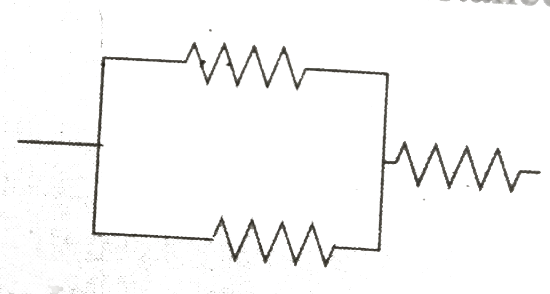
Each of three resistors in fig. 7.12 has...

Each of three resistors in fig. `7.12` has a resistance of `2 Omega` and can dissipate a maximum of `18 W` without becoming excessively heated. Find the maximum power the circuit can dissipate.

Text Solution

Verified by Experts

`P_(max) = (i_(max))^(2) R or 18 = i_(max)^(2) xx 2 or i_(max) = 3 A`
Here ` R_(eq) = 3 Omega`.
Promotional Banner

Topper's Solved these Questions

  • HEATING EFFECT OF CURRENT

    CENGAGE PHYSICS|Exercise Subjective|8 Videos
  • HEATING EFFECT OF CURRENT

    CENGAGE PHYSICS|Exercise Single Correct|60 Videos
  • HEATING EFFECT OF CURRENT

    CENGAGE PHYSICS|Exercise Solved Examples|13 Videos
  • GRAVITATION

    CENGAGE PHYSICS|Exercise Question Bank|39 Videos
  • INDUCTANCE

    CENGAGE PHYSICS|Exercise Concept Based|9 Videos

Similar Questions

Explore conceptually related problems

Each of three resistors in figure has a resistance of 2.4 Omega and can dissipate a maximum of 36 W without becoming excessively heated. What is the maximum power the circuit can dissipate?

The resistance of each of the three wires joined as shown in figure is 4 Omega and each one can have a maximum power of 20 watt (otherwise it will melt). What maximum power will the whole circuit dissipate ?

In the circuit shown in Fig.6.1, each of the three resistors of 4Omega can have a maximum power of 20W (otherwise it will melt). What maximum power can the whole circuit take?

Three 2 Omega resistors, A, B and C are connected as shown in figure. Each of them dissipates energy and can with stand a maximum power of 18 W without melting. Find the maximum current that can flow through the three resistors ?

Draw a circuit diagram of an electric circuit containing a cell, a key, an ammeter, a resistance of 4 Omega in series with a combination of two resistors (8 Omega) in parallel and a voltmeter across the parallel combination. Each of them dissipate maximum energy and can withstand a maximum power of 16 W without melting. Find the maximum current that can flow through the three resistors.

Draw a circuit diagram of an electric circuit containing a cell, a key, an ammeter, a resistor of 4Omega in series with a combination of two resistors ( 8Omega each ) in parallel and a voltmeter across parallel combination. Each of them dissipate maximum energy and can withstand a maximum power of 16 W without melting. Find the maximum current that can flow through the three resistors.

An experiment is preformed to determine the I-V characteristics of a Zener diode, which has a protective resistance of R = 100 Omega , and maximum power of dissipation rating of 1 W. The minimum voltage range of the DC source in the circuit is :-

Two wires have resistance of 2 Omega and 4 Omega connected to same voltage, ratio of heat dissipated at resistance is

Suppose the circuit in Exercise 7.18 has a resistance of 15 Omega Obtain the average power transferred to each element of the circuit, and the total power absorbed.

In the following figures, each of the three resistances, the rating of 24 W and resistance of 6Omega . Find the maximum power rating of the circuit.

CENGAGE PHYSICS-HEATING EFFECT OF CURRENT-Exercise 7.1
  1. (a) what is the rate at which energy being delivered to a light bulb ...

    Text Solution

    |

  2. A heater joined in series with a 50 W bulb is connected to the mains ...

    Text Solution

    |

  3. Each of three resistors in fig. 7.12 has a resistance of 2 Omega and c...

    Text Solution

    |

  4. An electric bulb rated 220 V and 60 W is connected in series with anot...

    Text Solution

    |

  5. We have a 30 W, 6 V bulb , which we want to glow by a supply of 120 V ...

    Text Solution

    |

  6. Two heater coils made of the same material are connected in parallel a...

    Text Solution

    |

  7. A series circuit consists of three identical lamps connected to a batt...

    Text Solution

    |

  8. Two wires of the same material and having the same uniform area of cro...

    Text Solution

    |

  9. Water boils in an electric kettle in 15 min after being switched on . ...

    Text Solution

    |

  10. An electric motor operating on a 50 V dc supply draws a current of 12...

    Text Solution

    |

  11. A fuse with a circular cross - sectional radius of 0.15 mm blows at 1...

    Text Solution

    |

  12. A motor operating on 120 V draws a current of 2 A . If the heat is dev...

    Text Solution

    |

  13. The walls of a closed cubical box of edge 40 cm are made of a material...

    Text Solution

    |

  14. Two tungsten lamps with resistances R(1) and R(2), respectively , are ...

    Text Solution

    |

  15. n identical bulbs are connected in series and illuminated by a power s...

    Text Solution

    |

  16. An electric motor is designed to work at 100 Vand draws a current of ...

    Text Solution

    |

  17. A house is fitted with certain numbers of 100 W, 230 V incandescent la...

    Text Solution

    |

  18. A house is fitted with seven tubelights of rating 220 V, 40 W each , t...

    Text Solution

    |

  19. Two bulbs are marked 200 V, 300 W and 200 V, 600 W, respectively. The ...

    Text Solution

    |

  20. A servo voltage stabiliser restricts the voltage output to 220 V +- 1%...

    Text Solution

    |
