Home
Class 12
PHYSICS
There is a fixed positive charges Q at O...

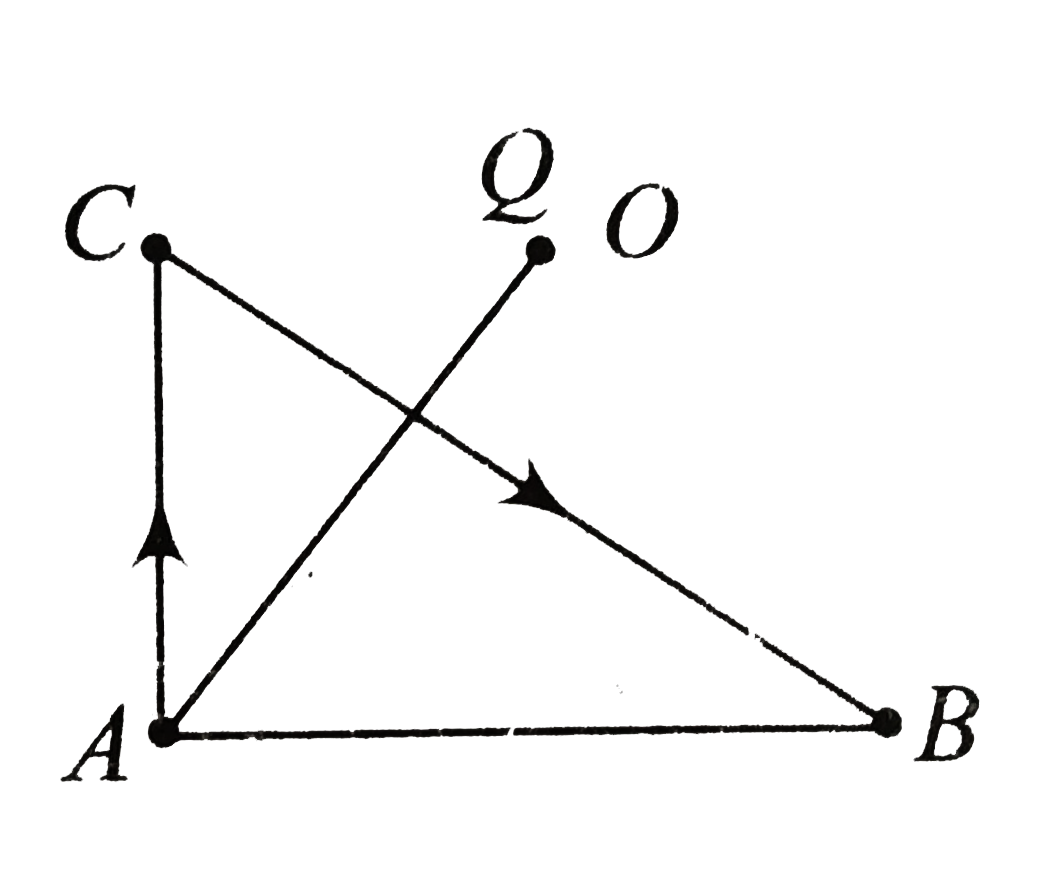
There is a fixed positive charges Q at O, and A and B are points equidistant from O. A positive charge +q is taken slowly by an external agent from A to B along the line AC and then along the line CB.

A

The total work done on the charge is zero.

B

The work done by the electrostatic force from A to C is negative.

C

The work done by the electrostatic force from C to B is positive.

D

The work done by electrostatic force in taking the charge from A to B is dependent on the actual path.

Text Solution

Verified by Experts

The correct Answer is:
A, B, C

a.,b.,c.
(a) is correc because potential of `A` and `B` is same. (b) is correct because charge is going from low potential to high potential. Electric potential energy increases and electrostatic forces do negative work. Similarly (c) is also correct.
Promotional Banner

Topper's Solved these Questions

  • MISCELLANEOUS VOLUME 3

    CENGAGE PHYSICS|Exercise Assertion and Reason Type|8 Videos
  • MISCELLANEOUS VOLUME 3

    CENGAGE PHYSICS|Exercise Comprehension Type|94 Videos
  • MISCELLANEOUS VOLUME 3

    CENGAGE PHYSICS|Exercise True and False|3 Videos
  • MECHANICAL PROPERTIES OF SOLIDS

    CENGAGE PHYSICS|Exercise Question Bank|4 Videos
  • MISCELLANEOUS VOLUME 5

    CENGAGE PHYSICS|Exercise Integer|12 Videos

Similar Questions

Explore conceptually related problems

The work done in bringing a unit positive charge from infinite distance to a point at distance x from a positive charge Q is W. Then the potential phi at that point is

Two charges +Q each are fixed at points C and D. Line AB is the bisector line of CD. A third charge +q is moves from A to B, then from B to C

A positive charge +q is located at a point. What is the work done if a unit positive charge is carried once around this charge along a circle ofradius r about :

Two equal positive charges Q are fixed at points (a, 0) and (-a,0) on the x-axis. An opposite charge -q at rest is relased from point (0, a) on the y-axis. The charge -q will

Two identical negative charges are fixed on X axis at equal distances from the origin (O). A particle having positive charge starts at a large distance from O, moves along the Y axis, passes through the origin and moves far away from O in the positive Y direction. Describe qualitatively how its acceleration charges as it moves. Draw a rough graph showing the variation of acceleration (a) vs position of the particle (y). Take the acceleration of the particle to be positive in + Y direction.

A charge +q is placed at the origin O of X- Y axes as shown in the figure . The work done in taking a charge Q from A to B along the straight line AB is

Two equal negative charges are fixed at points and on y-axis. A positive charge Q is released from rest at the point on the x-axis. The charge Q will:

Two identical positive charges are fixed on the y-axis, at equal distances from the origin O. A particle with a negative charges starts on the x-axis at a large distance from O. moves along the x-axis passes through O, and moves far away from O on the other side. Its acceleration a is taken as positive along its direction of motion. Plot acceleration a of the particle against its x-coordinate.

Two fixed, equal, positive charges, each of magnitude 5xx10^-5 coul are located at points A and B separated by a distance of 6m. An equal and opposite charge moves towards them along the line COD, the perpendicular bisector of the line AB. The moving charge, when it reaches the point C at a distance of 4m from O, has a kinetic energy of 4 joules. Calculate the distance of the farthest point D which the negative charge will reach before returning towards C.

CENGAGE PHYSICS-MISCELLANEOUS VOLUME 3-Multiple Correct Answer type
  1. Three charged particle sare in equilibrium under their electrostatic f...

    Text Solution

    |

  2. Consider the following conclusiond regarding the components of an elec...

    Text Solution

    |

  3. There is a fixed positive charges Q at O, and A and B are points equid...

    Text Solution

    |

  4. The electric potential in a region is given by the relation V(x) = 4+5...

    Text Solution

    |

  5. S is a solid neutral conducting sphere. A point charge q of 1 xx 10^(-...

    Text Solution

    |

  6. A parallel plate capacitor is charged as shown (Q is given). A metal s...

    Text Solution

    |

  7. Five plates are arranged as shown in the figure and connected across a...

    Text Solution

    |

  8. A parallel plate air capacitor is connected to a battery. The quantiti...

    Text Solution

    |

  9. A parallel plate capacitor is charged and the charging battery is then...

    Text Solution

    |

  10. A parallel plate capacitor of plate area A and plate separation d is c...

    Text Solution

    |

  11. A dielectric slab of thickness d is inserted in a parallel plate capa...

    Text Solution

    |

  12. A positively charged thin metal ring of radius R is fixed in the xy pl...

    Text Solution

    |

  13. A non-conducting solid sphere of radius R is uniformly charged. The ma...

    Text Solution

    |

  14. An ellipsoidal cavity is carved within a perfect conductor. A positive...

    Text Solution

    |

  15. A spherical symmetric charge system is centered at origin. Given, Elec...

    Text Solution

    |

  16. A few electric field lines for a system of two charges Q1 and Q2 fixed...

    Text Solution

    |

  17. A spherical metal shell A of radius RA and a solid metal sphere B of r...

    Text Solution

    |

  18. A cubical region of side a has its centre at the origin. It encloses t...

    Text Solution

    |

  19. Six point charges are kept at the vertices of a regular hexagon of sid...

    Text Solution

    |

  20. In the circuit shown in the figure, there are two parallel plate capac...

    Text Solution

    |

