Home
Class 12
PHYSICS
Two small spheres are attached to the en...

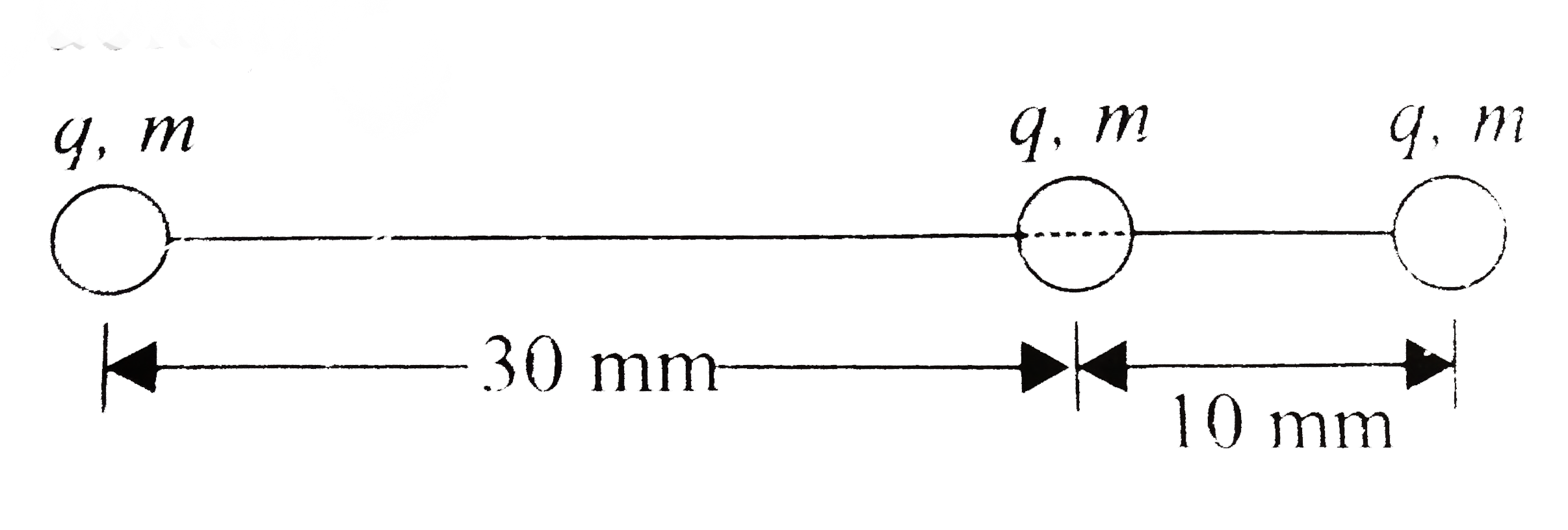
Two small spheres are attached to the ends of a long light nonconducting rod at a distance 40 mm from each other. All three spheres are nonconducting, have identical masses `m = 1 g`, and a positive charge `q = 1C` is distributed evenly on the surface of each sphere. The whole system is placed on a horizontal frictionless nonconducting surface. Initially, all three spheres are at rest and the middle sphere is located a distance 30 mm from one of the ends of the rod and a distance 10 mm from the other. Find the maximum speed v `(in ms^(-1))` of the middle sphere after the system is released.

Text Solution

Verified by Experts


Since the charge is evely distributed, the charges can be treated as point charges. Looking at the "believe" and "after" pictures and taking right as positive and left as negative, conservation of momentum gives `sumvecP_(b)=sumvecP_(a)`
`0=2mv_(2)-mv_(1)`,which gives `v_(2)=V_(1)//2`
The maximum velocity of the middle charge will occur when the middle charge is at the middle. Beyond the middle point, there will be a net force to the right that will tend to slow the charge down. The situation will be the same for the middle charge even if the two end charges are moving. Applying the law of conservation of energy to the system and using the middle charge position of maximum velocity as the "after" position, one gets `E_(b)=E_(a)`
`PE_(b)=KE+PE_(a)`
or `(kq^(2))/(3d)+(kq^(2))/(d)=(1)/(2)mv_(1)^(2)+(1)/(2)(2m)v_(2)^(2)+(2kq^(2))/(2d)`
Now using the conservation of momentum result above for `v_(2)` and simplifying, we get
or `(kq^(2))/(3d)=(1)/(2)mv_(1)^(2)+m(v_(1)^(2))/(4)=(3mv_(1)^(2))/(4)`
Finally solving for the maximum velocity
`v_(1)=(2q)/(3) sqrt((k)/(md))=20 ms^(-1)`
Promotional Banner

Topper's Solved these Questions

  • MISCELLANEOUS VOLUME 3

    CENGAGE PHYSICS|Exercise Fill in the blanks|10 Videos
  • MISCELLANEOUS VOLUME 3

    CENGAGE PHYSICS|Exercise True and False Type|5 Videos
  • MISCELLANEOUS VOLUME 3

    CENGAGE PHYSICS|Exercise Comprehension Type|94 Videos
  • MECHANICAL PROPERTIES OF SOLIDS

    CENGAGE PHYSICS|Exercise Question Bank|4 Videos
  • MISCELLANEOUS VOLUME 5

    CENGAGE PHYSICS|Exercise Integer|12 Videos

Similar Questions

Explore conceptually related problems

Three identical spheres each of radius 'R' are placed on a horizontal surface touching one another. If one of the spheres is removed, the shift in the centre of mass of the system is.

Three identical spheres each of radius 3cm are placed on a horizontal surface touching one another. The distance of centre of mass of system from any centre of the sphere is

The sphere A of mass m_(1) moves with velocity V on a frictionless horizontal surface and strikes with sphere B of mass m_(2) at rest. The sphere A comes back with speed V//10 . Choose the correct option.

There is a cubical cavity inside a conducting sphere of radius R. A positive point charge Q is placed at the centre of the cube and another positive charge q is placed at a distance 1(gtR) from the centre of the sphere. The sphere is earthed Net charge on the outer surface of conducting sphere is

Two small spheres, each having a mass of 20 g, are suspended form a common point by two insulating strings of length 40 cm each. The spheres are identically charged and the speration between the balls at equilibrium is found to be 4 cm . Find the charge on each sphere.

If 64 identical small spheres are made out of a big sphere of diameter 8 cm, what is surface area of each small sphere?

A charge q is to be distributed on two conducting spheres. What should be the value of the charges on the spheres so that the repulsive force between them is maximum when they are placed at a fixed distance from each other in air ?

A sphere of mass m and radius r is placed on a rough plank of mass M . The system is placed on a smooth horizontal surface. A constant force F is applied on the plank such that the sphere rolls purely on the plank. Find the acceleration of the sphere.

CENGAGE PHYSICS-MISCELLANEOUS VOLUME 3-Interger Answer type
  1. Two point charges q1=q2=2muC are fixed at x1=+3 m and x2=-3m as shown ...

    Text Solution

    |

  2. Two concentric spherical conducting shells of radii R and 2R carry cha...

    Text Solution

    |

  3. The capacitance of a capacitor between 4//3 times its original value i...

    Text Solution

    |

  4. A particle having charge that of an electron and mass 1.6xx10^(-30)kg ...

    Text Solution

    |

  5. The electric field in a region is radially outward with magnitude E = ...

    Text Solution

    |

  6. A wire is bent in the form of a regular hexagon and a total charge q i...

    Text Solution

    |

  7. A Uniform electric field of 10NC ^(-1) exists in the vertically downwa...

    Text Solution

    |

  8. The kinetc energy of a chargd particle decreased by 10 J as it moves f...

    Text Solution

    |

  9. A charge of 20 muC is placed on the positive plante of on isolated p...

    Text Solution

    |

  10. A capacitor with stored energy 4.0J is connected with an identical ca...

    Text Solution

    |

  11. Excess electrons are placed on a small lead sphere of mass 6.90 g so ...

    Text Solution

    |

  12. Two mutually perpendicular infinite wires along x-axis and y-axis carr...

    Text Solution

    |

  13. The electric field strength depends only on the x, y, and z coordinate...

    Text Solution

    |

  14. A positive charge +q1 is located to the left of a negative charge -q2....

    Text Solution

    |

  15. Figure shows, in cross section , two solid spheres with uniformly dist...

    Text Solution

    |

  16. A positively charged particle starts at rest 25 cm from a second posit...

    Text Solution

    |

  17. In the circuit shown, all capacitors are identical. Initially, the swi...

    Text Solution

    |

  18. Two small spheres are attached to the ends of a long light nonconducti...

    Text Solution

    |

  19. A solid sphere of radius R has a charge Q distributed in its volume wi...

    Text Solution

    |

  20. An infinitely long solid cylinder of radius R has a uniform volume ch...

    Text Solution

    |

