Home
Class 12
PHYSICS
A narrow monochromatic beam of light of ...

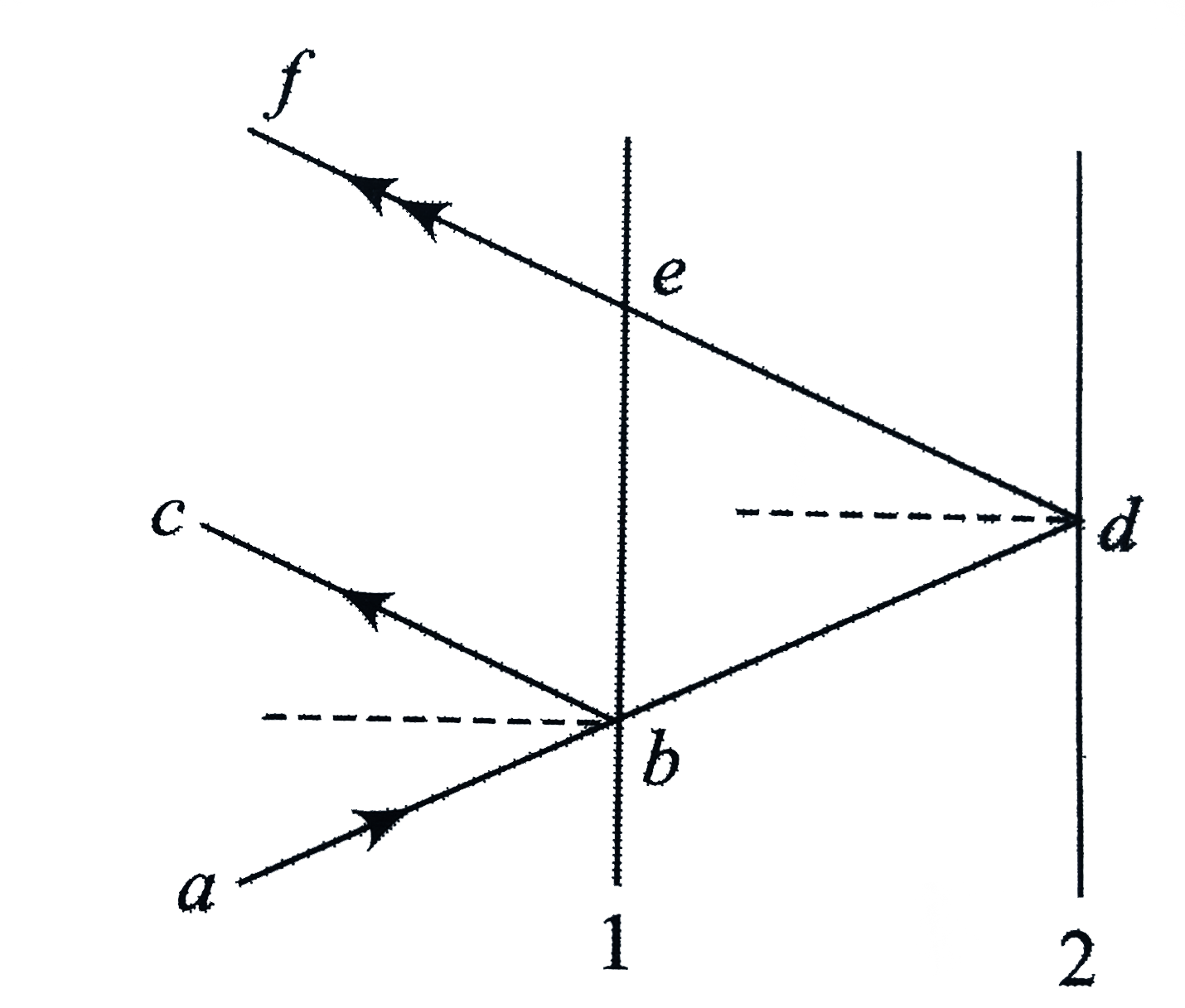
A narrow monochromatic beam of light of intensity 1 is incident on a glass plate as shown in figure Another identical glass plate is kept close to the first one and parallel to it. Each glass plate reflects `25%` of the light incident on it and transmits intensities in the interference pattern formed by two beams obtained after one reflection at each plate.

Text Solution

Verified by Experts

`I` is the intensity of incident beam ab. The interfering waves. Are bc and ef, reflected from surface of plates 1 and 2, respectively.
Reflectoin coefficient of intensity
`r = 25% = 0.25`
Transmission coefficient of intensity,
`t = 75% = 0.75`
The intensity of beam bc, `I_(1) = 0.25 I = (1)/(4) I`
The intensity of beam `bd = 0.75 I`
The intensity of beam `de = 0.25 xx 0.75 I`
The intensity of beam ef,
`I_(2) = 0.75 xx 0.25 xx 0.75 I = (9)/(64) I`
Ratio of maximum and minimum intensities,
`(I_(max))/(I_(min)) = (a_(1) + a_(2))^(2) / (a_(1) - (a_(2))^(2)) =(a_(1)^(2) + a_(2)^(2)+ 2a_(1) a_(2))/(a_(1)^(2) - a_(1)^(2)-2 a_(1) a_(2))`
`=(I_(1) +I_(2) + 2sqrt((I_(1) I_(2))))/(I_(1) + I_(2) - 2sqrt((I_(1) I_(2))) )=((1)/(4) I + (9)/(64) I + 2((1)/(4)I xx(9)/(64 )I))/((1)/(4) I + (9)/(64) I- 2sqrt(((1)/(4) I xx (9)/(64) I))`
`((49//64)I)/((1//64)I) = (49)/(1)`.
Promotional Banner

Topper's Solved these Questions

  • WAVE OPTICS

    CENGAGE PHYSICS|Exercise Exercise 2.1|12 Videos
  • WAVE OPTICS

    CENGAGE PHYSICS|Exercise Exercise 2.2|22 Videos
  • WAVE OPTICS

    CENGAGE PHYSICS|Exercise QUESTION BANK|37 Videos
  • THERMODYNAMICS

    CENGAGE PHYSICS|Exercise QUESTION BANK|34 Videos
  • WAVES

    CENGAGE PHYSICS|Exercise QUESTION BANK|38 Videos

Similar Questions

Explore conceptually related problems

A narrow monochromatic beam of light of intensity I is incident on a galss plate as shown in figure. Another identical glass plate is kept close to the first one & parallel to it. Each glass plate reflects 25% of the light incident on it % transmits the remaining find the ratio of the minimum & the maximum intensities in the interference pattern formed by the two beams obtained after one reflection at each plate.

A narrow monochromatic beam of light of intensity I is incident on a glass plate. Another identical glass plate is kept close to the first one and parallel to it. Each plate reflects 25% of the incident light and transmits the remaining. Calculate the ratio of minimum and maximum intensity in the interference pattern fromed by two beams obtained after reflection from each plate.

A ray light of intensity I is incident on a parallel glass-slab at a point A as shown in figure it undergoes partial reflection and refraction. At each reflection 20% of incident energy is refracted rays AB and A'B' undergo interference find the ratio I_(max)//I_(min)

A ray of light intensity I is incident on a parallel glass-slab at a point A as shown in figure. It undergoes partial reflection and refraction. At each reflection 25% of incident energy is reflected. The rays AB and A^(')B^(') undergo interference. The ratio I_(max)//I_(min) is

Two thin glass plates are placed parallel to each other such that distance between them is very small. Each glass plate reflects 25% of incident energy and transmits remaining 75% Light beam is incident on this system. Consider the interference of two light beams obtained after one reflection from each glass plate. Calculate ratio of the maximum to minimum intensity.

A parallel beam of light of intensity I is incident on a glass plate. 25% of light is reflected in any reflection by upper surface and 50% of light is reflected by any reflection from lower surface. Rest is refracted The ratio of maximum to minimum intensity in interference region of reflected rays is

A ray of light of intensity I is incident on a parallel glass slab at a point A as show. It undergoes partial reflection and refraction. At each reflaction 25% of incident energy is reflected. The rays AB and A'B' undergo interference. The ratio I_(max)//I_(min) is

A ray of unpolarised light is incident on a glass plate of refractive index 1.54 at polarising angle, then angle of refraction is :

A ray of light in incident on a glass plate at an angle of 60^@ . What is the refractive index of glass if the reflected and refracted rays are perpendicular to each other?
