Home
Class 12
PHYSICS
In the path of a uniform light beam of l...

In the path of a uniform light beam of large cross-sectional area and intensity I. a solid sphere of redius R which is perfectly reflecting is placed . Find the force exerted on this sphere due to the light beam.

Text Solution

Verified by Experts


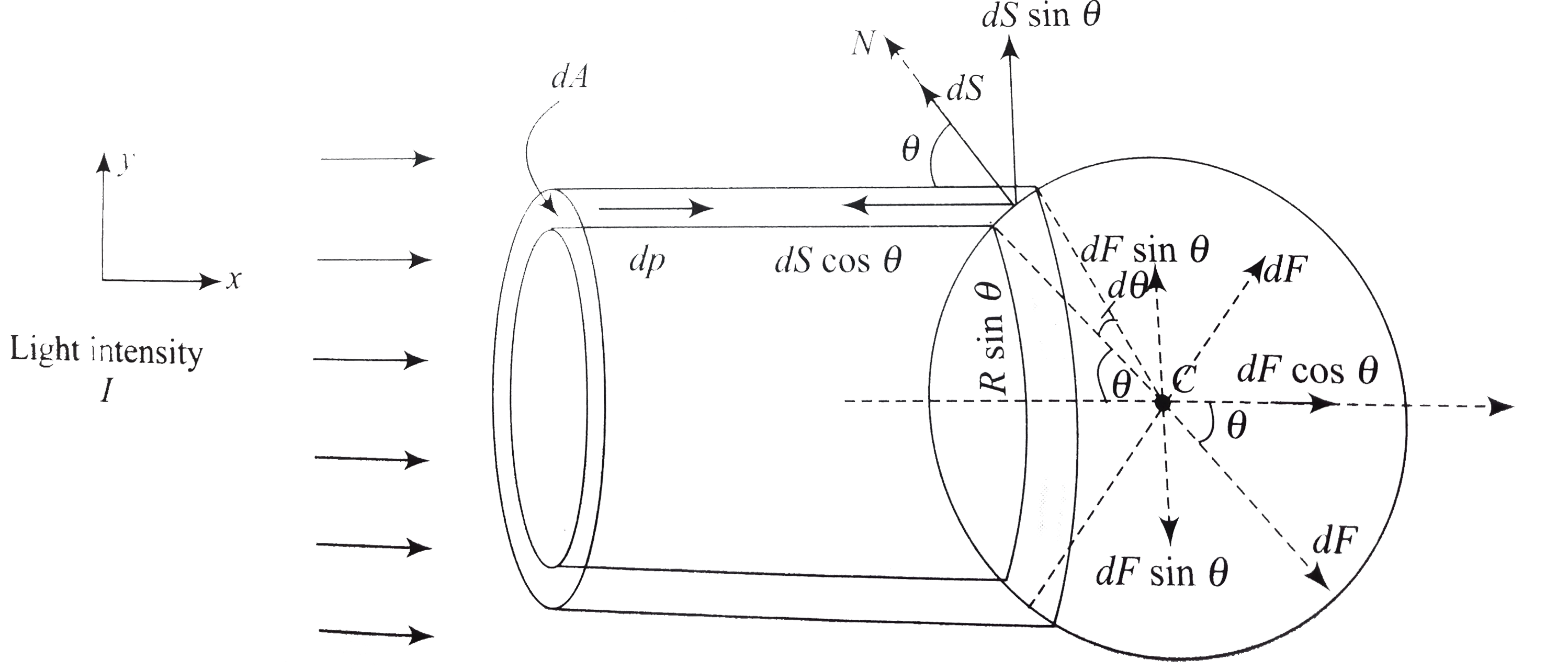
The front surface of the sphere will be illuminated by the light as shown in Fig as angle of incidence of light is different position of the front face of the sphere.
We can cosider a small elemental circular strip (ring) of angular width `dtheta` on its surface at an angle `theta` from its horizontal diameter as shown . Let the area of this elemental strip is dS, then
`dS=2thetaRsinthetaRd` `theta`...(i)
`Rsintheta` is the radius of this circular strip (ring).
We take the projection of area of this slant elemental circular strip in vertical plane. Let dA be the projection of the slant strip area dS along the cross-sectional plane of the light beam and it is given as
`dA=dScostheta`....(ii)
Hence, the power of light incident on this strip is `dP=IdA`. The momentum of photons per second incident on this strip is `dA=(dP)/(c)=(IdA)/(c)`....(iii)
These photons are incident at an angle `theta` to the normal N of this strip. As the surface of the sphere is perfectly reflecting, the photons will be reflected at the same angle `theta` to N as shown in the figure.
Hence, the change in linear momentum of photons is along the normal and thus force exerted on this strip along the normal is
`dF=2dpcostheta=(2IdA)/(c)costheta`...(iv)
Thus, the net force on sphere will be along the x-axis only.
Thus, the force on the sphere will be given as
`FintdFcostheta=int(2IdA)/(c)cos^(2)theta`
`=int_0^((pi)/(2))(2I)/(c)(2piRsinthetacosthetaRd theta)cos^(2)theta`
`(4IpiR^(2))/(c)int_0^((pi)/(2))cos^(3)thetasinthetad theta=(4IpiR^(2))/(c)[-(cos^(4))/(4)]_0^((pi)/(2))`
`(IpiR^(2))/(c)[1-0]=(IpiR^(2))/(c)`...(v)

Promotional Banner

Topper's Solved these Questions

  • PHOTOELECTRIC EFFECT

    CENGAGE PHYSICS|Exercise Examples|8 Videos
  • PHOTOELECTRIC EFFECT

    CENGAGE PHYSICS|Exercise Exercise 3.1|15 Videos
  • NUCLEI

    CENGAGE PHYSICS|Exercise QUESTION BANK|59 Videos
  • RAY OPTICS

    CENGAGE PHYSICS|Exercise DPP 1.6|12 Videos

Similar Questions

Explore conceptually related problems

There is a parallel beam of light of larger aperture . Let I be the intensity of light . Perfectly reflecting sphere of radius r is kept in the path of this parallel beam . Find the force exerted by the light beam on sphere .

A sphere of radius 1.00 cm is placed in the path of a parallel beam of light of large aperture. The intensity of the light is 0.50 W cm^-2 . If the sphere completely absorbs the radiation falling on it, find the force exerted by the light beam on the sphere.

If a parallel beam of light having intensity I is incident normally on a perfectly reflecting surface, the force exerted on the surface, equal F. When the surface is held at an angle theta , the force is

A light beam of wavelength lambda incident on a silver sphere of radius r. suspended by a nonconducting thread. Find potentical aquired by sphere

Figure2.25 shows a cone of radius R and height H with perfectly reflecting lateral surface, is placed in the path of a light beam of intensity I. Find the force exerted on this cone.

A horizontal ray of light is incident on a solid glass sphere of radius R and refractive index mu . What is net deviation of the beam when it emerged from the other side of the sphere?

A parallel beam of monochromatic light of frequency v is incident on a surface. Intensity of the beam is I and area of the surface is A. Find the force exerted by the light beam on the surface for following cases– (i) the surface is perfectly absorbing and the light beam is incident normally on it. (ii) the surface is perfectly reflecting and the light beam is incident normally. (iii) the surface is perfectly absorbing and the light beam is incident at an angle of incidence theta . (iv) the surface is perfectly reflecting and the light beam is incident at an angle of incidence theta .

A ray of light, travelling parallel to diameter of a sphere enters the sphere through a hole at point A as shown in the figure. The inner surface of the sphere is made perfectly reflecting. Find the number of reflections suffered by the ray before coming out of the sphere.

A parellel beam of monochromatic light of wavelength 500 nm is incident normally on a perfectly absorbing surface. The power through any cross section of the beam is 10 W. Find (a) the number of photons absorbed per second by the surface and (b) the force exerted by the light beam on the surface.
