Home
Class 12
PHYSICS
A toy truck has dimensions as shown in f...


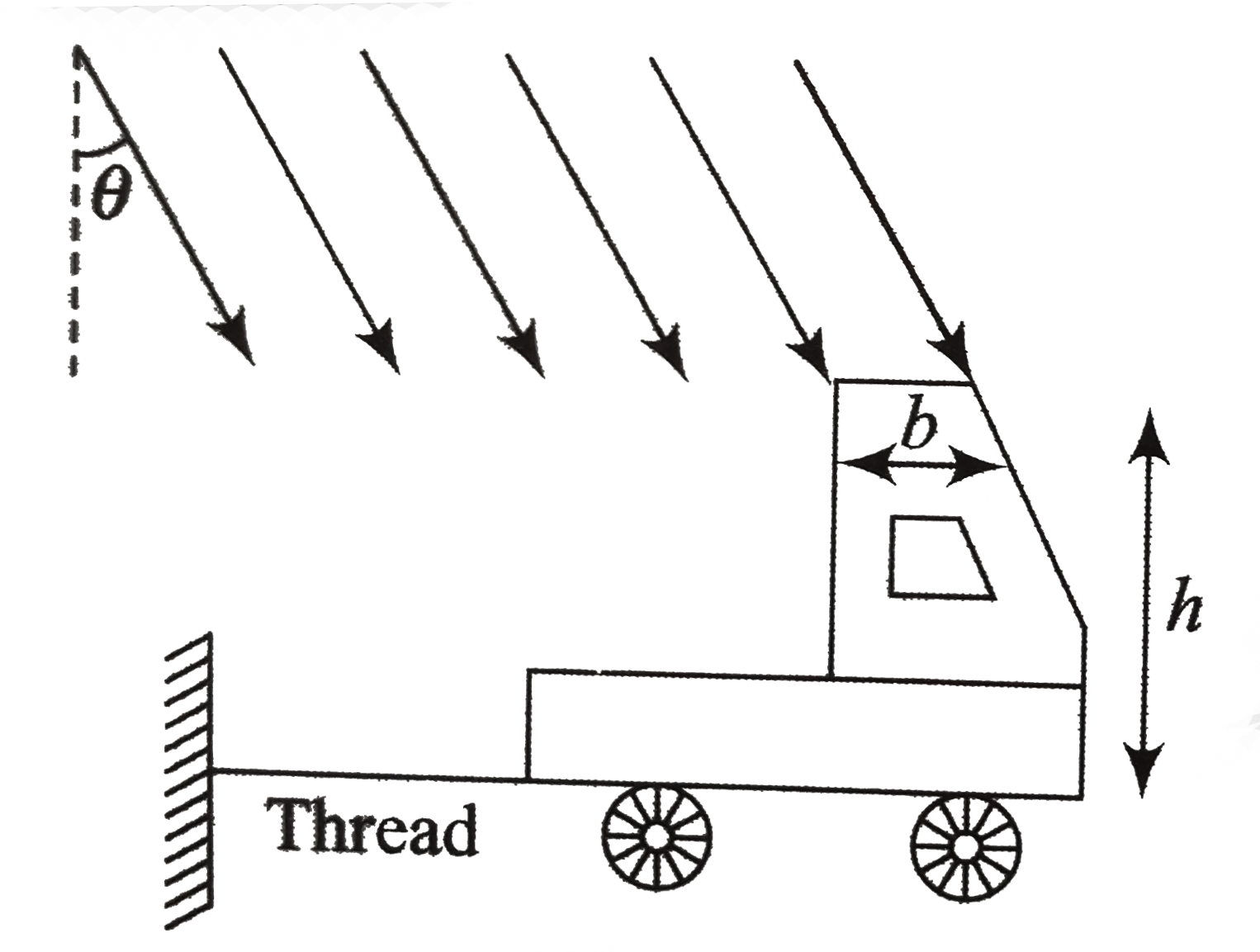
A toy truck has dimensions as shown in fig. and its width, normal to the plane of this paper, is d. The sun rays are incident on it as shiwn in the figure. If intensity of rays is I and all surfaces of truck are perfectly black, calculate tension in the thread used to keep the truck stationary. Neglect friction.

Text Solution

Verified by Experts

First, we have to calculate power incident on the truck and then momentum of light photons incident per second. Since the truck surfaces are perfectly black, therefore momentum finally reduces to zero. It means that the rate of change of momentum of light is equal to the momentum of photons incident per second.
Area of top of the driving cabin`=bd`.
Light is incident due to the component I `costheta` of intensity I.
Power incident on top of the cabin`=bdIcostheta`
Similarly, power incident on rear horizontal part of the truck is `adIcostheta` and power incident on rear vertical wall of the driving cabin in `hdIsintheta`.
Total power incident on the truck is
`P=(bcostheta+acostheta+hsintheta)Id`
Momentum of these photons is `p=(P)/(c)` (where c is speed of light in vacuum).
But rate of change in momentum of photons,
`p=((Id)/(c))(bcostheta+acostheta+hsintheta)`
This momentum is inclined at angle `theta` with vertical. Its vertical component `pcostheta` is balanced by normal reaction of the floor and horizontal component `psintheta` is balanced by tension in the thread.
Tension `=p sintheta=((Id)/(c)(bcostheta+acostheta+hsintheta)sintheta)`
Promotional Banner

Topper's Solved these Questions

  • PHOTOELECTRIC EFFECT

    CENGAGE PHYSICS|Exercise Examples|8 Videos
  • PHOTOELECTRIC EFFECT

    CENGAGE PHYSICS|Exercise Exercise 3.1|15 Videos
  • NUCLEI

    CENGAGE PHYSICS|Exercise QUESTION BANK|59 Videos
  • RAY OPTICS

    CENGAGE PHYSICS|Exercise DPP 1.6|12 Videos

Similar Questions

Explore conceptually related problems

A uniform, horizontal parallel beam of light is incident upon a prism as shown. The prism is in the shape of a quarter cylinder, of radius 5cm, and has refractive index 5/3. The width of the regionat which the incident rays after normal incidence on plane surface and subsequent refraction at curved surface intersect on x axis is (Neglect the ray which travels along x-axis)

(i) Four small blocks are interconnected with light strings and placed over a fixed sphere as shown. Blocks A, B and C are identical each having mass m = 1 kg. Block D has a mass of m´ = 2 kg. The coefficient of friction between the blocks and the sphere is mu = 0.5 . The system is released from the position shown in figure. (a) Find the tension in each string. Which string has largest tension? (b) Find the friction force acting on each block. [Take "tan"37^(@) = (3)/(4) , g = 10 m//s^(2) ] (ii) A fixed square prism ABCD has its axis horizontal and perpendicular to the plane of the figure. The face AB makes 45^(@) with the vertical. On the upper faces AB and BC of the prism there are light bodies P and Q respectively. The two bodies (P and Q) are connected using a string S_(1) and strings S_(0) and S_(2) are hanging from P and Q respectively. All strings are mass less, and inextensible. String S_(1) is horizontal and the other two strings are vertical. The coefficient of friction between the bodies and the prism is mu_(0) . Assume that P and Q always remain in contact with the prism. (a) If tension in S_(0) is T_(0) , find the minimum tension (T_(1)) in S_(1) to keep the body P at rest. (b) A mass M_(0) is tied to the lower end of string S_(0) and another mass m_(2) is tied to S_(2) . Find the minimum value of m2 so as to keep P and Q at rest.
