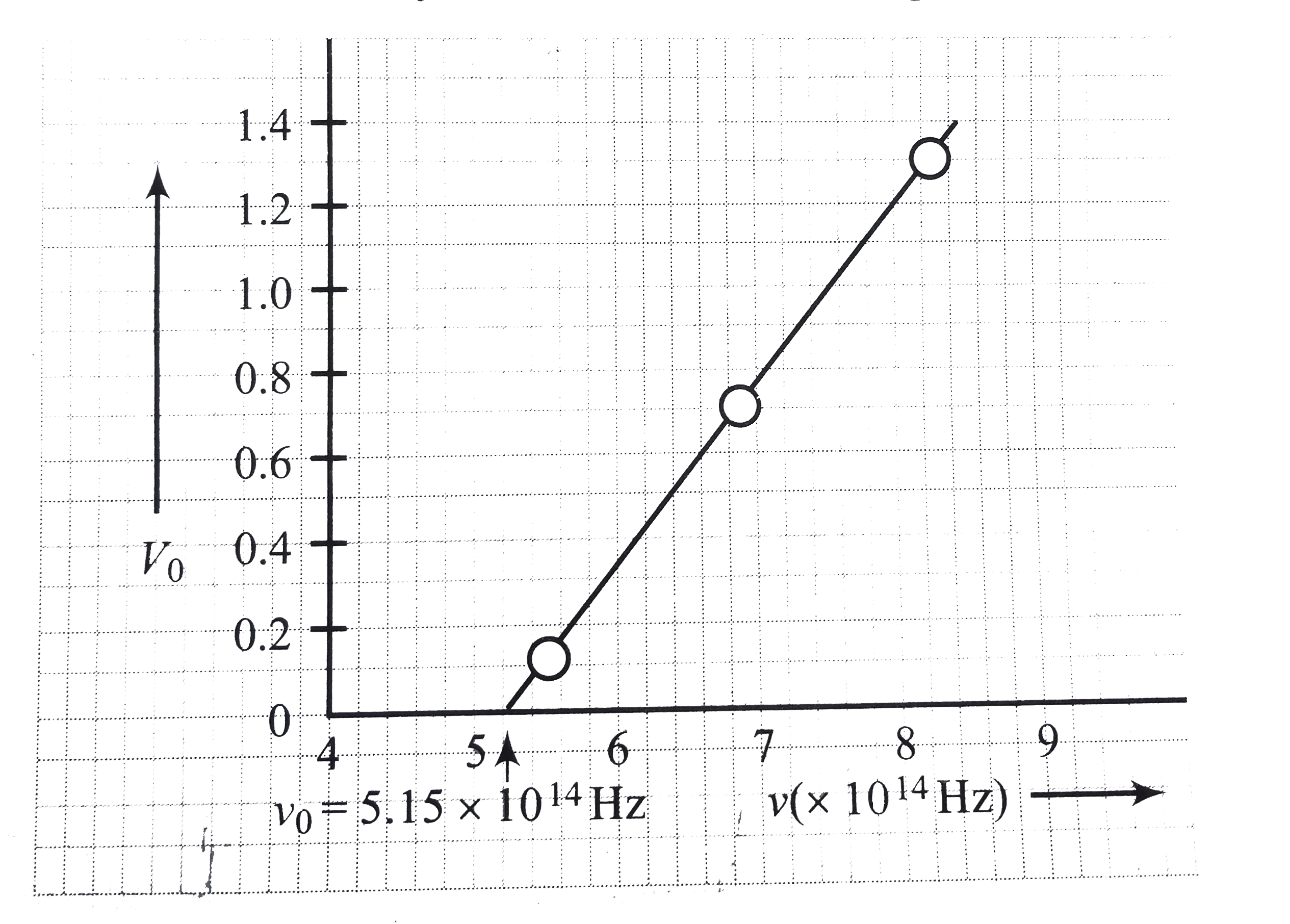
a. Let the respective frequencies fo the five spectral lines of mercury be `V_1,V_2,V_3,V_4` and `V_5`. Then
`V_1=(c)/(lamda_1)=(3xx10^(8))/(3650xx10^(-1))=8.22xx10^(14)Hz`
`V_2=(c)/(lamda_2)=(3xx10^(8))/(4047xx10^(-10))=7.41xx10^(14)Hz`
`V_3=(c)/(lamda_3)=(3xx10^8)/(4358xx10^(-10))=6.88xx10^(-10)Hz`
`V_4=(c)/(lamda_4)=(3xx10^8)/(5461xx10^(-10))=5.49xx10^(14)Hz`
and `V_5=(c)/(lamda_5)=(3xx10^8)/(5461xx10^(-10))=4.34xx10^(14)Hz`
From Einstein's photoelectric equation, we have
`hv=hv_0+(1)/(2)mv_(max)^(2)`
If `V_0` is the stopping potential, then
`eV_0=(1)/(2)mv_(max)^2`
`hv=hv_0+eV_0`
or `V_0=(hc)/(e)-(hv_0)/(e)`
It represents the equation of a straight line, whose slope is `(h)/(e)` and makes an intercept `(hv_0)/(e)` on negative. `V_0-axis`. The plot of graph between v (along X-axis) and `V_0`(along Y-axis) for the given data for the five spectral lines of mercury will be as shoen in fig

From the graph, slope of the graph is
`(1.28-0.16)/(8.22xx10^(14)-5.49xx10^(14))l=4.1xx10^(-15)JsC^(-1)`
`(h)/(e)=4.1xx10^(-15)`
or `h=exx4.1xx10^(-15)`
`=1.6xx10^(-19)xx4.1xx10^(-15)`
`=6.57xx10^(-34)Js`
b. Also the intercept made by the graph on v-axis is equal to `v_0`. Therefore, from the graph, we have
`v_0=5.15xx10^(14)Hz`
Hence, the work function of rubidum,
`w=hv_0`
`=6.456xx10^(34)xx5.15xx10^(14)`
`=3.38xx10^(-19)J=(3.38xx10^(-19))/(1.6xx10^(-19))=2.11eV`


