Home
Class 12
PHYSICS
The graph between 1//lambda and stopping...

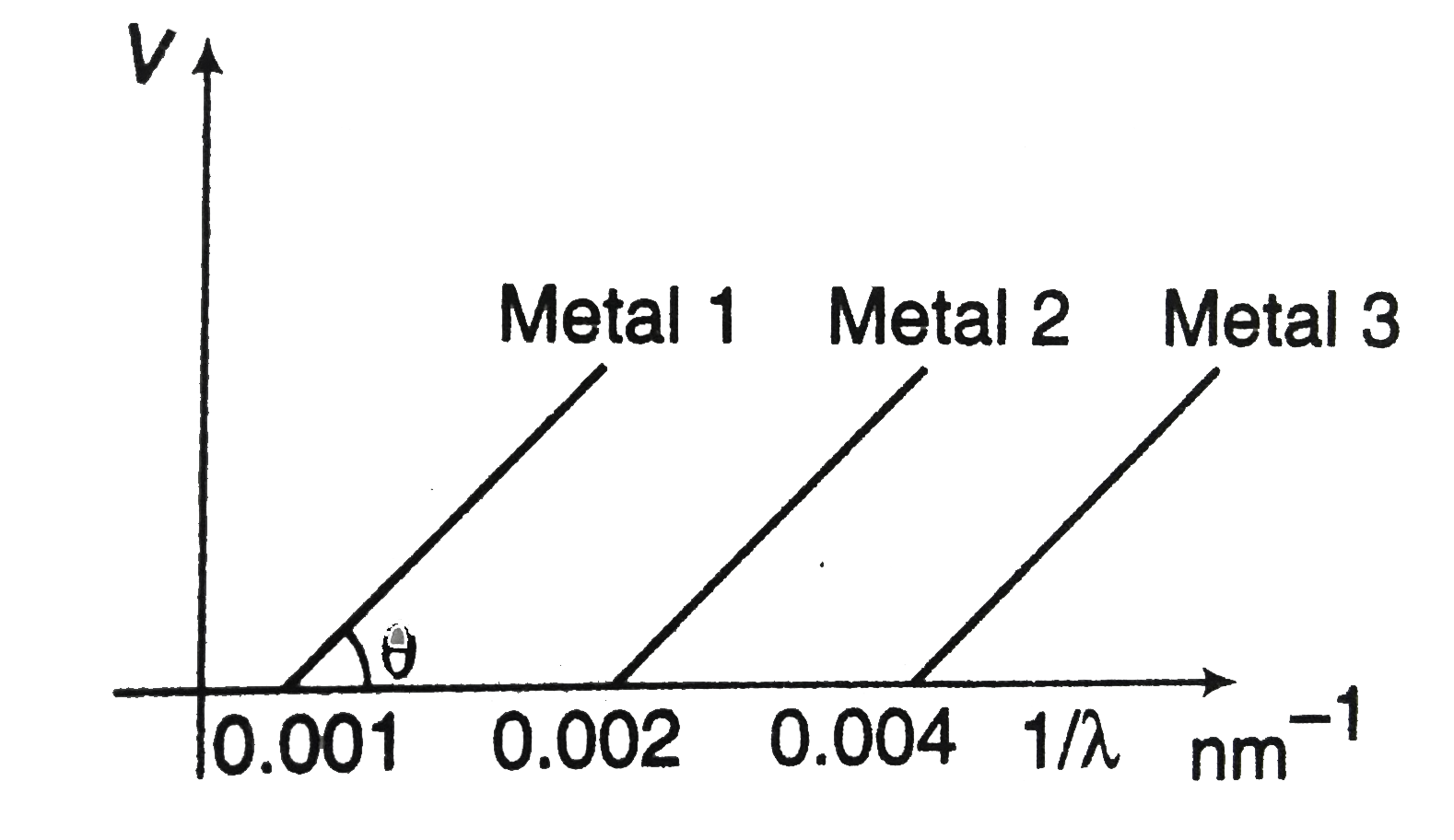
The graph between `1//lambda` and stopping potential (V) of three metals having work- functions `Phi_1`, `Phi_2` and `Phi_3` in an experiment of photoelectric effect is plotted as shown in the figure. Which of the following statement(s) is/are correct? (Here, `lambda` is the wavelength of the incident ray). (a) Ratio of work functions `phi_1 : phi_2 : phi_3 = 1 : 2 : 4` (b) Ratio of work functions `phi_1 : phi_2 : phi_3 = 4 : 2 : 1` (c ) tan `theta` is directly proportional to hc / e, where h is Planck constant and c is the speed of light (d) The violet colour light can eject photoelectrons from metals 2 and 3 .

A

`phi_1:phi_2:phi_3=1:2:4`

B

`phi_1:phi_2:phi_3=4:2:1`

C

`tanthetaprop((hc))/(e)`

D

Ultraviolet light can be used to emit photoelectrons from metal 2 and metal 3 only

Text Solution

Verified by Experts

The correct Answer is:

A, C

`phi_a:phi_2:phi_3=eV_(01):eV_(02):eV_(03)`
`V_(01):V_(02):V_(03)=0.001:0.002:0.003=1:2:4`
therefore, option (a) is correct.
By Einstein's photoelectric equation, `(hc)/(lamda)-phi=eV`
`impliesV=(hc)/(elamda)-(phi)/(e)` ..(i)
Comparing Eq. (i) by `y=mx+c`, we get the slope of the line `m=(hc)/(e)=tantheta`
`implies` Option (c ) is correct.
From the graph it is clear that,
`(1)/(lamda_(01))=0.001nm^(-1)`
`implieslamda_(01)=(1)/(0.001)=1000nm`
Also, `(1)/(lamda_(02))=0.002nm^(-1)implieslamda_(02)=500nm`
and `lamda_(03)=250nm`
Violet color light will have wavelength less that 400 nm. Therefore, this light will be unable to show photoelectric effect on plate 3 `implies` Option (d) is wrong.
Promotional Banner

Topper's Solved these Questions

  • PHOTOELECTRIC EFFECT

    CENGAGE PHYSICS|Exercise Linked Comprehension Type|3 Videos
  • PHOTOELECTRIC EFFECT

    CENGAGE PHYSICS|Exercise Integer Type|4 Videos
  • PHOTOELECTRIC EFFECT

    CENGAGE PHYSICS|Exercise Single Correct Answer Type|7 Videos
  • NUCLEI

    CENGAGE PHYSICS|Exercise QUESTION BANK|59 Videos
  • RAY OPTICS

    CENGAGE PHYSICS|Exercise DPP 1.6|12 Videos

Similar Questions

Explore conceptually related problems

The graph between 1 //lambda and stopping potential ( V ) of three metals having work functions phi_(1) , phi_(2) and phi_(3) in an experiment of photoelectric effect is plotted as shwon in the figure. Which of the following statement (s) is // are correct ? [Here lambda is the wavelength of incident ray ].

The graph between 1/lambda and stopping potential V_(0) of two metals having work funcation phi_(1) and phi_(2) in an experiment of photoelectric effect is obtained as shown in the figure. Find out - (i) Threshold wavelength ofboth metals (ii) phi_(1) : phi_(2) (iii) Whihc metal cen emit photoelectrons with visible light ?

For a photocell, the work function is phi and the stopping potential is V_(s) . The wavelength of the incident radiation is

If A={phi,{phi},1.{1,phi},7}, then Which of the following are true?

The graph between the stopping potential (V_(0)) and ((1)/(lambda)) is shown in the figure phi_(1) , phi_(2) and phi_(3) are work function , which of the following is //are correct

A beam of ligth having frequency v is incident on an initially neutral metal or work function phi(hv gt phi) . Then

Let A={phi{phi},1,{1,phi},2}. Determine which of the following is true or fase.

Consider the following statements I. phi in {phi} II. {phi} sube phi Which of the statements given above is/are Correct?

A light of 4 eV incident on metal surface of work function phi eV . Another light of 2.5 eV incident on another metal surface of work function phi_2 eV . Find the ratio of maximum velocity of photo electrons (v_1/v_2) .
