Home
Class 12
PHYSICS
A neutron which is going to collde head ...

A neutron which is going to collde head on to a stationary `H` atom has intial kinetic energy of `24.5 eV`. Discuss different possibilites of collsion.

Text Solution

Verified by Experts
If perfectly inelastic collision takes place , then the maximum energy lost can be given as
`Delta E_(max) = (1)/(2) E_(i) = (1)/(2) (12.25) e V = 12.25 e V`
From this energy . `H` atom can obsoeve either `10.2 e V` or `12.09 e V` for its excitation from `n = 1 to n = 2` or from `n = 1 to n = 3` energy level. Thus in this case there may be three possibilities for collision. These are
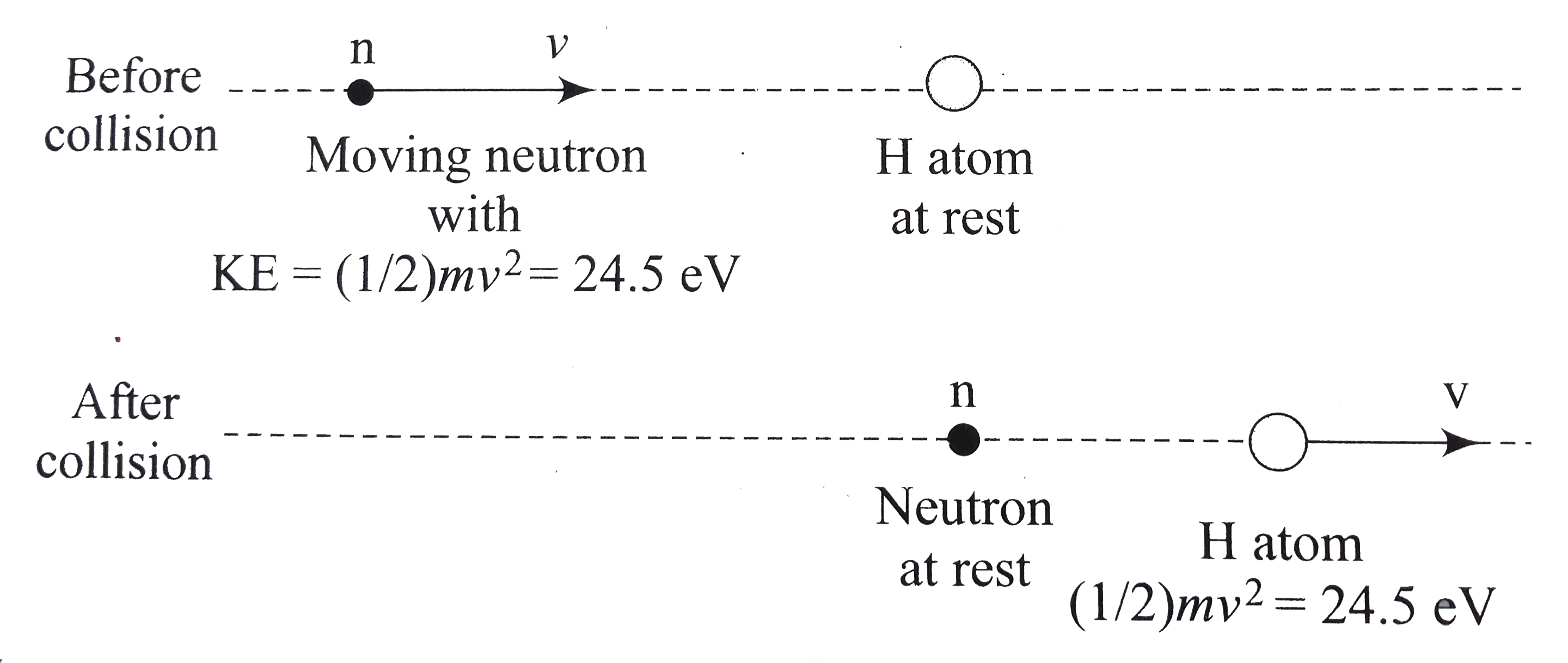
a. It may be possible that the collision is profectly elastic and no energy is obserbed by `H` atom shown in figure

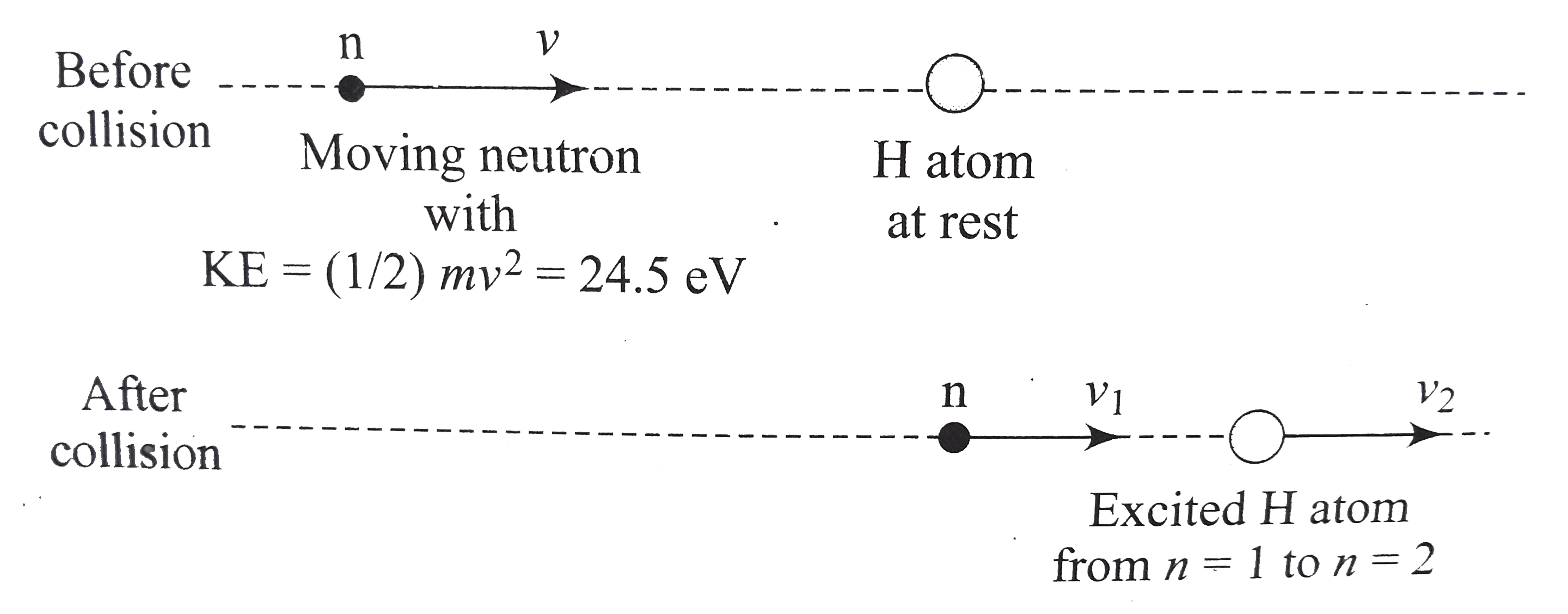
b. It may be possible that the `H` atom will absorb `10.2 e V` energy during collision and both the neutron and `H` atom will be moving with kinetic energy `24.5 - 10.2 = 14.3 e V` after collision as shown in figure . In this case , the collision will be partically elastic.

Final kinetic energy .
`E_(f) = (1)/(2) m v_(1)^(2) + (1)/(2) m v_(2)^(2) = 14.3 e V`
In this case, the final speed of neutron and `H` atom can be obtained by using equation of low of conservation of momentum and energy. Here by momentum conservation law, we have
`mv = mv_(1) + mv_(2)`
or `v = v_(1) + v_(2)`
Using energy conservation, we have
`(1)/(2) m v^(2) - 10.2 e V = (1)/(2) m v_(1)^(2) + (1)/(2) m v_(2)^(2)`
or `24.5 e V -10.2 e V = (1)/(2) m v_(1)^(2) + (1)/(2) m v_(2)^(2)`
`(1)/(2) m v_(1)^(2) + (1)/(2) m v_(2)^(2) = 14.3 e V`
Now solving Eqs. (i)and (ii) , we will get the value of `v_(1) and v_(2)` which are the possible speed of neutron and `H` atom after collision.
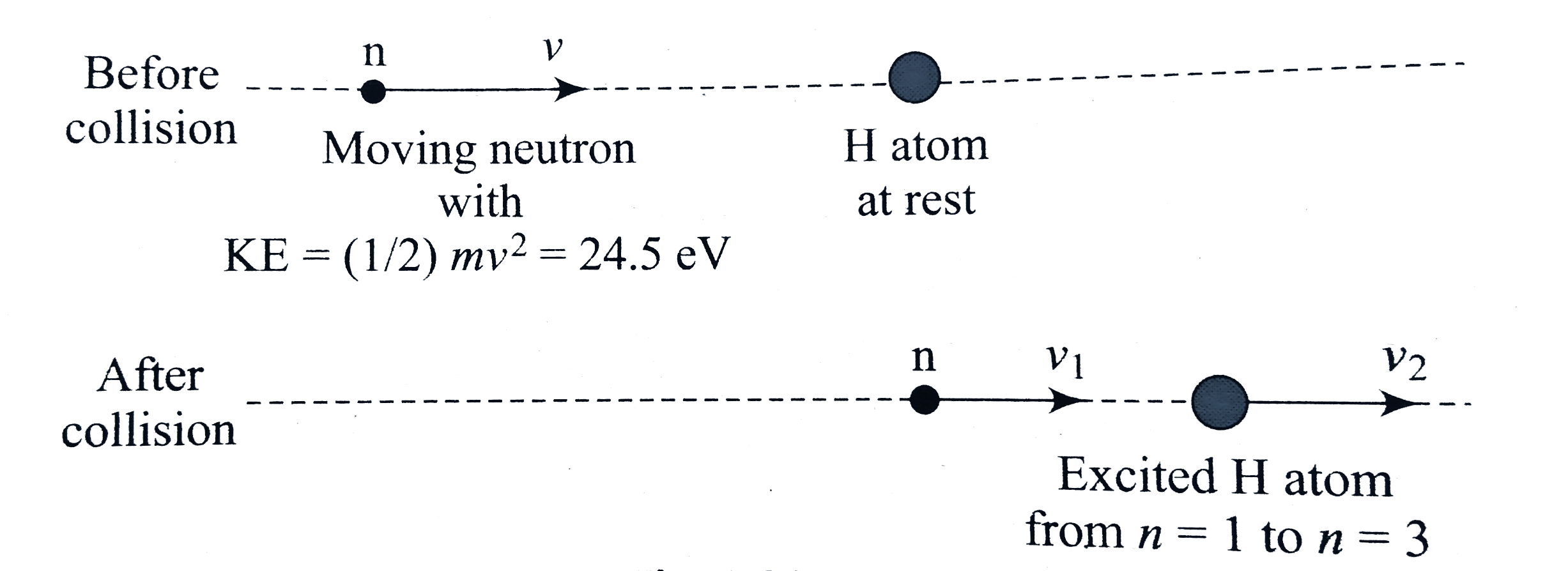
c. It may be possible that `H` atom will absorbe `12.09 e V` energy during collision and both the neutron and `H` atom will be moving with kinetic energy `24.5 - 12.09 = 12.41 e V` after collision as shown in figure . in this case , the collision will be partically clastic.

Final kinetic energy .
`E_(f) = (1)/(2) m v_(1)^(2) + (1)/(2) m v_(2)^(2) = 12.41 e V`
In this case, the final speed of neutron and `H` atom can be obtained by using equation of low of conservation of momentum and energy. Here by momentum conservation law, we have
`mv = mv_(1) + mv_(2)`
or `v = v_(1) + v_(2)` ...(iii)
Using energy conservation, we have
`(1)/(2) m v^(2) - 12.09 e V = (1)/(2) m v_(1)^(2) + (1)/(2) m v_(2)^(2)`
or `24.5 e V -12.09 e V = (1)/(2) m v_(1)^(2) + (1)/(2) m v_(2)^(2)`
or `(1)/(2) m v_(1)^(2) + (1)/(2) m v_(2)^(2) = 12.41 e V` ...(iv)
Now solving Eqs. (iii)and (iv) , we will get the value of `v_(1) and v_(2)` which are the possible speed of neutron and `H` atom after collision.
Promotional Banner

Topper's Solved these Questions

  • ATOMIC PHYSICS

    CENGAGE PHYSICS|Exercise Solved Examples|23 Videos
  • ATOMIC PHYSICS

    CENGAGE PHYSICS|Exercise Exercise 4.1|15 Videos
  • ALTERNATING CURRENT

    CENGAGE PHYSICS|Exercise QUESTION BANK|65 Videos
  • ATOMS

    CENGAGE PHYSICS|Exercise QUESTION BANK|40 Videos