Home
Class 12
PHYSICS
A He^(+) ion is at rest and is in ground...

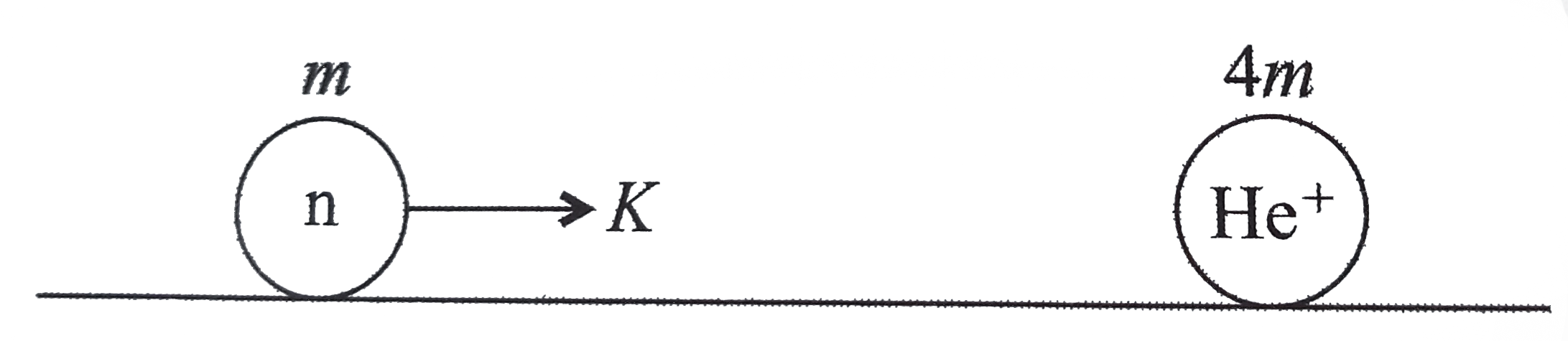
A `He^(+)` ion is at rest and is in ground state. A necutron with intial kinetic energy`K` collides heads on with the `He^(+)` ion. Find minimum value of `K` so that there can be an inelastic collision between these two particals.

A

`K_(min) = 51 e V`

B

`K_(min) = 48.6 e V`

C

`K_(min) = 512 e V`

D

`K_(min) = 13.6 e V`

Text Solution

Verified by Experts

The correct Answer is:

A

Here the loss during the collision can only be used to excite the atoms or electrons
So , according to quantum mechaincs possible losses can be
`{0, 40.8 e V, 48.36 e V}` (i)
from `E_(n) = - 13.6 e V (Z^(2))/(n^(2))`
Now according to Newtonion mechanics. Minimum loss `= 0`. Maximum loss will be for perfectly inelclastic collision.
Let `v_(0)` be the inital speed of neutron and `v_(f)` be the final common speed
So, by momentum conservation :
`m v_(0) = m v_(f) + 4m v_(f) implies v_(f) = (v_(0))/(5)`
where `m = "mass of meutron and mass of" He^(+)` ion =` 4 m`. Final kinetic energy of system:
`KE = (1)/(2) m v_(f)^(2) + (1)/(2) 4 m v_(f)^(2)`
`= (1)/(2) (5 m) = v_(0)^(2)/(25) = (1)/(5) ((1)/(2) m v_(0)^(2)) = (K)/(5)`
maximum loss `= K - (K)/(5) = (4K)/(5)`
So , loss will be `[0 (4K)/(5)]`
For inelastic collition, there should be at least one common value other than zero in Eqs. (i) and (ii)
`:. (4K)/(5) gt 40.8 e V implies K gt 51 e V`
Hence maximum value of `K` for an inelastic collision , `K_(min) = 51 e V`.
Promotional Banner

Topper's Solved these Questions

  • ATOMIC PHYSICS

    CENGAGE PHYSICS|Exercise Solved Examples|23 Videos
  • ATOMIC PHYSICS

    CENGAGE PHYSICS|Exercise Exercise 4.1|15 Videos
  • ALTERNATING CURRENT

    CENGAGE PHYSICS|Exercise QUESTION BANK|65 Videos
  • ATOMS

    CENGAGE PHYSICS|Exercise QUESTION BANK|40 Videos

Similar Questions

Explore conceptually related problems

An H atom in ground state is moving with initial kinetic energy K .It collides head on with He ^(+) ion in ground state kept at rest but free to move. Find minimum value of K so that both the particles can excite to their first excited state.

In the previous question , find minimum value of K so that all types of collisions are piossible.

A free hydrogen atom in its ground state is at rest. A neutron having kinetic energy k_(0) collides head one with the atom. Assume that mass of both neutron and the atom is same. (a) Find minimum value of k_(0) so that this collision can be inelastic. (b) If k_(0) = 25 eV , find the kinetic energy of neutron after collision if its excites the hydrogen atom to its second excited state. Take ionization energy of hydrogen atom in ground state to be 13.6 eV .

The ground state energy of hydrogen atom is -13.6 eV . The energy of second excited state of He^(+) ion in eV is

Two hydrogen atom in ground state are moving on opposite direction with the same speed and collide head on . The minimum kinetic energy of each hydrogen atom for the collision to be inelastic so that both the atoms are eccited is

A particle moving with kinetic energy K makes a head on elastic collision with an identical particle at rest. Find the maximum elastic potential energy of the system during collision.

An electron of kinetic energy E_(0) is scattered by an atomic hydrogen sample in ground state. Find the minimum value of E_(0) ,so that a photon of wavelength 656.3 nm may be emitted by H-atom.

An electron collides with a free molecules initially in its ground state. The collision leaves the molecules in an excited state that is metastable and does not decay to the ground state by radiation. Let K be the sum of the initial kinetic energies of the electron and the molecule, and vecP the sum of their initial momenta. Let K' and vecP represent the same physical quantities after the collision. Then
