Home
Class 12
PHYSICS
A moving hydrogen atom makes a head-on c...

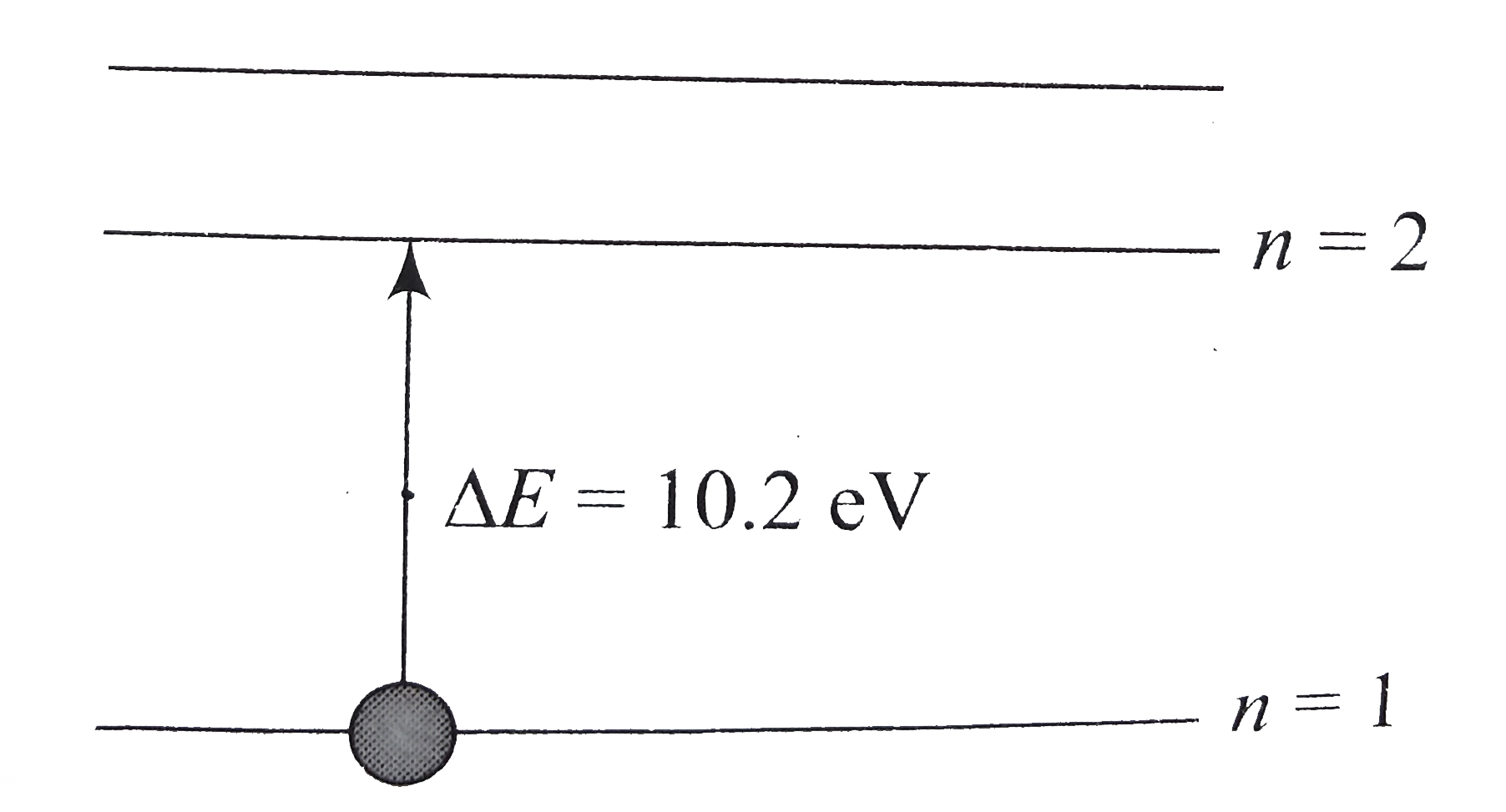
A moving hydrogen atom makes a head-on collision with a stationary hydrogen atom. Before collision, both atoms are in ground state and after collision they move together . What is the minimum KE of an atom, such that one of the atoms reaches one of the excitation state.

A

`20.4 e V`

B

`25.4 e V`

C

`2 e V`

D

`204 e V`

Text Solution

Verified by Experts

The correct Answer is:
A

Let `K` be the kinetic energy of the moving hydrogen atom `K`' the kinetic energy of combined mass after collision.
From conservation of liner momentum .
`p = p' implies sqrt (2 K m) = sqrt(2 K' (2 m))`
or `K = 2K'`
From conservation of energy
`K = K' + Delta E`
Solving Eqs. (i) and (ii), we get `Delta E = (K)/(2)`
Now, minimum value of `Delta E` for hydrogen atom is `10.2 e V`.
or `Delta E ge 10.2 e V`
`:. (K)/(2) ge 10.2 e V`
`:. K ge 20.4 e V`

Therefore, the minimum kinetic energy of moving hydrogen is `20.4 e V`
Promotional Banner

Topper's Solved these Questions

  • ATOMIC PHYSICS

    CENGAGE PHYSICS|Exercise Solved Examples|23 Videos
  • ATOMIC PHYSICS

    CENGAGE PHYSICS|Exercise Exercise 4.1|15 Videos
  • ALTERNATING CURRENT

    CENGAGE PHYSICS|Exercise QUESTION BANK|65 Videos
  • ATOMS

    CENGAGE PHYSICS|Exercise QUESTION BANK|40 Videos

Similar Questions

Explore conceptually related problems

A moving hydrogen atom makes a head on collision with a stationary hydrogen atom. Befor collision both atoms are in in ground state and after collision they move together. What is the minimum value of the kinetic energy of the moving hydrogen atom, such that one of the atoms reaches one of the excited state?

Suppose a moving hydrogen atom makes a head on inelastic collision with a stationary hydrogen atom. Before collision, both atoms are ground state and after collision, they move together. What is the minimum velocity of the moving hydrogen atom if one of the atoms is to be given the minimum excitation energy after the collisions? Take m_H=1.0078 am u. 1.66xx10^(-27)kg.

Suppose a moving hydrogen atmo makes a head on inelastic collision with a stationary hydrogen atmo. Before collision both atoms are in ground state and after collision they move together. What is the minimum velocity of the moving hydrogen atom if one of the atom is to be given the minimum excitation energy after the collision ? (m_(H) = 1.0078 am u, 1 am u = 1.66 xx 10^(-27) kg)

Atomic collision

Atomic Collision

Atomic Collision

An hydrogen atom moves with a velocity u and makes a head on inelastic collision with another stationary H-atom. Both atoms are in ground state before collision. The minimum value of u if one of them is to be given a minimum excitation energy is

A H-atom moving with speed v makes a head on collision with a H-atom in rest. Both atoms are in ground state. Find the minimum value of velocity v for which one of atom may excite.

A moving H-atom makes a head on perfectly inelastic collision with a stationary Li^(++) ion. Just before collision, both - H and Li^(++) are in their first excited state. Immediately after collision H was found to be in ground state and Li^(++) was in its second excited state. Find the kinetic energy of H – atom before collision. No photon is emitted in the process. Assume that mass of Li^(++) is nearly 7 times the mass of H.

A neutron collies head-on with a stationary hydrogen atom in ground state. Which of the following statements is/are correct ?

