Home
Class 12
PHYSICS
A radioactive substance X decays into an...

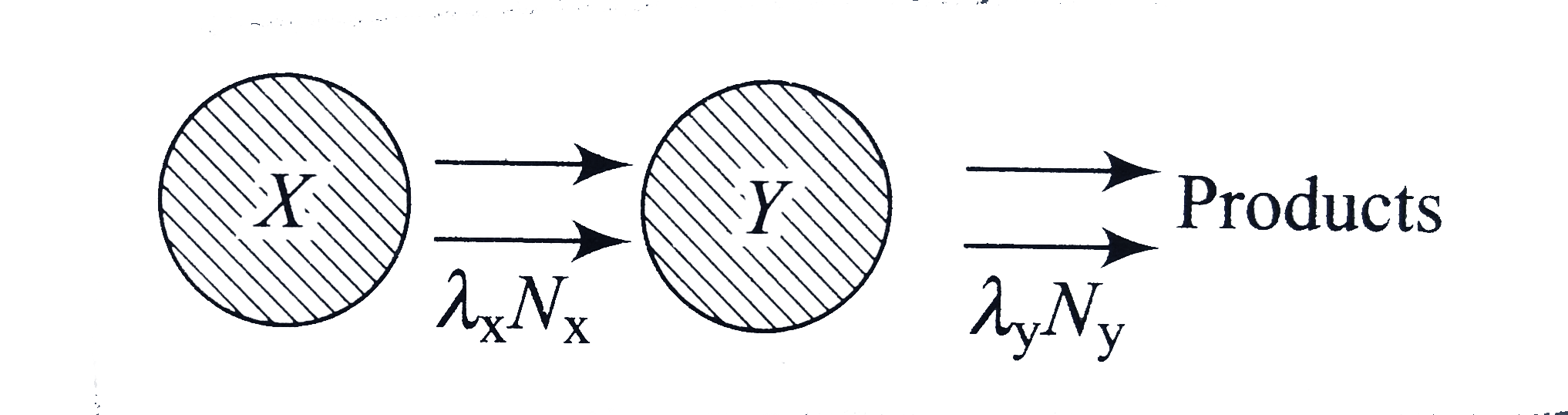
A radioactive substance `X` decays into another radioactive substance `Y`. Initially, only `X` was present . `lambda_(x)` and `lambda_(y)` are the disintegration constant of `X` and Y. `N_(y)` will be maximum when.

A

`(N_(y))/(N_(x) -N_(y)=lambda_(y)/lambda_(x)-lambda_(y))`

B

`(N_(y))/(N_(x) -N_(y)=lambda_(y)/lambda_(x)-lambda_(y))`

C

`lambda_(y) N_(y)=lambda_(x)N_(x)`

D

`lambda_(y) N_(x)=lambda_(x)N_(y)`

Text Solution

Verified by Experts

The correct Answer is:
C


`Net rate foramtion of `Y` at any time `t` is
`(dN_(y))/(dt) =lamb_(y) N_(y)`da_(x) N_(x)-lambda`
`N_(y)` is maximum when
`(dN_(y))/(dt) =0`
or `lambda_(x) N_(x)-lambda_(y) N_(y)`.
Promotional Banner

Topper's Solved these Questions

  • NUCLEAR PHYSICS

    CENGAGE PHYSICS|Exercise Linked Comprehension|29 Videos
  • NUCLEAR PHYSICS

    CENGAGE PHYSICS|Exercise Integer|6 Videos
  • NUCLEAR PHYSICS

    CENGAGE PHYSICS|Exercise Subjective|35 Videos
  • Moving charges and magnetism

    CENGAGE PHYSICS|Exercise Question Bank|20 Videos
  • NUCLEI

    CENGAGE PHYSICS|Exercise QUESTION BANK|59 Videos

Similar Questions

Explore conceptually related problems

A radioactive substance "A" having N_(0) active nuclei at t=0 , decays to another radioactive substance "B" with decay constant lambda_(1) . B further decays to a stable substance "C" with decay constant lambda_(2) . (a) Find the number of nuclei of A, B and C time t . (b) What should be the answer of part (a) if lambda_(1) gt gt lambda_(2) and lambda_(1) lt lt lambda_(2)

The decay constants of a radioactive substance for a and b emission are lambda_(a) and lambda_(b) respectively. If the substance emits alpha and beta simultaneously, the average half life of the material will be -

The half-life period of a radioactive element x is same as the mean life time of another radioactive element y. Initially, both of them have the same number of atoms. Then, (a) x and y have the same decay rate initially (b) x and y decay at the same rate always (c) y will decay at a faster rate than x (d) x will decay at a faster rate than y

Two samples X and Y contain equal amounts of radioactive substances. If 1/16 th of a sample X and 1/256 th of sample Y remain after 8h, then the ratio of half periods of X and Y is

Consider radioactive decay of A to B with which further decays either to X or Y , lambda_(1), lambda_(2) and lambda_(3) are decay constant for A to B decay, B to X decay and Bto Y decay respectively. At t=0 , the number of nuclei of A,B,X and Y are N_(0), N_(0) zero and zero respectively. N_(1),N_(2),N_(3) and N_(4) are the number of nuclei of A,B,X and Y at any instant t . At t=oo , which of following is incorrect ?

Consider radioactive decay of A to B with which further decays either to X or Y , lambda_(1), lambda_(2) and lambda_(3) are decay constant for A to B decay, B to X decay and Bto Y decay respectively. At t=0 , the number of nuclei of A,B,X and Y are N_(0), N_(0) zero and zero respectively. N_(1),N_(2),N_(3) and N_(4) are the number of nuclei of A,B,X and Y at any instant t . The net rate of accumulation of B at any instant is

Consider radioactive decay of A to B with which further decays either to X or Y , lambda_(1), lambda_(2) and lambda_(3) are decay constant for A to B decay, B to X decay and Bto Y decay respectively. At t=0 , the number of nuclei of A,B,X and Y are N_(0), N_(0) zero and zero respectively. N_(1),N_(2),N_(3) and N_(4) are the number of nuclei of A,B,X and Y at any instant t . The number of nuclei of B will first increase and then after a maximum value, it decreases for

CENGAGE PHYSICS-NUCLEAR PHYSICS-Single Correct Option
  1. A radioactive substance is being consumed at a constant of 1 s^(-1). A...

    Text Solution

    |

  2. A radioactive isotope is being produced at a constant rate X. Half-lif...

    Text Solution

    |

  3. A radioactive substance X decays into another radioactive substance Y....

    Text Solution

    |

  4. There are two radio nuclei A and B. A is an alpha emitter and B a beta...

    Text Solution

    |

  5. Half-life of a radioactive substance A is two times the half-life of a...

    Text Solution

    |

  6. There are two radioactive substance A and B. Decay constant of B is tw...

    Text Solution

    |

  7. A radioactive nucleus A finally transforms into a stable nuccelus B. T...

    Text Solution

    |

  8. If .(92)U^(238) changes to .(85)At^(210) by a series of alpha-and beta...

    Text Solution

    |

  9. Number of nuclei of a radioactive substance are 1000 and 900 at times ...

    Text Solution

    |

  10. A radioacitve nucleus is being produced at a constant rate alpha per s...

    Text Solution

    |

  11. In a sample of a radioactive substance, what fraction of the initial n...

    Text Solution

    |

  12. The activity of a radioactive substance is R(1) at time t(1) and R(2) ...

    Text Solution

    |

  13. In problem 43, number of atoms decayed between time interval t(1) and ...

    Text Solution

    |

  14. The ratio of molecular mass of two radioactive substances is 3//2 and ...

    Text Solution

    |

  15. N(1) atoms of a radioactive element emit N(2) beta partilces per secon...

    Text Solution

    |

  16. The binding energy of nuclei X and Y are E(1) and E(2), respectively. ...

    Text Solution

    |

  17. The binding energy per nucleon number for deutron H(1)^(2)and helium...

    Text Solution

    |

  18. .(92)U^(238) absorbs a neutron. The product emits an electron. This pr...

    Text Solution

    |

  19. The activity of a radioative element decreases to one third of the ori...

    Text Solution

    |

  20. The half-life of a radioactive decay is x times its mean life. The val...

    Text Solution

    |

