Home
Class 12
PHYSICS
The compound unstabel nucleus .(92)^(236...

The compound unstabel nucleus `._(92)^(236)U` often decays in accordance with the following reaction
`._(92)^(236)U rarr ._(54)^(140)Xe +._(38)^(94)Sr ` + other particles
During the reaction, the uranium nucleus ''fissions'' (splits) into the two smaller nuceli have higher nuclear binding energy per nucleon (although the lighter nuclei have lower total nuclear binding energies, because they contain fewer nucleons).
Inside a nucleus, the nucleons (protonsa and neutrons)attract each other with a ''strong nuclear'' force. All neutrons exert approxiamtely the same strong nuclear force on each other. This force holds the nuclear are very close together at intranuclear distances.
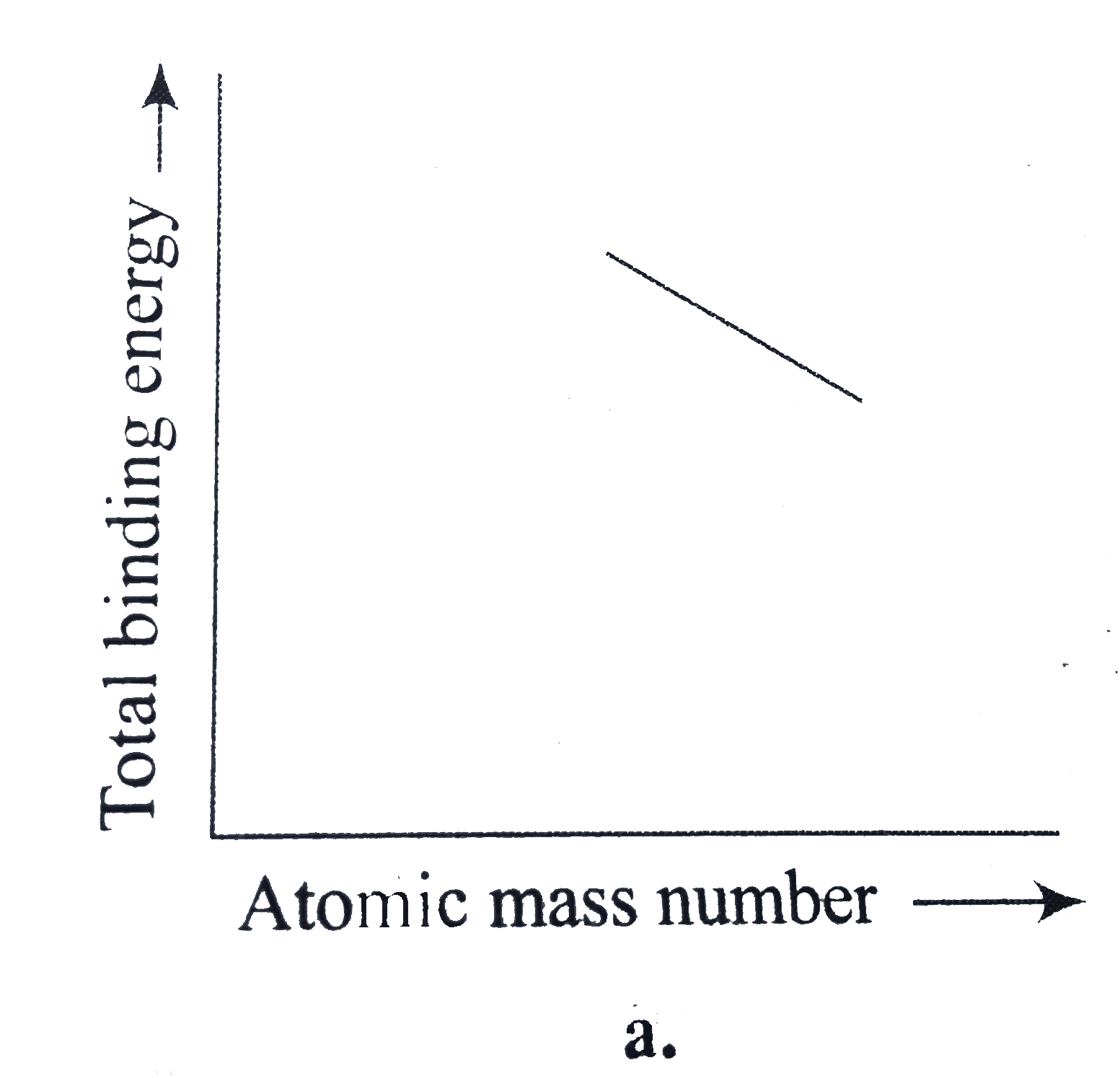
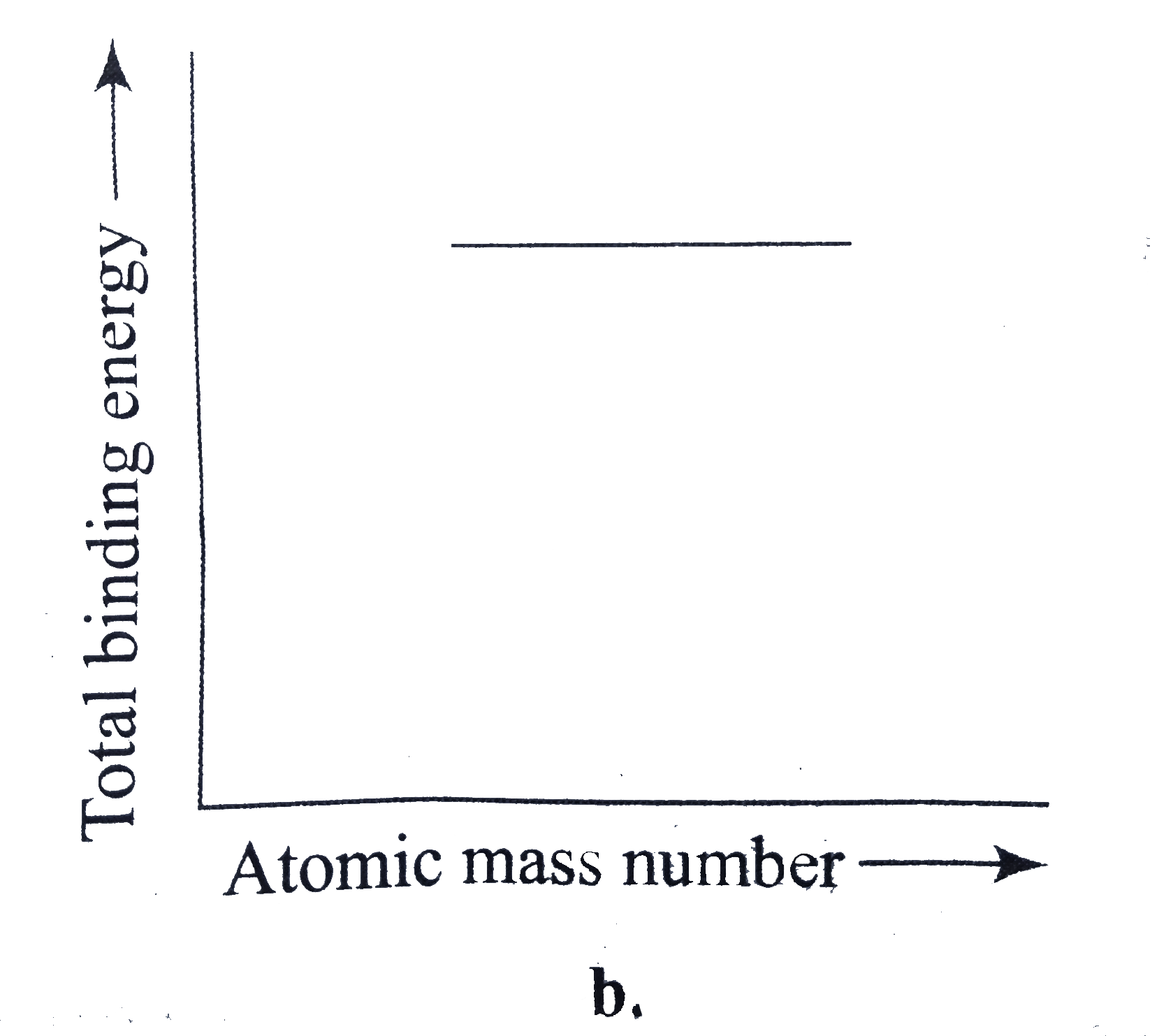
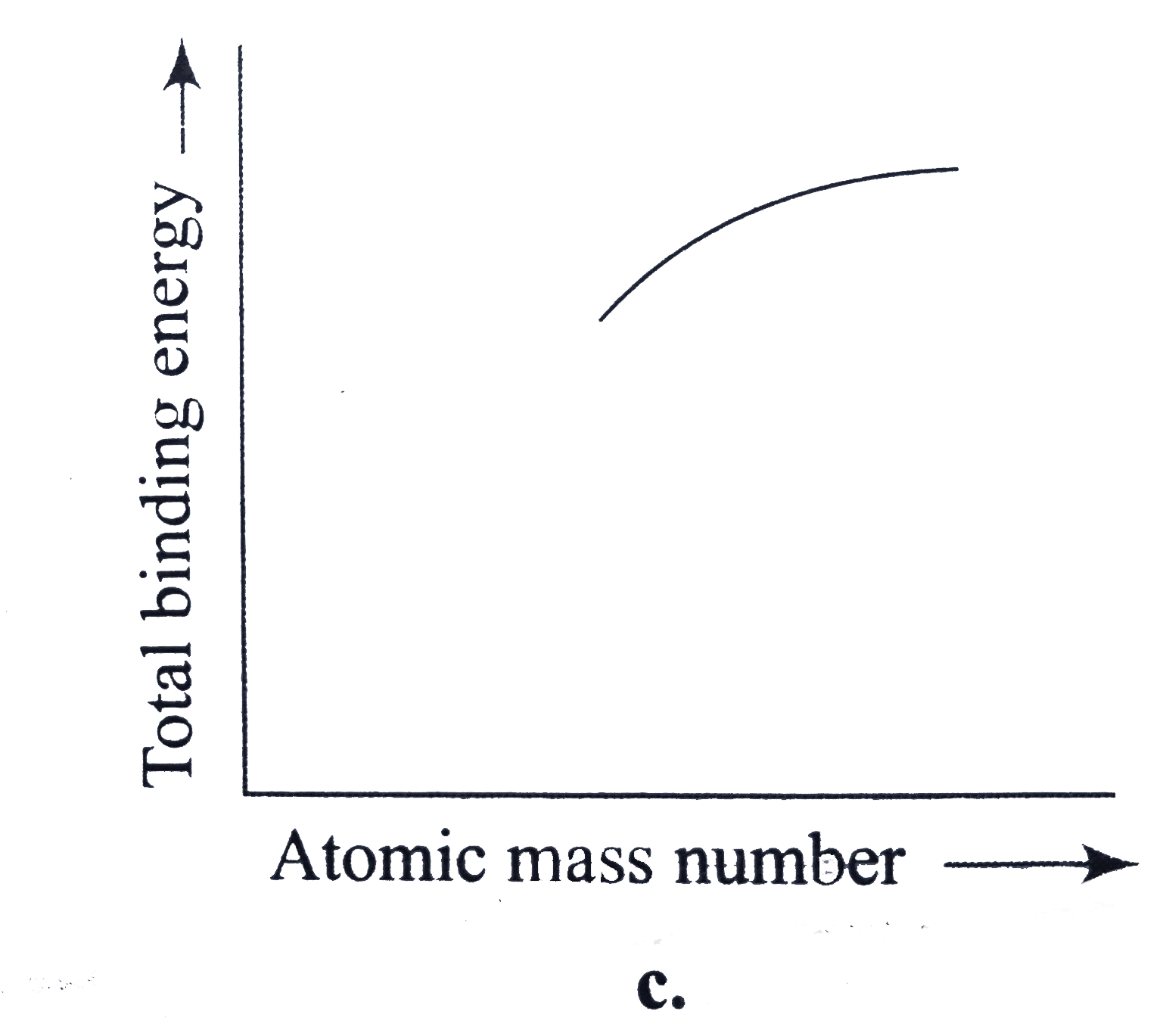
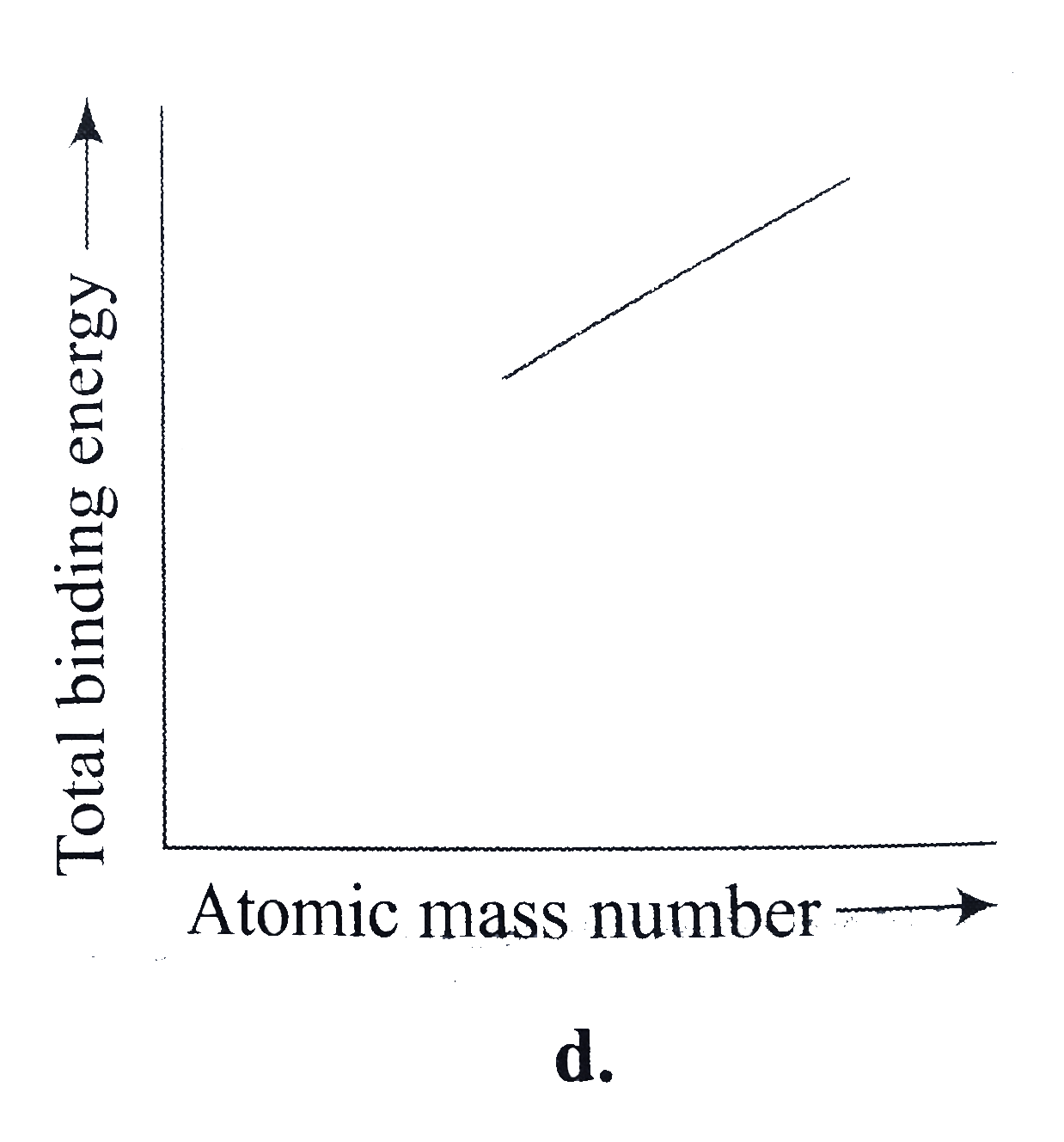
Which of the following graphs might represent the relationship between atomic number (i.e., ''atomic weight'') and the total binding energy of the nucleus, for nuclei heavier than `._(38)^(94)Sr` ?

A

B

C

D

Text Solution

Verified by Experts

The correct Answer is:

c

Graph (a) would correcrtly show the binding energy per nucleons, but this differs from the total binding energy of the nucleus. The total binding energy takes into account not only the binding energy takes into account not only the binding energy per nucleon, but also the number of nucleons.
To understand this subtle point, compare `._(38)^(94)Sr` to `._(32)^(236)U`. As the passage states, `._(38)^(94)Sr` has a higher binding energy per nucleon. Here,
`._(38)^(94)Sr` binding enrgy per nucleon `~~ 9MeV`
`._(32)^(236)U` binding enrgy per nucleon `~~ 7MeV`
But `._(32)^(236)U` still has a higher total binding energy, simply because it contaisn more nucleons. Indeed, since total binding energy of a nucleus=binding energy per nucleon `xx`number of nuclei, the total binding energies are
`._(38)^(94)Sr xx (94 nucleons)~~846 MeV`
`._(32)^(236)U xx (236 nucleons) ~~1650 MeV`
So, as atomic mass increase linearly with atomic mass. It incerease at a smaller and smaller rate, precisely because the binding energy per nucleon decreases. Indeed, since 'atomic mass number' specifies the number of necleons, the binding energy per nucleon is simply the slope of a binding energy vs. atomic mass number graph. Between strontium and uranium, this slope decrease, as just explained. Thus, the answer must be (c) rather than (d).
Promotional Banner

Topper's Solved these Questions

  • NUCLEAR PHYSICS

    CENGAGE PHYSICS|Exercise Integer|6 Videos
  • NUCLEAR PHYSICS

    CENGAGE PHYSICS|Exercise Fill In The Blanks|5 Videos
  • NUCLEAR PHYSICS

    CENGAGE PHYSICS|Exercise Single Correct Option|182 Videos
  • Moving charges and magnetism

    CENGAGE PHYSICS|Exercise Question Bank|20 Videos
  • NUCLEI

    CENGAGE PHYSICS|Exercise QUESTION BANK|59 Videos

Similar Questions

Explore conceptually related problems

The compound unstabel nucleus ._(92)^(236)U often decays in accordance with the following reaction _(92)^(236)U rarr ._(54)^(140)Xe + _(38)^(94)Sr + other particles During the reaction, the uranium nucleus ''fissions'' (splits) into the two smaller nuceli have higher nuclear binding energy per nucleon (although the lighter nuclei have lower total nuclear binding energies, because they contain fewer nucleons). Inside a nucleus, the nucleons (protonsa and neutrons)attract each other with a ''strong nuclear'' force. All neutrons exert approxiamtely the same strong nuclear force on each other. This force holds the nuclear are very close together at intranuclear distances. In the nuclear reaction presented above, the ''otter particles'' might be .

The compound unstabel nucleus ._(92)^(236)U often decays in accordance with the following reaction ._(92)^(236)U rarr ._(54)^(140)Xe +._(38)^(94)Sr + other particles During the reaction, the uranium nucleus ''fissions'' (splits) into the two smaller nuceli have higher nuclear binding energy per nucleon (although the lighter nuclei have lower total nuclear binding energies, because they contain fewer nucleons). Inside a nucleus, the nucleons (protonsa and neutrons)attract each other with a ''strong nuclear'' force. All neutrons exert approxiamtely the same strong nuclear force on each other. This force holds the nuclear are very close together at intranuclear distances. Why is a ._2^4He nucleus more stable than a ._3^4Li nulceus?

The compound unstabel nucleus ._(92)^(236)U often decays in accordance with the following reaction ._(92)^(236)U rarr ._(54)^(140)Xe +._(38)^(94)Sr + other particles During the reaction, the uranium nucleus ''fissions'' (splits) into the two smaller nuceli have higher nuclear binding energy per nucleon (although the lighter nuclei have lower total nuclear binding energies, because they contain fewer nucleons). Inside a nucleus, the nucleons (protonsa and neutrons)attract each other with a ''strong nuclear'' force. All neutrons exert approxiamtely the same strong nuclear force on each other. This force holds the nuclear are very close together at intranuclear distances. A proton and a neutron are both shot at 100 m s^(-1) toward a ._6^(12)C nuleus. Which partilce, if either, is more likely to be absorebed by the nucleus?

Binding Energy Per Nucleon

The compound unstable nucleus ""_(92) ^(236) U oftendecays in accordance with the following reaction ""_(92)^(236) U to ""_(54)^(140) Xe + ""_(38)^(94) Sr + other particles In the nuclear reaction presented above , the "other particle" might be

For atomic nuclei, the binding energy per nucleon

The average binding energy per nucleon is maximum for the nucleus

The binding energy per nucleon of nucleus is a measure of its.

As the mass number A increases, the binding energy per nucleon in a nucleus.

Nuclear energy is released in fission since binding energy per nucleon is

CENGAGE PHYSICS-NUCLEAR PHYSICS-Linked Comprehension
  1. Many unstable nuclie can decay spontaneously to a nucleus of lower mas...

    Text Solution

    |

  2. Many unstable nuclie can decay spontaneously to a nucleus of lower mas...

    Text Solution

    |

  3. All nuclei consist of two types of particles- protaon and neutrons. Nu...

    Text Solution

    |

  4. All nuclei consist of two types of particles- protaon and neutrons. Nu...

    Text Solution

    |

  5. All nuclei consist of two types of particles- protaon and neutrons. Nu...

    Text Solution

    |

  6. The compound unstabel nucleus .(92)^(236)U often decays in accordance ...

    Text Solution

    |

  7. The compound unstabel nucleus .(92)^(236)U often decays in accordance ...

    Text Solution

    |

  8. The compound unstabel nucleus .(92)^(236)U often decays in accordance ...

    Text Solution

    |

  9. The compound unstabel nucleus .(92)^(236)U often decays in accordance ...

    Text Solution

    |

  10. A beam of alpha paricles is incident on a target of lead. A particular...

    Text Solution

    |

  11. A beam of alpha paricles is incident on a target of lead. A particular...

    Text Solution

    |

  12. A beam of alpha paricles is incident on a target of lead. A particular...

    Text Solution

    |

  13. A nucleus kept at rest in free space, brakes up into smaller nuclei of...

    Text Solution

    |

  14. A nucleus kept at rest in free space, brakes up into smaller nuclei of...

    Text Solution

    |

  15. A nucleus kept at rest in free space, brakes up into smaller nuclei of...

    Text Solution

    |

  16. Nuceli A and B convert into a stable nucleus C. Nucleus A is converted...

    Text Solution

    |

  17. The half-life of a radioactive nuclide is 20 hours. What fraction of o...

    Text Solution

    |

  18. A radioactive sample has 8.0xx10^(18) active nuclei at a certain insta...

    Text Solution

    |

  19. A radioactive sample decays with an average life of 20 ms. A capacitor...

    Text Solution

    |

  20. A radioactive sample decays through two different decay processes alph...

    Text Solution

    |
