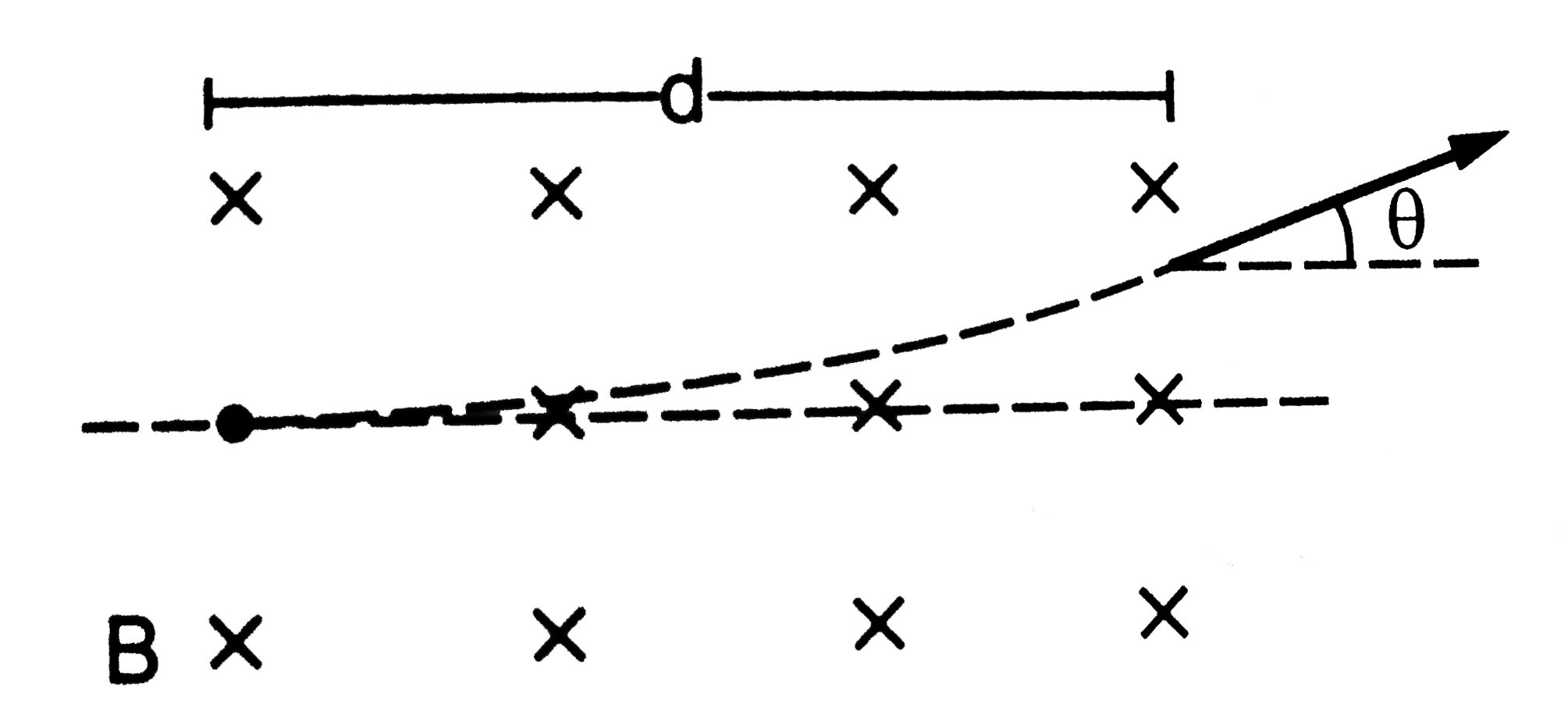
A particle of mass m and charge q is projected into a region having a perpendicular magnetic field B. Find the angle of deviation fo the particle as it comes out of the magnetic field if the width d of the regions is very smaller then
Text Solution
Verified by Experts
The radius of the circular orbit is `r=(mv)/(qB)` The deviation `theta` may be obtained from in as `sin theta =d/r=(dBq)/(mv)` or ` theta =sin^-1((dBq)/(mv))`
Topper's Solved these Questions
MAGNETIC FIELD AND MAGNETIC FORCES
CENGAGE PHYSICS|Exercise Solved Example|25 Videos
MAGNETIC FIELD AND MAGNETIC FORCES
CENGAGE PHYSICS|Exercise Exercise 1.1|22 Videos
KINETIC THEORY
CENGAGE PHYSICS|Exercise Question Bank|31 Videos
Magnetism and Matter
CENGAGE PHYSICS|Exercise Question Bank|50 Videos
Similar Questions
Explore conceptually related problems
A particle of mass m and charge q is projected into a region having a perpendicular magnetic, field B . Find the angle of deviation of the particle as it comes out of the magnetic field if th,, width of the region is (b) (a) (2mv)/(Bq) (b) (mv)/(Bq) (c) (mv)/(2 Bq)
A particle having mass m , charge q enters a cylindrical region having uniform magnetic field B in the inward direction as shown. If the particle is deviated by 60^(@) as it emerges out of the field then what is the time spent by it in the field?
A particle of mass m and charge q is thrown in a region where uniform gravitational field and electric field are present. The path of particle:
When a charged particle moves perpendicular to a magnetic field, then:
A charged particle of mass m and charge q is projected into a uniform magnetic field of induciton vecB with speed v which is perpendicular to vecB . The width of the magnetic field is d. The impulse imparted to the particle by the field is (dlt lt mv//qB)
A particle of charge q and mass m, is fired perpenducular to a magnetic field (B) with a velocity v. What is the frequency of revolution of the particle?
Figure shows a circular region of radius R-sqrt3m which has a uniform magnetic field B=0.2T directed into the plane of the figure. A particle having mass m =2g, speed v = 0.3 m//s and charge q = 1 mC is projected along the radius of the circular region as shown in figure. Calculate the angular deviation produced in the path of the particle as it comes out of the magnetic field. Neglect any other force apart from the magnetic force.
If a charged particle goes unaccelerated in a region containing electric and magnetic fields,
CENGAGE PHYSICS-MAGNETIC FIELD AND MAGNETIC FORCES-Multiple Correct Answer type