Home
Class 12
PHYSICS
If in previous illustration, The charge ...

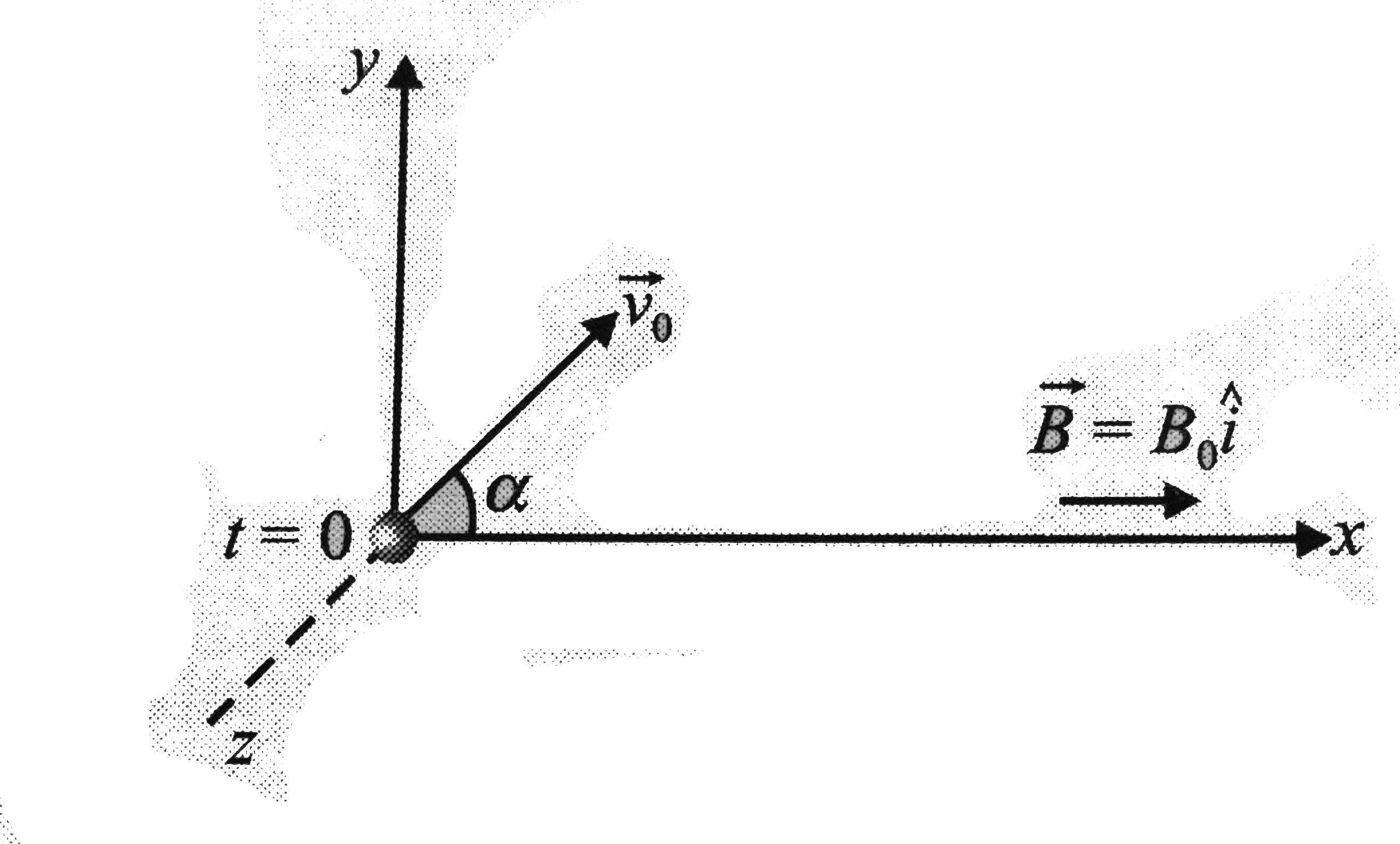
If in previous illustration, The charge particle is projected at angle `alpha` with x-axis with magnitude of velocity. Find
a. velocity vector in function of time `vec v (t).`
b. position vector in function of time `vec r (t).`

Text Solution

Verified by Experts

We can make components of the velocity of the particle along x-axis and y-axis. The component which is along the magnetic field will remain unchanged. But the component perpendicular to the magnetic field will provide circular motion. In a combined way, the path of the particle will be helical.
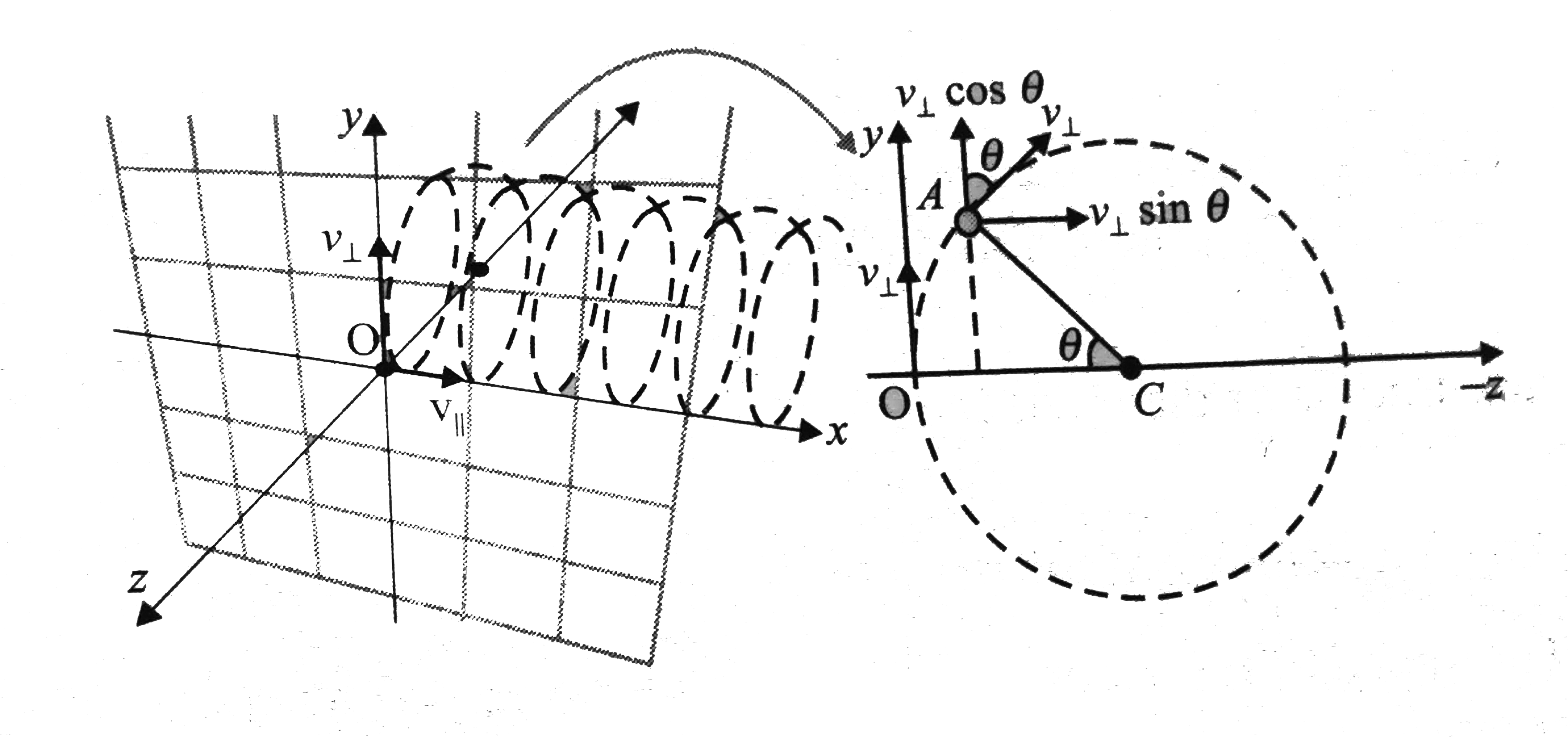
The component of velocity parallel to magnetic field
`v_(||)=v cos alpha`
The component of velocity perpendicular to magnetic field
`v_(bot)=v sin alpha`
The y and z components of velocity and position vector can be calculated in the same way as in previous illustration. The only difference is in place of v we substitute `v_(bot)`. Hence, velocity vector `[vecv_(bot)(t)]` in function of time can be writtens as
`vecv_(bot)(t)=v_(bot)cos. (qB)/m t hatj-v_(bot) sin. (qB)/m t hatk`
Hence net velocity
`vec (v) =v_(||)hat(i)+v_(bot) cos.(qB)/(m)t hat(j)-v_(bot) sin.(qB)/(m)t hat(k)`
And position vector in function of time
`vecr(t)=v_(||)t hati+R sin.(qBt)/m hatj-R(1-cos.(qBt)/m)hatk`.
Promotional Banner

Topper's Solved these Questions

  • MAGNETIC FIELD AND MAGNETIC FORCES

    CENGAGE PHYSICS|Exercise Solved Example|25 Videos
  • MAGNETIC FIELD AND MAGNETIC FORCES

    CENGAGE PHYSICS|Exercise Exercise 1.1|22 Videos
  • KINETIC THEORY

    CENGAGE PHYSICS|Exercise Question Bank|31 Videos
  • Magnetism and Matter

    CENGAGE PHYSICS|Exercise Question Bank|50 Videos

Similar Questions

Explore conceptually related problems

A charge particle of mass m and charge q is projected with velocity v along y-axis at t=0. Find the velocity vector and position vector of the particle vec v (t) and vec r (t) in relation with time.

A particle is projected with velocity u at angle theta with horizontal. Find the time when velocity vector is perpendicular to initial velocity vector.

A particle I projected at an angle of elevation alpha after time t it makes an angle beta with horizontal. The velocity of projection is

A particle travels so that its acceleration is given by vec(a)=5 cos t hat(i)-3 sin t hat(j) . If the particle is located at (-3, 2) at time t=0 and is moving with a velocity given by (-3hat(i)+2hat(j)) . Find (i) The velocity [vec(v)=int vec(a).dt] at time t and (ii) The position vector [vec(r)=int vec(v).dt] of the particle at time t (t gt 0) .

A projectill is projected at an angle (alpha gt 45^(@)) with an initial velocity u. The time t, at which its magnitude of horizontal velocity will equal the magnitude of vertical velocity is :-

A particle is projected from ground at angle 45^@ with initial velocity 20(sqrt2) m//s . Find (a)change in velocity, (b)magnitude of average velocity in a time interval from t=0 to t=3s .

A radius vector of a particle varies with time t as r=at(1-alphat) , where a is a constant vector and alpha is a positive factor. Find: (a) the velocity v and the acceleration w of the particles as functions of time, (b) the time interval Deltat taken by the particle to return to the initial points, and the distance s covered during that time.

A particle is projected with a speed v and an angle theta to the horizontal. After a time t, the magnitude of the instantaneous velocity is equal to the magnitude of the average velocity from 0 to t. Find t.

The velocity vector of the motion described by the position vector of a particle, r = 2t hati + t^(2) hatj is given by

A particle of specific charge q/m=pi C//kg is projected from the origin towards positive x -axis with a velocity of 10 m//s in a uniform magnetic field vec(B)=-2hatk T . The velocity vec(v) of particle after time t=1/12 s will be (in m//s )

