Home
Class 12
PHYSICS
A mass spectrometer separates ions accor...

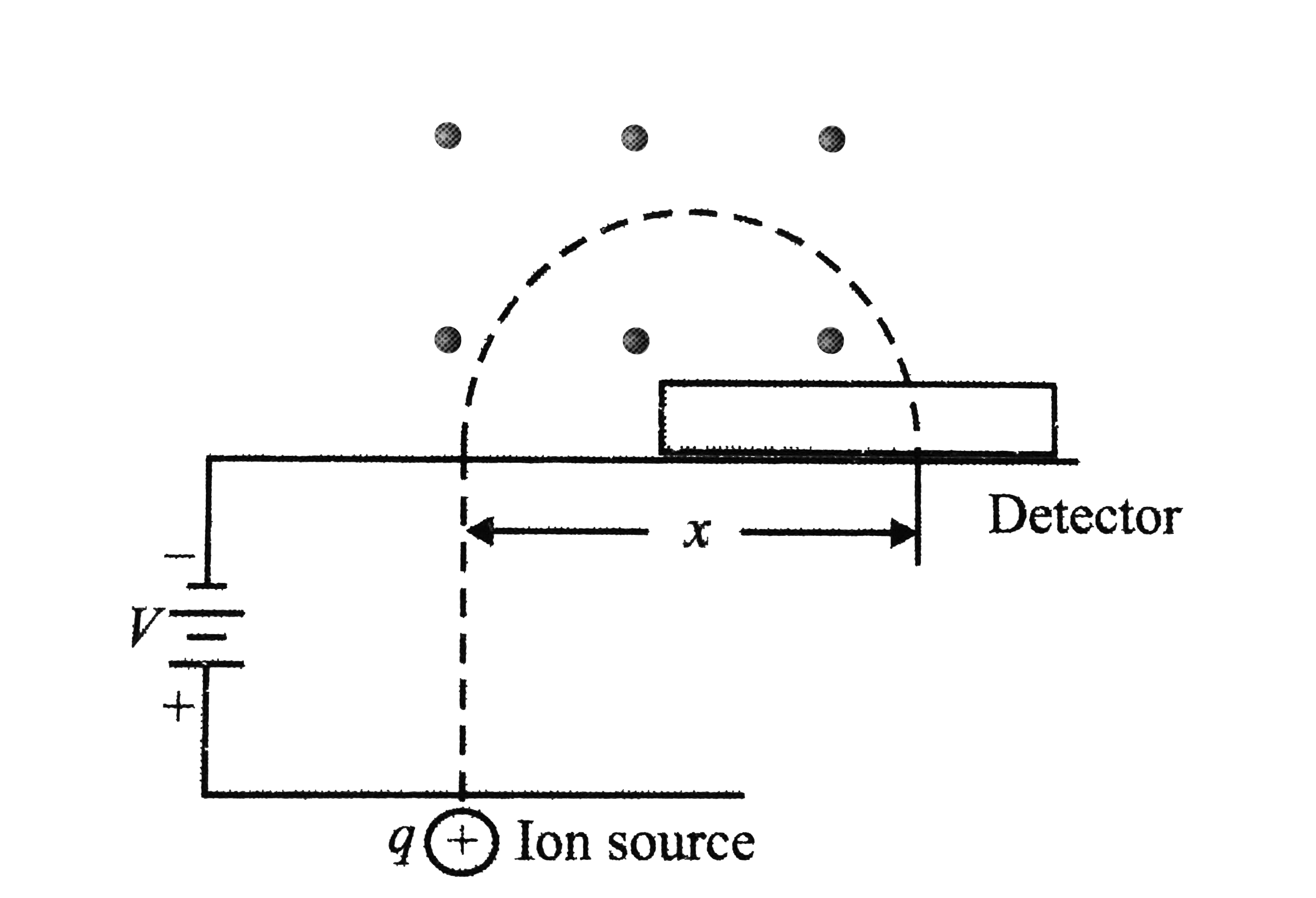
A mass spectrometer separates ions according to their ratio of charge to mass. Such devices are widely used in silence and engineering to analyze unknown mixtures and to separate isotopes of chemical elements. Figure 1.24 shows ions of charge q and mass m first being accelerated from rest through a potential difference V and then entering a region of uniform magnetic field B pointing out of the page. Only the magnetic force acts on the ions in this region, so they undergo circular motion and, after half an orbit, land on a detector. Find an expression for the horizontal distancexxfrom the entrance slit to the point where an ion lands on the detector.

Text Solution

Verified by Experts

This problem is about charged particle undergoing circular motion in a uniform magnetic field. The distance we are asked for is the diameter of the particle's circular path.
Equation, `r=mv//qB`, shows that the path radius depends on the field and on the particle's mass, change and speed. We know everything but the speed, so this becomes a two-step problem in which we will first find the speed, We are given the potential difference -energy per unit charge-so we can use energy conservation to find the kinetic energy and hence the ion's speed in the magnetic field region, Then we will use equation to find the radius of the ion's circular path.
A charge q gains kinetic energy qV in ''faling'' through a potential difference V, so an ion's kinetic energy once it enters the magnetic field is
`1/2mv^2=qV`
Solving for v gives `v=sqrt(2qV//m)`.
Our answer, the path diameter x, is then twice the radius gives in equation.
`x=2r=(2mv)/(qB)=(2msqrt(2qV//m))/(qB)=2/Bsqrt((2mv)/q)`.
Promotional Banner

Topper's Solved these Questions

  • MAGNETIC FIELD AND MAGNETIC FORCES

    CENGAGE PHYSICS|Exercise Solved Example|25 Videos
  • MAGNETIC FIELD AND MAGNETIC FORCES

    CENGAGE PHYSICS|Exercise Exercise 1.1|22 Videos
  • KINETIC THEORY

    CENGAGE PHYSICS|Exercise Question Bank|31 Videos
  • Magnetism and Matter

    CENGAGE PHYSICS|Exercise Question Bank|50 Videos

Similar Questions

Explore conceptually related problems

An electron of charge e and mass m is accelerated from rest by a potential difference V . the de Broglie wavelength is

An electron of mass m and charge e is accelerated from rest through a potential difference V in vacuum. The final speed of the electron will be

A particle of mass 'm' and charge 'q' is accelerated through a potential difference of V volt, its energy will be

A charge particle of mass m and charge q is accelerated by a potential difference V volt. It enters in a region of uniform magnetic field Bas shown in figure-4.93. Find the time after which it will come out from the magnetic field.

The mass of an electron is m, charge is e and it is accelerated from rest through a potential difference of V volts. The velocity acquired by electron will be

A particle of charges Q and mass m travels through a potential difference V from rest. The final momentum of the particle is

An electron of mass 'm' is accelerated through a potential difference of V and then it enters a magnetic field of induction B . Normal to the lines of force. Then the radius of the circular path is
