Home
Class 12
PHYSICS
An electron accelerated by a potential d...

An electron accelerated by a potential difference `V= 3` volt first enters into a uniform electric field of a parallel plate capacitor whose plates extend over a length `l= 6 cm` in the direction of initial velocity. The electric field is normal to the direction of initial velocity and its strength varies with time as `E= alpha t,` where `alpha= 3600 V m^-1 s^-1.` Then the electron enters into a uniform magnetic field of induction `B = pi xx 10^-9 T.` Direction of magnetic field is same as that of the electric field. Calculate pitch of helical path traced by the electron in the magnetic field. (Mass of electron, `m = 9 xx 10^-31 kg`)

Text Solution

Verified by Experts
Since, electron is accelerated thorugh a potential difference
V, therefore, its initial velcity `v_0` is given by `1/2mv_0^2=eV`
`v_0=sqrt((2eV)/m)....(i)`
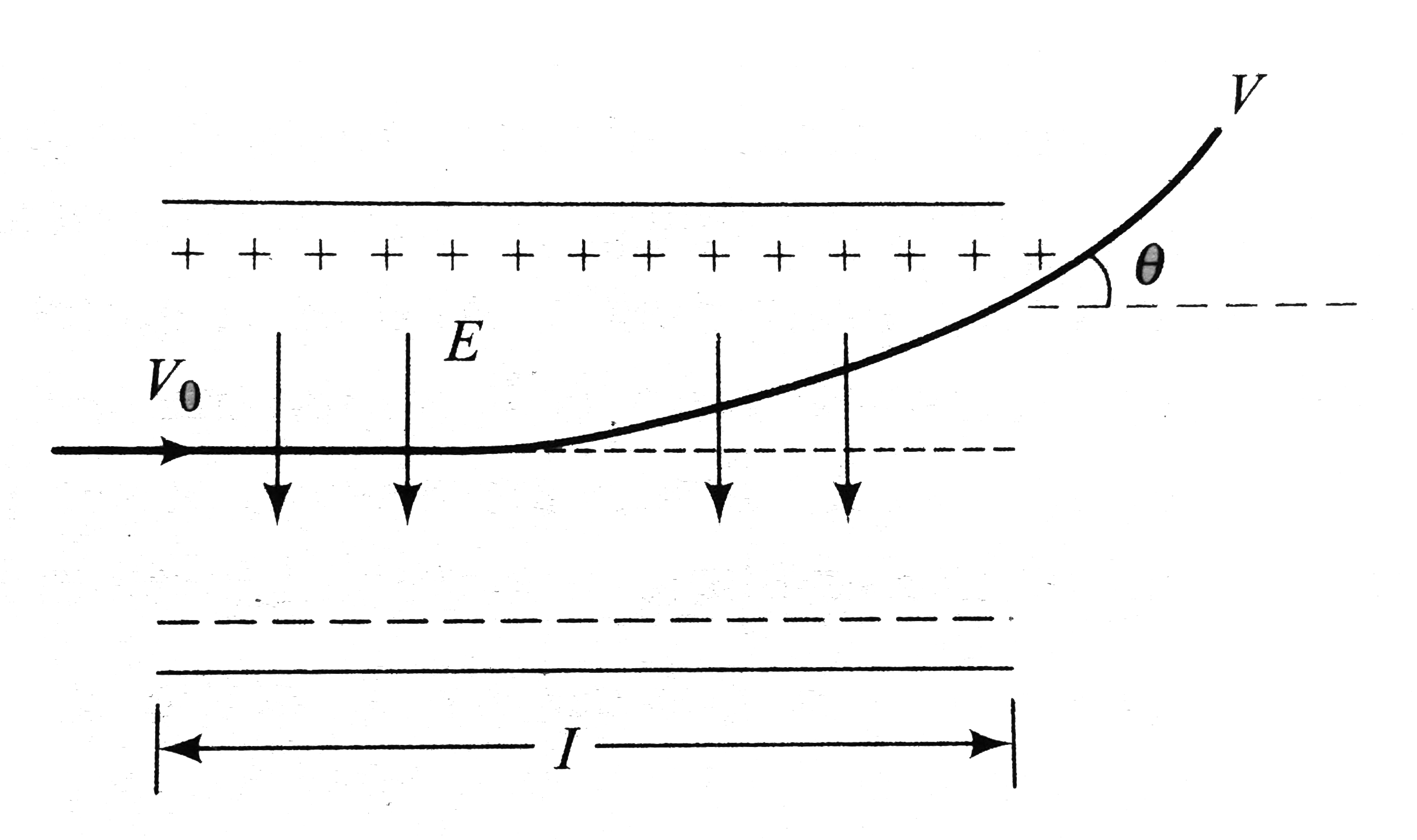
Since, initial velocity is paralle to plates or normal to the
direction of electric field, therefore, component of velocity
parallel to plates remains constant as `v_0`.

Hence, time taken by the electron to cross the electric field is
`t_0=1/(upsilon_0)`
Now consider motion of electron , normal to plates.
At some instant t, its acceleration `=(eE)/m=(e alpha t)/m`
Let velocity component normal to plates to `v_y`
Then this acceleration is equal to `d/(dt)upsilon_y`
`d/(dt)upsilon_y=(ealphat)/m` or `d upsilon_y=(ealphat)/mdt`
But at initial moment`t=0, v_y=0 implies int_0^(v_y)dupsilon_y=(ealpha)/(m) int_0^(t_0) tdt`
`upsilon_y=(ealpha)/(2m)t_0^2=(alphal^2)/(4V)....(ii)`
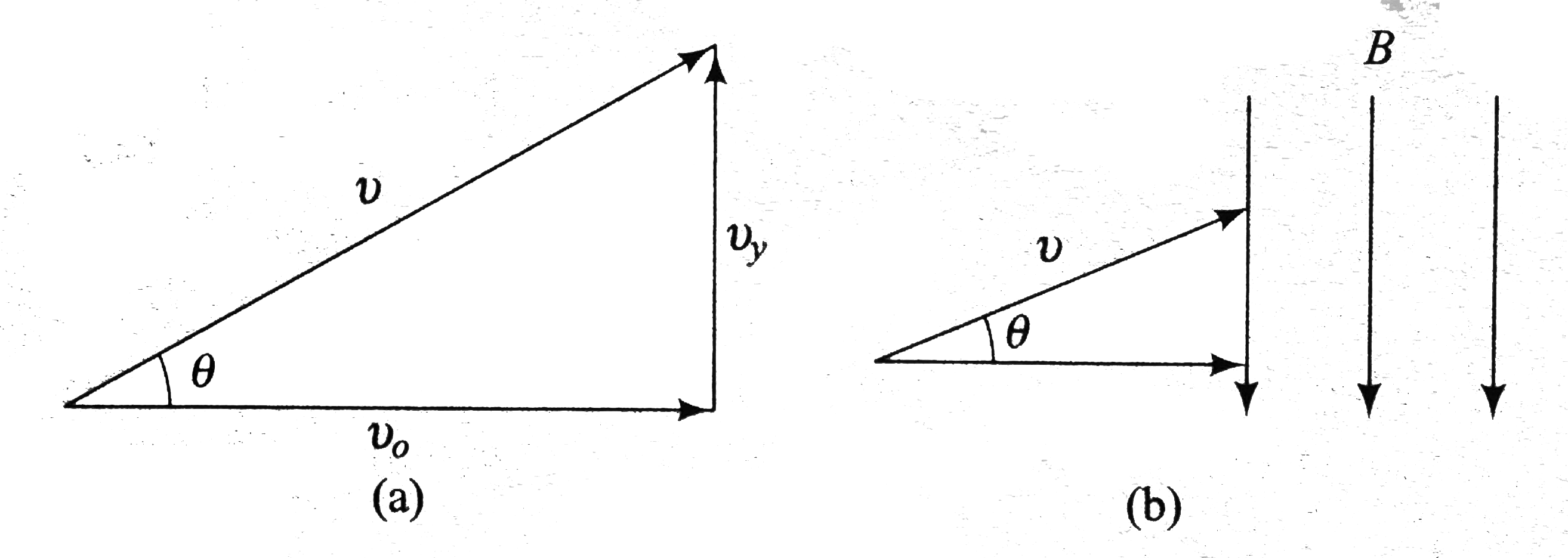
Angular deviation `theta` of electron form its initial direction of motion is shown in Fig.
Now electron enters into magnetic field. Pitch of its helical path
`P=(2pim)/(eB)vcos(90- theta)`

`=(2pim)/(eB)vsin theta=(2pim)/(eB)v_y`
`=(pimalphaI^2)/(2eBV)=1.214 cm`.
Promotional Banner

Topper's Solved these Questions

  • MAGNETIC FIELD AND MAGNETIC FORCES

    CENGAGE PHYSICS|Exercise Exercise 1.1|22 Videos
  • MAGNETIC FIELD AND MAGNETIC FORCES

    CENGAGE PHYSICS|Exercise Exercise 1.2|13 Videos
  • MAGNETIC FIELD AND MAGNETIC FORCES

    CENGAGE PHYSICS|Exercise Multiple Correct Answer type|2 Videos
  • KINETIC THEORY

    CENGAGE PHYSICS|Exercise Question Bank|31 Videos
  • Magnetism and Matter

    CENGAGE PHYSICS|Exercise Question Bank|50 Videos

Similar Questions

Explore conceptually related problems

A proton accelarted by a potential differnce V gets into the unifrom electric field of a paralallel-plate capacitor whose plates extended over a length l in the motion direction. The field strenth varies with time as E = at , where a is a constant. Assuming the proton to be non-relatistic, find the angle between the motion directions of the proton before and after its fight throgh the capacitor, the proton gets in the field at the moment t = 0 . The edge effects are to be neglected.

An electron after being accelerated through a potential difference of 100 V enters a uniform magnetic field of 0*004T , perpendicular to its direction of motion. Calculate the radius of the path described by the electron.

A electron e^(-) is accelerated by V volts experiences a force F, when it enters in a uniform magnetic field. What will the force experienced when it is accelerated by 2V?

An electron enters in an electric field with its velocity in the direction of the electric lines of force. Then

A n electrically charged particle enters into a uniform magnetic induction field in a direction perpendicular to the field with a velocity v then it travels

If an electron has an initial velocity in a direction different from that of an electric field, then the path of the electron is

An electron emmited by a heated cathode and accelerated through a potential difference of 2*0kV enters a region with a uniform magnetic field of 0*15T . Determine the trajectory of the electron if the field (a) is transverse to its initial velocity (b) makes an angle of 30^@ with the initial velocity.

CENGAGE PHYSICS-MAGNETIC FIELD AND MAGNETIC FORCES-Solved Example
  1. An electron in the ground state of hydrogen atom is revolving in antic...

    Text Solution

    |

  2. A particle of mass m and charge q is moving in a region where uniform,...

    Text Solution

    |

  3. A uniform constant magnetic field B is directed at an angle of 45^(@) ...

    Text Solution

    |

  4. The region between x=o and x = L is filled with uniform, steady magn...

    Text Solution

    |

  5. A rectangular loop PQRS made from a uniform wire has length a, width b...

    Text Solution

    |

  6. A ring of radius R having unifromly distributed charge Q is mounted on...

    Text Solution

    |

  7. In a moving coil galvanometer, torque on the coil can be experessed as...

    Text Solution

    |

  8. A slightly divergent beam of charged particles accelerated by a Potent...

    Text Solution

    |

  9. A small charged ball having mass m and charge q is suspended from a ri...

    Text Solution

    |

  10. Non-relativistic protons move reactilinearly in the region of space wh...

    Text Solution

    |

  11. A current i, indicated by the crosses in figure, is established in a s...

    Text Solution

    |

  12. A straight conductor of weight 1 N and length 0.5 m, is located in a p...

    Text Solution

    |

  13. There is a constant homogeneous electric field of 100 Vm^-1 within the...

    Text Solution

    |

  14. A positively charged particle of mass m and charge q is projected on a...

    Text Solution

    |

  15. A loop of flexible conducting wire of length 0.5 m lies in a magnetic ...

    Text Solution

    |

  16. A circular coil of 100 turns has an effective radius of 0.05 m and car...

    Text Solution

    |

  17. A positively charged particle having charge q1 = 1 C and mass m1 =40 g...

    Text Solution

    |

  18. An electron accelerated by a potential difference V= 3 volt first ente...

    Text Solution

    |

  19. A particle having mass m and charge q is released from the origin in a...

    Text Solution

    |

  20. A non-relativistic charge q of mass m originates at a point A lying on...

    Text Solution

    |