Home
Class 12
PHYSICS
A particle having mass m and charge q is...

A particle having mass `m` and charge `q` is released from the origin in a region in which electric field and megnetic field are given by `vec(B) = -B_(0)hat(j)` and `vec(E) = vec(E)_(0)hat(k)`. Find the speed of the particle as a function of its `z`-coordinate.

Text Solution

Verified by Experts
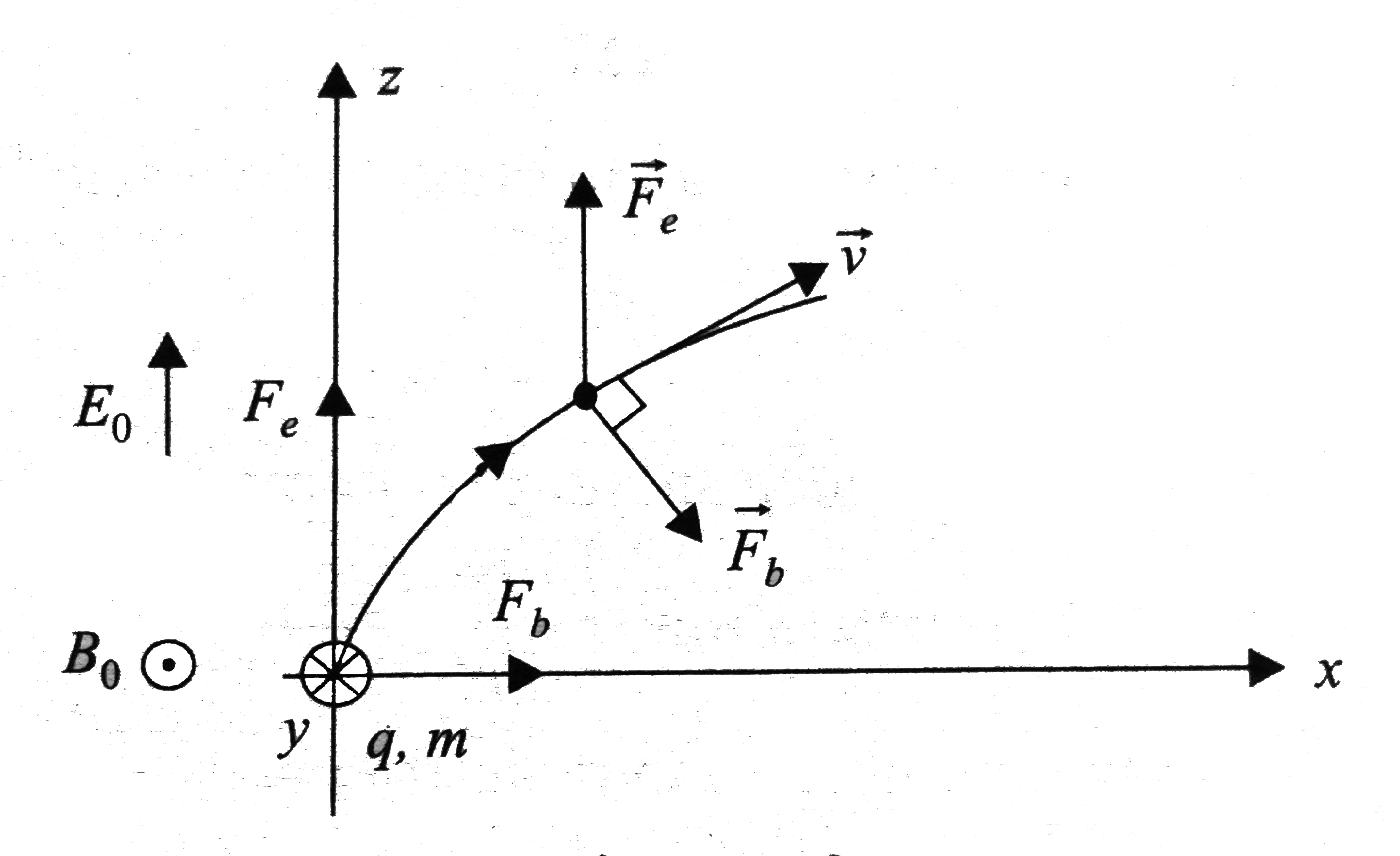
In Fig shown `B_0` is outward. As soon as we release the
particle at origin. Electric field will apply force `F_e=qE_0` on the
particle. Due to this force, the charge particle will gain accelera-
tion and hence velocity along z-axis. And as it gains velocity
along z-axis, then magnetic field will apply the force `F_b` on charge particle. Now both the forces are always in x-z plane, so
path of charge will be in x-z plane as shown. Let at any time its
velocity is `vecv=v_xhati+v_zhatk`. Let `veca=a_xhati+a_zhatk` is the acceleration
at any time.

Then `vecF_(net)=mveca`
`implies qE_0hatk-q(v_xhati+v_zhatk)xxB_0hatj=m(a_xhati+a_zhatk)`
`implies qE_0hatk-qv_xB_0hatk+qv_zB_0hati=m(a_xhati+a_zhatk)`
`implies ma_x=qv_zB_0 and ma_z=q(E_0-v_xB_0)...(i)`
`implies m(dv_x)/(dt)=qv_zB_0 and m(dv_z)/(dt)=q(E_0-v_xB_0)...(ii)`
From Eq. (ii), `(dv_z)/(dt)=q/m(E_0-v_xB_0)implies (d^2v_z)/(dt^2)=(-qB_0)/m (dv_x)/(dt)`
`implies (d^2v_z)/(dt^2)=(-qB_0)/m (qB_0)/mv_z=-((qB_0)/m)^2v_z`
Solution of the above equation is : `v_z=v_(z0) sin (omegat+phi) .....(iii)`
(where `omega=(qB_0)/m`)
Puting at `t=0, v_z=0, we get phi=0`
Differentiating Eq. (iii),
`(dv_z)/(dt)=v_(z0)omegacos(omegat+phi) implies a_z=omegav_(z0) cos omegat`
at `t=0, a_z=(F_e)/m=(qE_0)/m`
`implies (qE_0)/m=(qB_0)/m v_(z0) cos 0^@ implies v_(z0)=(E_0)/(B_0)`
So Eq. (iii) can be written as : `v_z=(E_0)/(B_0) sin(omegat)....(iv)`
Puting the value of `v_z` in Eq. (ii), `m(dv_x)/(dt)=(qE_0)/(B_0) (sin omegat)B_0`
`implies int_0^vdv_x=int_0^t(qE_0)/m sin omegatdt implies v_x=(qE_0)/(momega)[1-cos omegat]`
`implies v_x=(qE_0)/(m(qB_(0))//m)[1-cos omegat]implies v_x=(E_0)/(B_0)[1-cosomegat]....(v)`
Equations (iv) and (v) give velocity as a function of time.
From Eq.(v), `(dx)/(dt)=(E_0)/(B_0)(1-cos omegat)`
`implies int_0^xds=(E_0)/(B_0)int_0^t(1-cosomegat)dt`
`implies x=(E_0)/(omegaB_0)[omegat-sinomegat]....(vi)`
From Eq.(iv)
`(dz)/(dt)=(E_0)/(B_0) sin omegat implies int_0^zdz=(E_0)/(B_0)int_0^tsinomegatdt`
`implies z=(E_0)/(omegaB_0)[1-cosomegat]....(vii)`
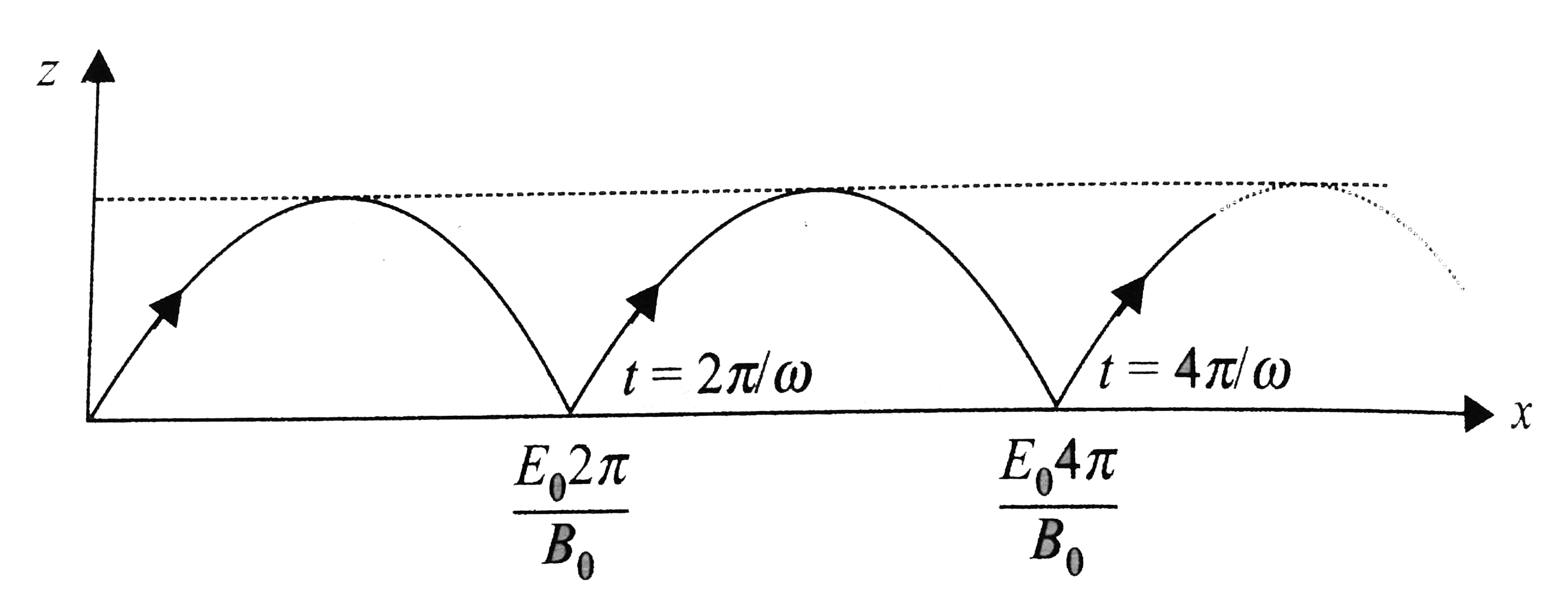
Equations (vi) and (vii) give the path of the verticle.
We see that at `t=2pi`
`x=(E_0)/(B_0)2pi, z=0`

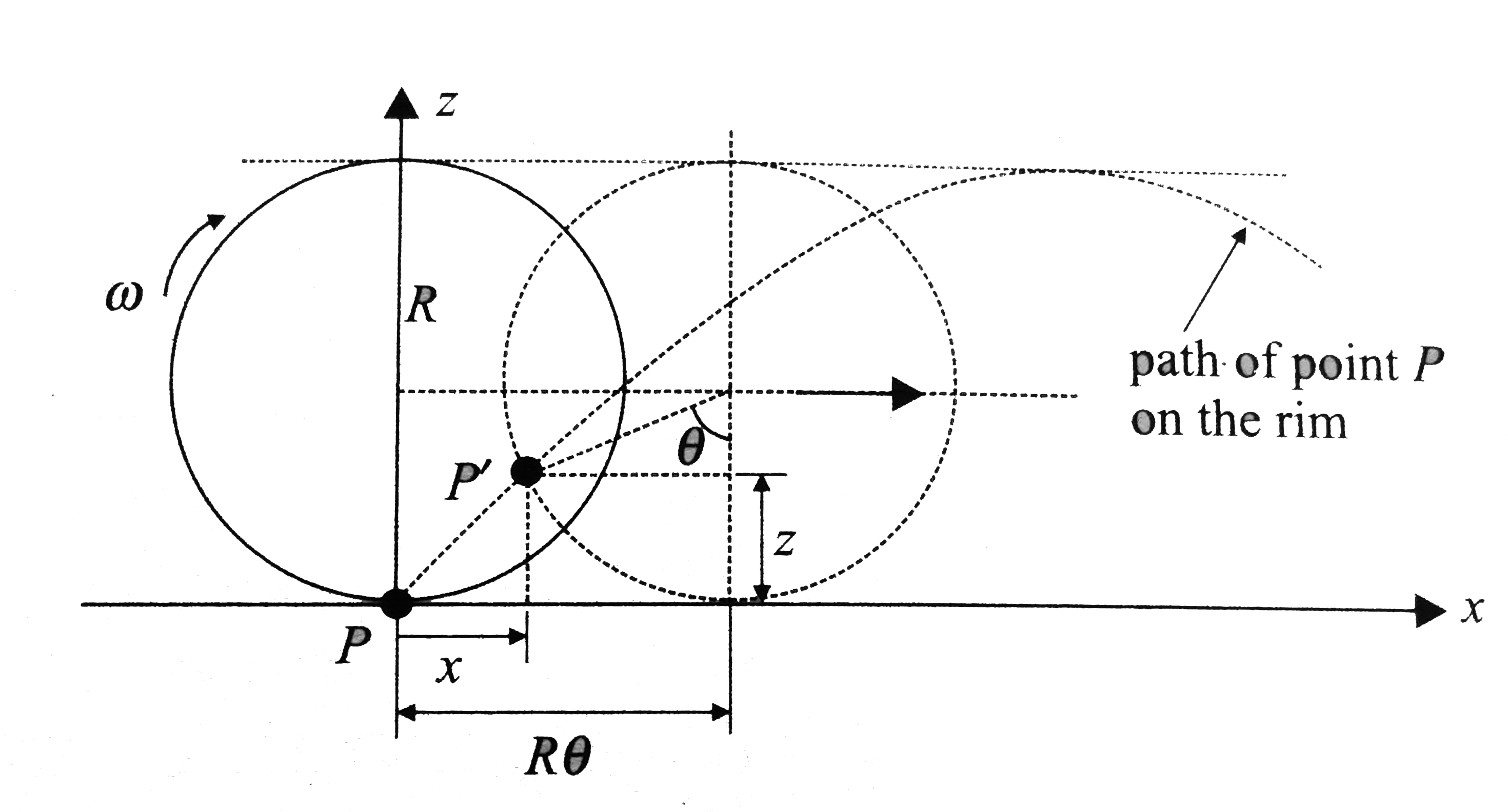
This path is known as cycloided path. This is the same kind of path as followed by a point on the rim of a purely rolling wheel, which is expalined as below.
Let a wheel is rolling purely with angular velocity `omega` as shown.
Let at `t=0`, a point P on the rim is at the bottom-most position of
the wheel. After time t, the wheel turns by an angle `theta` as shown
and point P comes at point P'. Let us find the coordinates of P'.

`x=R theta-R sin theta=Romegat-Rsin omegat=R[omegat-sinomegat]...(viii)`
`z=R-Rcos theta=R[1-cosomegat]....(ix)`
Equations (viii) and (ix) resemble Eqs (vi) and (vii).
Hence, the resulting path followed by charge is cycloidal.
(b) To find velocity as function of z-coordinate.
From equations (iv) and (v)
`v=sqrt(v_x^2+v_z^2)=(E_0)/(B_0)sqrt((1-cosomegat)^2+(sinomegat)^2)`
`=(E_0)/(B_0)sqrt((1-cos omega t)^2+(1-cos omega t)(1+cos omega t))`
`=(E_0)/(B_0) sqrt(1-cos omega t)^2=(E_0)/(B_0)sqrt((z omega B_0)/(E_0))2 [From Eq. (vii)]`
`=sqrt((E_0^2)/(B_0^2) (zqB_0)/m (B_0)/(E_0) 2)=sqrt((2qE_0Z)/m)`
Alternate Method to find velocity: Since the magnetic field does
not perform any work, therefore, whatever has been the gain in
kinetic energy it is only because of the work done by electric
field. Applying work-energy theoram, `W_E=DeltaK`
`implies qE_0z=1/2mv^2-0 or v=sqrt((2qE_0Z)/m)`
Promotional Banner

Topper's Solved these Questions

  • MAGNETIC FIELD AND MAGNETIC FORCES

    CENGAGE PHYSICS|Exercise Exercise 1.1|22 Videos
  • MAGNETIC FIELD AND MAGNETIC FORCES

    CENGAGE PHYSICS|Exercise Exercise 1.2|13 Videos
  • MAGNETIC FIELD AND MAGNETIC FORCES

    CENGAGE PHYSICS|Exercise Multiple Correct Answer type|2 Videos
  • KINETIC THEORY

    CENGAGE PHYSICS|Exercise Question Bank|31 Videos
  • Magnetism and Matter

    CENGAGE PHYSICS|Exercise Question Bank|50 Videos

Similar Questions

Explore conceptually related problems

A particle having mass m and charge q is released from the origin in a region in which electric field and magnetic field are ginen by B=+B_(0)hatj and vecE=+E_(0)hati . Find the speed of the particle as a function of its X -coordinate.

A particle having mass m and charge q is released from the origin in a region in which electric field and magnetic field are given by vecB =- B_0vecJ and vecE - E_0 vecK. Find the speed of the particle as a function of its z-coordinate.

A particle having mass m and charge q is released from the origin in a region in which ele field and magnetic field are given by B=-B_0hatj and E=E_0hatk . Find the y- component of the velocity and the speed of the particle as a function of it z-coordinate.

A particle of charge q and mass m released from origin with velocity vec(v) = v_(0) hat(i) into a region of uniform electric and magnetic fields parallel to y-axis. i.e., vec(E) = E_(0) hat(j) and vec(B) = B_(0) hat(j) . Find out the position of the particle as a functions of time Strategy : Here vec(E) || vec(B) The electric field accelerates the particle in y-direction i.e., component of velocity goes on increasing with acceleration a_(y) = (F_(y))/(m) = (F_(e))/(m) = (qE_(0))/(m) The magnetic field rotates the particle in a circle in x-z plane (perpendicular to magnetic field) The resultant path of the particle is a helix with increasing pitch. Velocity of the particle at time t would be vec(v) (t) = v_(x) hat(i) + v_(y) hat(j) + v_(z) hat(k)

A charged particle of mass m and charge q is projected on a rough horizontal XY plane. Both electric and magnetic fields are given by vec(E)=-10hat(k)N//C and magnetic field vec(B)=-5vec(k) tesla are present in the region. The particle enters into the magnetic field at (4,0,0)m with a velocity 50vec(j) m//sec . The particle starts into a curved path on the plane. If coefficietn of friction mu=(1)/(3) between particle and plane, then (qE=2mg,g=10m//s^(2)) . Total work done by electric force on the particle is

A charged particle of mass m and charge q is projected on a rough horizontal XY plane. Both electric and magnetic fields are given by vec(E)=-10hat(k)N//C and magnetic field vec(B)=-5vec(k) tesla are present in the region. The particle enters into the magnetic field at (4,0,0)m with a velocity 50vec(j) m//sec . The particle starts into a curved path on the plane. If coefficietn of friction mu=(1)/(3) between particle and plane, then (qE=2mg,g=10m//s^(2)) . The time after which particle comes to rest, is

A charged particle of mass m and charge q is projected on a rough horizontal XY plane. Both electric and magnetic fields are given by vec(E)=-10hat(k)N//C and magnetic field vec(B)=-5vec(k) tesla are present in the region. The particle enters into the magnetic field at (4,0,0)m with a velocity 50vec(j) m//sec . The particle starts into a curved path on the plane. If coefficietn of friction mu=(1)/(3) between particle and plane, then (qE=2mg,g=10m//s^(2)) . Total distance covered by the particle is

A charged particle of mass m and charge q is projected on a rough horizontal XY plane. Both electric and magnetic fields are given by vec(E)=-10hat(k)N//C and magnetic field vec(B)=-5vec(k) tesla are present in the region. The particle enters into the magnetic field at (4,0,0)m with a velocity 50vec(j) m//sec . The particle starts into a curved path on the plane. If coefficietn of friction mu=(1)/(3) between particle and plane, then (qE=2mg,g=10m//s^(2)) . Radius of curvature of the path followed by particle, initially is

Magnetic force on a charged particle is given by vec F_(m) = q(vec(v) xx vec(B)) and electrostatic force vec F_(e) = q vec (E) . A particle having charge q = 1C and mass 1 kg is released from rest at origin. There are electric and magnetic field given by vec(E) = (10 hat(i)) N//C for x = 1.8 m and vec(B) = -(5 hat(k)) T for 1.8 m le x le 2.4 m A screen is placed parallel to y-z plane at x = 3 m . Neglect gravity forces. The speed with which the particle will collide the screen is

Magnetic force on a charged particle is given by vec F_(m) = q(vec(v) xx vec(B)) and electrostatic force vec F_(e) = q vec (E) . A particle having charge q = 1C and mass 1 kg is released from rest at origin. There are electric and magnetic field given by vec(E) = (10 hat(i)) N//C for x = 1.8 m and vec(B) = -(5 hat(k)) T for 1.8 m le x le 2.4 m A screen is placed parallel to y-z plane at x = 3 m . Neglect gravity forces. y-coordinate of particle where it collides with screen (in meters) is

CENGAGE PHYSICS-MAGNETIC FIELD AND MAGNETIC FORCES-Solved Example
  1. An electron in the ground state of hydrogen atom is revolving in antic...

    Text Solution

    |

  2. A particle of mass m and charge q is moving in a region where uniform,...

    Text Solution

    |

  3. A uniform constant magnetic field B is directed at an angle of 45^(@) ...

    Text Solution

    |

  4. The region between x=o and x = L is filled with uniform, steady magn...

    Text Solution

    |

  5. A rectangular loop PQRS made from a uniform wire has length a, width b...

    Text Solution

    |

  6. A ring of radius R having unifromly distributed charge Q is mounted on...

    Text Solution

    |

  7. In a moving coil galvanometer, torque on the coil can be experessed as...

    Text Solution

    |

  8. A slightly divergent beam of charged particles accelerated by a Potent...

    Text Solution

    |

  9. A small charged ball having mass m and charge q is suspended from a ri...

    Text Solution

    |

  10. Non-relativistic protons move reactilinearly in the region of space wh...

    Text Solution

    |

  11. A current i, indicated by the crosses in figure, is established in a s...

    Text Solution

    |

  12. A straight conductor of weight 1 N and length 0.5 m, is located in a p...

    Text Solution

    |

  13. There is a constant homogeneous electric field of 100 Vm^-1 within the...

    Text Solution

    |

  14. A positively charged particle of mass m and charge q is projected on a...

    Text Solution

    |

  15. A loop of flexible conducting wire of length 0.5 m lies in a magnetic ...

    Text Solution

    |

  16. A circular coil of 100 turns has an effective radius of 0.05 m and car...

    Text Solution

    |

  17. A positively charged particle having charge q1 = 1 C and mass m1 =40 g...

    Text Solution

    |

  18. An electron accelerated by a potential difference V= 3 volt first ente...

    Text Solution

    |

  19. A particle having mass m and charge q is released from the origin in a...

    Text Solution

    |

  20. A non-relativistic charge q of mass m originates at a point A lying on...

    Text Solution

    |