Home
Class 12
PHYSICS
A rod of mass 0.720 kg and radius 6 cm r...

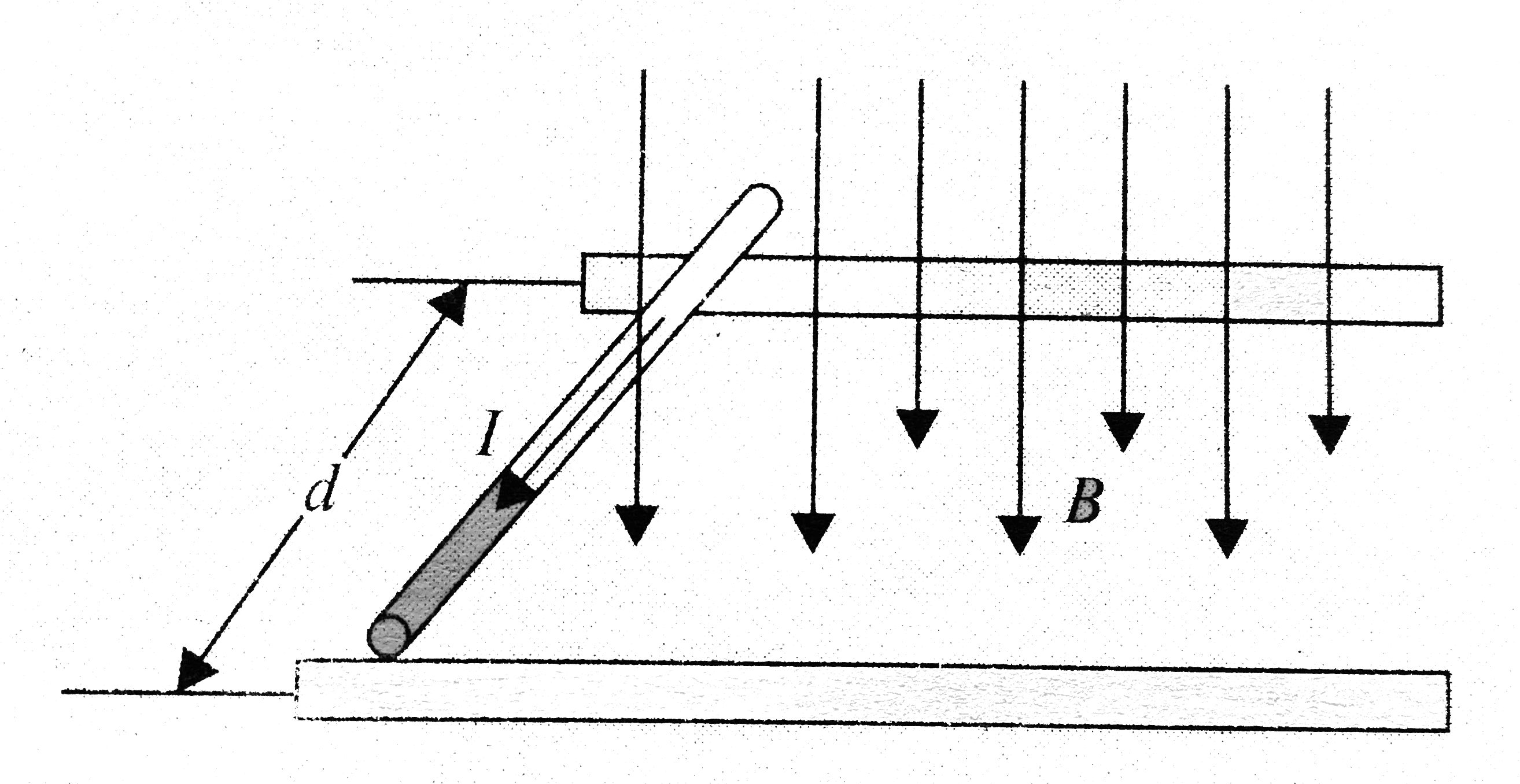
A rod of mass 0.720 kg and radius 6 cm rests on two parallel rails that are `d=12 cm` apart and length of rails is `L=49 cm.` The rod carried a current of `I=48 A` Fig. and rolls along the rails without slipping. A uniform magnetic field of magnetude 0.240 T is directed perpendicular to the rod and the rails. If it starts from rest, what is the speed of the rod as it leaves the rails?

Text Solution

Verified by Experts
`F=idB=48xx12/100xx0.240=1.3824N`

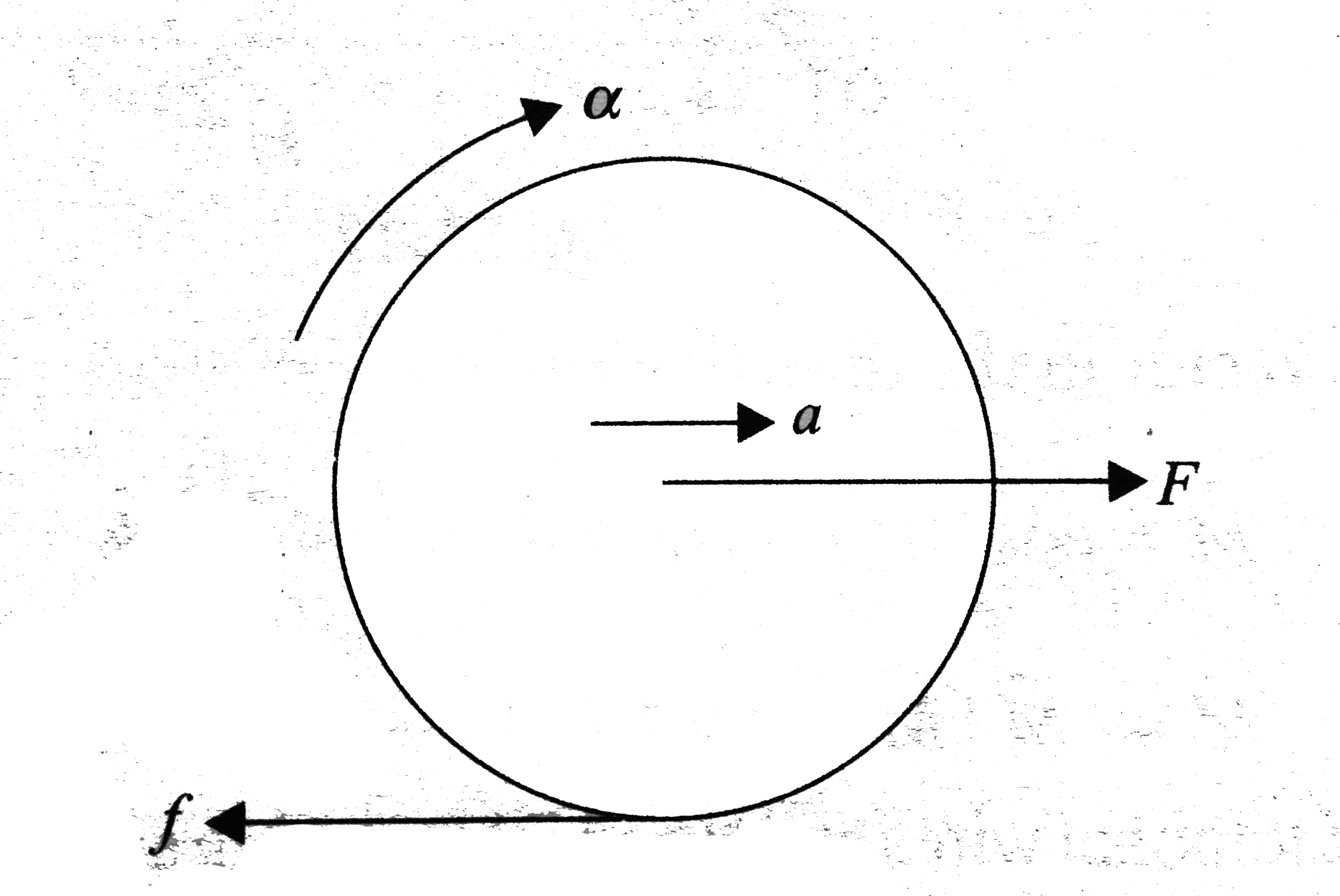
`F-f=ma and fR=Ialpha implies fR =Ia/R`
`implies F-(Ia)/(R^2)=ma`
`implies a=F/(m+I/R^2)=F/(m+1/2 (mR^2)/(R^2))=(2F)/(3m)`
`=(2xx1.3824)/(3xx0.720)=1.28 m//s^2`
Now, `v^2=u^2+2as`
`implies v=sqrt(2xx1.28xx0.49)=1.12 m//s`
Alternatively:
`W=DeltaKE implies FL=1/2mv^2+1/2Iomega^2`
`implies IdBL=1/2mv^2+1/2(1/2mr^2)omega^2`
`implies IdBL=3/4mv^2 implies v=sqrt(4/3 (IdBL)/m)=1.12ms^-1`
Promotional Banner

Topper's Solved these Questions

  • MAGNETIC FIELD AND MAGNETIC FORCES

    CENGAGE PHYSICS|Exercise Exercise1.3|14 Videos
  • MAGNETIC FIELD AND MAGNETIC FORCES

    CENGAGE PHYSICS|Exercise Exercises Subjective|10 Videos
  • MAGNETIC FIELD AND MAGNETIC FORCES

    CENGAGE PHYSICS|Exercise Exercise 1.1|22 Videos
  • KINETIC THEORY

    CENGAGE PHYSICS|Exercise Question Bank|31 Videos
  • Magnetism and Matter

    CENGAGE PHYSICS|Exercise Question Bank|50 Videos

Similar Questions

Explore conceptually related problems

A rod of mass m and radius R rest on two parallel rails that are distance l apart and have a length L . The rod carries a current I ( in the direction shown ) and rolls along the rails without slipping. A uniform magnetic field B is directed perpendicular to the rod and the rails. If it starts from rest, wat is the speed of the rod as it leaves the rails ?

Two parallel rails with negligible resistance are 10.0 cm apart. The are connected by a 5.0Omega resistor. The circuit also contains two metal rods having resistances of 10.0Omega and 15.0Omega along the rails. The rods are pulled away from the resistor at constant speeds 4.00 m/\s and 2.00 m//s respectively. A uniform magnetic field of magnitude 0.01 T is applied perpendicular to the, plane of the rails. Determine the current in the 5.0Omega resistor.

A vertical ring of radius r and resistance on R falls vertically. It is in contact with two vertical rails which are joined at the top. The rails are without friction and resistance. There is a horizontal uniform, magnetic field of magnitude B perpendicular to the plane of the ring and the rails. When the speed of the ring is v , the current in the section PQ is

Figure shows a wire sliding on two parallel, conducting rails placed at a separation L . A magnetic field B exists in a direction perpendicular to the plane of the rails. What force is necessary to keep the wire moving at a constant velocity V ?

A copper rod of mass m slides under gravity on two smooth parallel rails l distance apart set at an angle theta to the horizontal. At the bottom, the rails are joined by a resistance R . There is a uniform magnetic field perpendicular to the plane of the rails. the terminal valocity of the rod is

A conducting rod MN of mass m and length 'l' is placed on parallel smooth conducting rails connected to an uncharged capacitor of capacitance C and a battery of emf epsilon as shown. A uniform magnetic field B is existing perpendicular to the plane of the rails. The steady state velocity acquired by the conducting rod MN after closing switch S is (neglect the resistance of the parallel rails and the conducting rod)

