Home
Class 12
PHYSICS
H^(+), He^(+) and O^(++) all having the ...

` H^(+), He^(+) and O^(++)` all having the same kinetic energy pass through a region in which there is a uniform magnetic field perpendicular to their velocity . The masses of ` H^(+), He^(+) and O^(2+)` are `1 amu, 4 amu and 16 amu` respectively . Then

A

`H^(+)` will be deflected most

B

`O^(2+)` will be deflected most.

C

`He^(+) , and O^(2+)` will be deflected equally

D

All will be deflected equally

Text Solution

Verified by Experts

The correct Answer is:
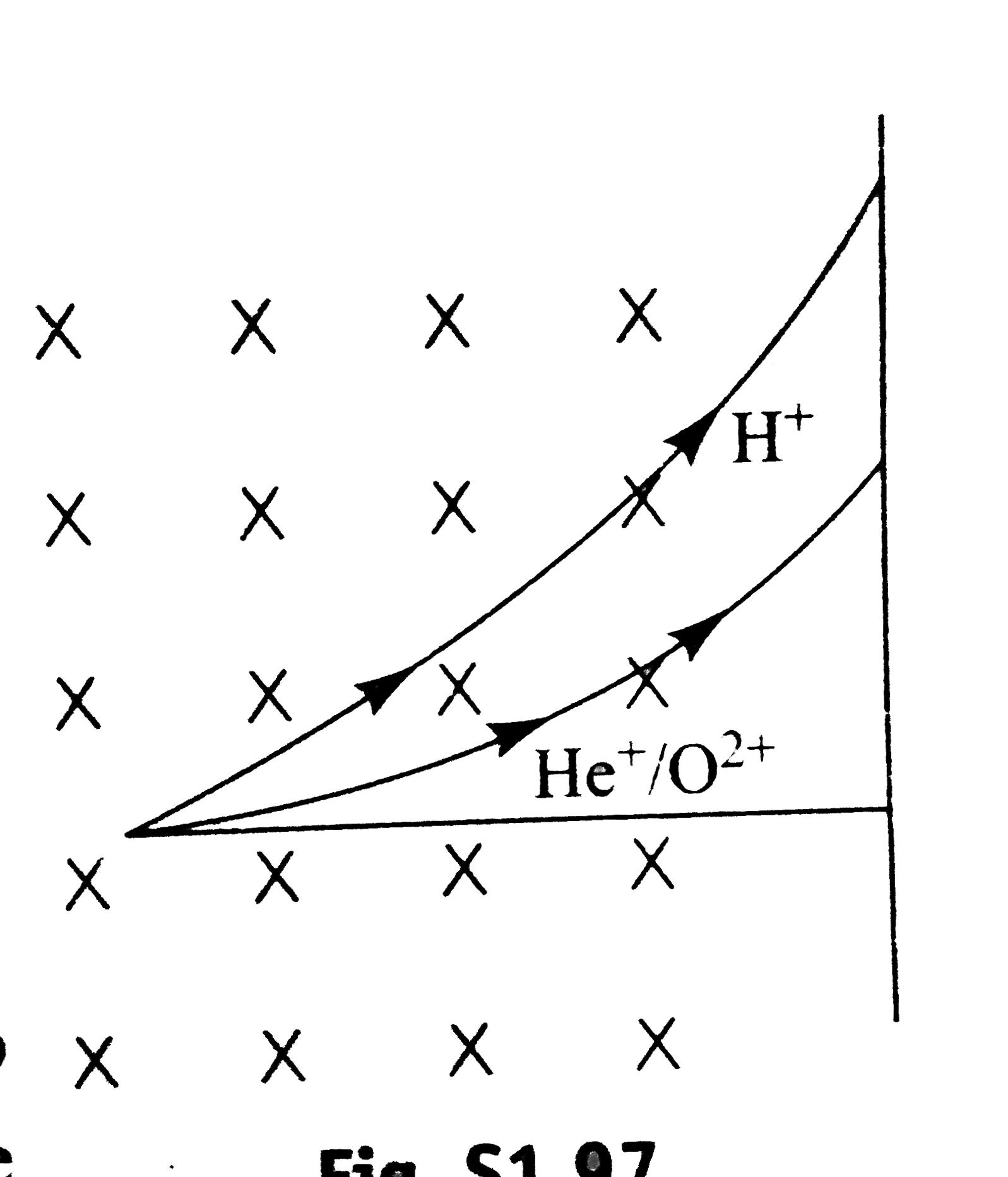
(a,c)

When the charged particles enter a magnetic field, then a
force acts on the particle which will acts as a centripetal force.
`q upsilonB=(m upsilon^2)/rimplies r=(m upsilon)/(qB)....(i) `
Now, `E=1/2m upsilon^2 implies upsilon=(sqrt(2E))/m....(ii)`
`:. r=m/(qB) sqrt((2E)/m)=(sqrt(2Em))/(qB)=(sqrt(2E))/Bxx(sqrtm)/q`
`implies rprop (sqrtm)/q`
`:. r_H^+ prop (sqrt1)/1, pr_(He^+) prop (sqrt4)/1, r_(O^+) prop (sqrt16)/2`
`implies r_(H^(+)) prop1, r_(He^(+))prop 2, r_(O^+)prop2`
`implies He^(+) and O^(+)` will be deflected
equally.
`H^(+)` will be deflected the most since its
radius is smallest.
`:.` (a),(c) are correct options.
Promotional Banner

Topper's Solved these Questions

  • MAGNETIC FIELD AND MAGNETIC FORCES

    CENGAGE PHYSICS|Exercise Archives Comprehension|2 Videos
  • MAGNETIC FIELD AND MAGNETIC FORCES

    CENGAGE PHYSICS|Exercise Archives Integer|1 Videos
  • MAGNETIC FIELD AND MAGNETIC FORCES

    CENGAGE PHYSICS|Exercise Archives Single Correct|18 Videos
  • KINETIC THEORY

    CENGAGE PHYSICS|Exercise Question Bank|31 Videos
  • Magnetism and Matter

    CENGAGE PHYSICS|Exercise Question Bank|50 Videos

Similar Questions

Explore conceptually related problems

H^(+),He^(+) and O^(2+) all having the same kinetic energy pass through a region in which there is a uniform magnetic field perpendicular to their velocity. The masses of H^(+), He^(+) and O^(2+) are 1 amu, 4 amu, and 16 amu respectively. Then :

A proton and an electron are projected into a region of uniform magnetic field in a direction perpendicular to the field. If they have the same initial velocities then

Calculate the energy released in MeV during the reaction ._(3)^(7)Li + ._(1)^(1)H to 2[._(2)^(4)He] if the masses of ._(3)^(7)Li, ._(1)^(1)H and ._(2)H_(4)He are 7.018, 1.008 and 4.004 amu respectively.

Two ions of masses 4 amu and 16 amu have charges +2e and +3e respectively. These ions pass through the region of constant perpendicular magnetic field. The kinetic energy of both ions is same. Then :

An electron, a proton and a He^(+) ion projected into a magnetic field with same kinetic energy, with velocities being perpendicular to the magnetic field. The order of the radii of circles traced by them is :

Mixed He^(+) and O^(2+) ions (mass of He^(+) =4 amu and that of O^(2+)=16 amu) beam passes a region of constant perpendicular magnetic field. If kinetic energy of all the ions is same then

An alpha particle (mass = 4amu) and a singly charged sulfur ion (mass 32 amu) are initially at rest. They are accelerated through potential V and then allowed to pass into a region of uniform magnetic field which is normal to velocities of the particles. Within this region the alpha particle and the sulfur ion move in circular orbits of radii r_a and r_s resp. The ratio (r_s/r_a) is

