Home
Class 12
PHYSICS
Two long, straight, parallel wires are 1...

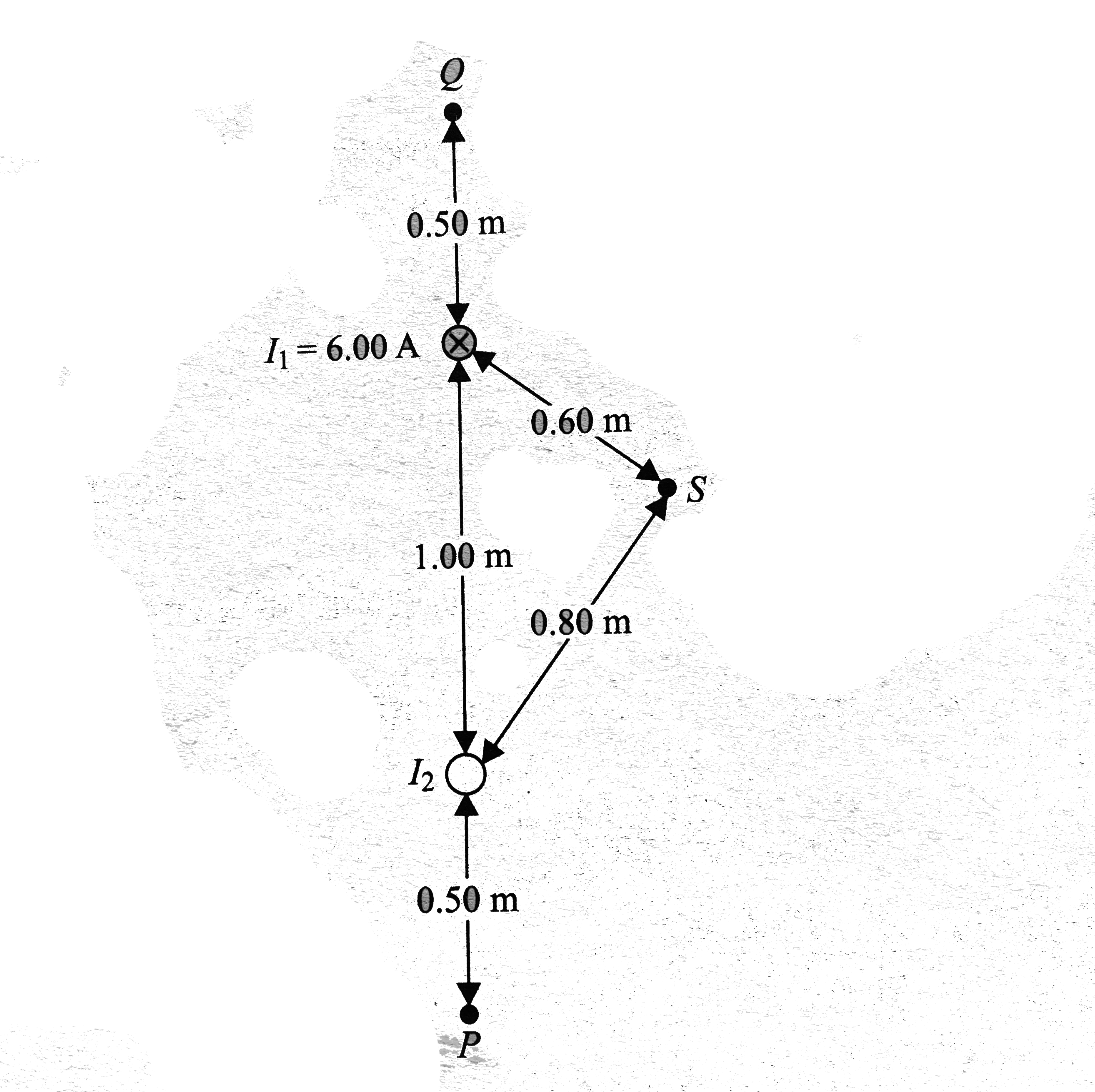
Two long, straight, parallel wires are 1.00m apart (as shown in Fig). The upper wire carries a current `I_1` of 6.00A into the plane of the paper.

What is the magnitude of the net field at S?

A

`4.1xx10^-6T`

B

`1.6xx10^-6T`

C

`3.2xx10^-6T`

D

`2.1xx10^-6T`

Text Solution

Verified by Experts

The correct Answer is:

D

(d) The magnitude of the field at S is given by the sum of the squres
of the two fields because they are at right angles. So,
`B_S=sqrt(B_1^2+B_2^2)=(mu_0)/(2pi)sqrt(((I_1)/(r_1))^2+((I_2)/(r_2))^2)`
`=(mu_0)/(2pi)sqrt(((6.00A)/(0.500m)-(2.00A)/(1.50m)))`
`=2.1xx10^-6T`
Promotional Banner

Topper's Solved these Questions

  • SOURCES OF MAGNETIC FIELD

    CENGAGE PHYSICS|Exercise Exercise (integer)|7 Videos
  • SOURCES OF MAGNETIC FIELD

    CENGAGE PHYSICS|Exercise Archives (fill In The Blanks)|1 Videos
  • SOURCES OF MAGNETIC FIELD

    CENGAGE PHYSICS|Exercise Exercise (assertion-reasioning )|2 Videos
  • SEMICONDUCTOR ELECTRONIC : MATERIALS, DEVICES AND SIMPLE CIRCUITS

    CENGAGE PHYSICS|Exercise QUESTION BANK|12 Videos
  • THERMAL PROPERTIES OF MATTER

    CENGAGE PHYSICS|Exercise Question Bank|40 Videos

Similar Questions

Explore conceptually related problems

Two long, straight, parallel wires are 1.00m apart (as shown in Fig). The upper wire carries a current I_1 of 6.00A into the plane of the paper. What is the magnitude of the net field at Q?

Two long, straight, parallel wires are 1.00m apart (as shown in Fig). The upper wire carries a current I_1 of 6.00A into the plane of the paper. What must the magnitude of the current I_2 be for the net field at point P to be zero?

Two long straight parallel wieres are 2m apart, perpendicular to the plane of the paper. The wire A carries a current of 9.6 A , directed into the plane of the paper. The wire B carries a current such that the magnetic field of induction at the point P , at a distance of 10/11 m from the wire B, is zero. find a. the magnitude and directiion of the current in B. b. the magnitude of the magnetic field of induction of the pont S . c. the force per unit length on the wire B .

Three long straight parallel wires are kept as shown in figure. The wire (3) carries a current I. (i) The direction of flow of current I in wire (3), is such that the net force, on wire (1), due to other two wires, is zero (ii) By reversing the direction of I, the net force, on the wire (2) due to the other two wires, becomes zero. What will be the directions of current I, in the two cases? Also obtain the relation between the magnitudes of current I_1 , I_2 and I.

Two long parallel wires are at a distance 2d apart. They carry steady equal currents flowing out of the plane of the paper , as shown. The variation of the magnetic field B along the line XX is given by

Two long parallel wires are at a distance 2d apart. They carry steady equal currents flowing out of the plane of the paper , as shown. The variation of the magnetic field B along the line XX is given by

Two long, straight wires a and b are 2*0 m apart, perpendicular to the plane of the paper as shown in figure . The wire a carries a current of 9*6 A directed into the plane of the figure,The magnetic field at the point P at a distance of 10/11 m from the wire b is zero. Find (a) the magnitude and direction of the current in b, (b) the magnitude of the magnetic field B at the point s and (c) the force per unit length on the wire b .

Two long straight horizontal parallel wires one above the other are separated by a distance '2a' . If the wires carry equal currents in opposite directions, the magnitude of the magnitude induction in the plane of the wires at a distance 'a' above the upper wire is

Figure 29-47 shows wire 1 in cross section, the wire is long and straight, carries a current of 2.50 mA out of the page, and is at distance d_(1)=4.00 cm from a surface. Wire 2 , which is parallel to wire 1 and also long, is at horizontal distance d_(2)=5.00 cm wire 1 and carries a current of 6.80 mA into the page. What is the x component of the magnetic force per unit length on wire 2 due to wire 1 ?

CENGAGE PHYSICS-SOURCES OF MAGNETIC FIELD-Exercise (linked Comprehension)
  1. There exists a long conductor along z-axis carrying a current I0 along...

    Text Solution

    |

  2. Curves in the graph shown in Fig. give, as function of radius distance...

    Text Solution

    |

  3. Curves in the graph shown in Fig. give, as function of radius distance...

    Text Solution

    |

  4. Curves in the graph shown in Fig. give, as function of radius distance...

    Text Solution

    |

  5. Ampere's law provides us an easy way to calculate the magnetic field d...

    Text Solution

    |

  6. Ampere's law provides us an easy way to calculate the magnetic field d...

    Text Solution

    |

  7. Ampere's law provides us an easy way to calculate the magnetic field d...

    Text Solution

    |

  8. According to Biot-Savarat's law, magentic field due to a straight curr...

    Text Solution

    |

  9. According to Biot-Savarat's law, magentic field due to a straight curr...

    Text Solution

    |

  10. In Fig. the circular and the straight parts of the wire are made of sa...

    Text Solution

    |

  11. In Fig. the circular and the straight parts of the wire are made of sa...

    Text Solution

    |

  12. Two long, straight, parallel wires are 1.00m apart (as shown in Fig). ...

    Text Solution

    |

  13. Two long, straight, parallel wires are 1.00m apart (as shown in Fig). ...

    Text Solution

    |

  14. Two long, straight, parallel wires are 1.00m apart (as shown in Fig). ...

    Text Solution

    |

  15. Figure shows an end view of two long, parallel wires perpendicular to ...

    Text Solution

    |

  16. Figure shows an end view of two long, parallel wires perpendicular to ...

    Text Solution

    |

  17. Figure shows an end view of two long, parallel wires perpendicular to ...

    Text Solution

    |

  18. Repeat the above problem, but with the current in both wires shown in ...

    Text Solution

    |

  19. Repeat the above problem, but with the current in both wires shown in ...

    Text Solution

    |

  20. Repeat the above problem, but with the current in both wires shown in ...

    Text Solution

    |
