Home
Class 12
PHYSICS
In a thin rectangular metallic strip a c...

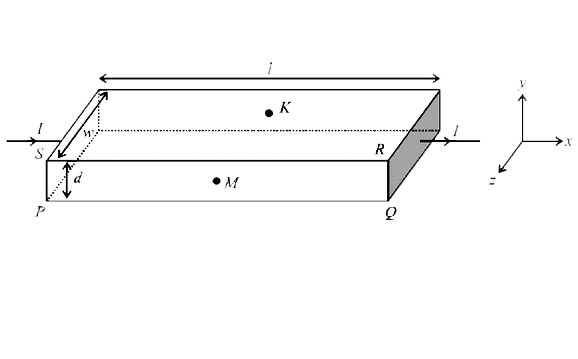
In a thin rectangular metallic strip a constant current `I` flows along the positive `x-direction` , as shown in the figure. The length , width and thickness of the strip are `l, w and d`, respectively.
A uniform magnetic field `vec(B)` is applied on the strip along the positive `y- direction` . Due to this, the charge carriers experience a net deflection along the `z- direction` . This results in accumulation of charge carriers on the surface `PQRS` ansd apperance of equal and opposite charges on the face opposite to `PQRS`. A potential difference along the `z-direction` is thus developed. Charge accumulation contiues untill the magnetic force is balanced by the electric force. The current is assumed to be uniformly distributed on the cross- section of the strip and carried by electrons.
Consider two different metallic strips `(1 and 2)` of the same material . Their lengths are the same,widths are `w_(1) and w_(2)` and thickness are `d_(1) and d_(2)` respectively. Two points `K and M` are symmetrically located on the opposite faces parallel to the ` x-y` plane ( see figure) . `V_(1) and V_(2)` are the potential differences between `K and M` in strips ` 1 and 2`, respectively . Then, for a given current `I` flowing through them in a given magnetic field strength `B`, the correct statement(s) is (are)

A

If `w_1=w_2 and d_1=2d_2, then V_2=2V_1`

B

If `w_1=w_2 and d_1=2d_2, then V_2=V_1`

C

If `w_1=2w_2 and d_1=d_2, then V_2=2V_1`

D

If `w_1=2w_2 and d_1=d_2, then V_2=V_1`

Text Solution

Verified by Experts

The correct Answer is:

A, D

(a,d): `qVB=Eq`
`E=VB i=n_0 eAVd`
`E=i/(n_0eA).B`
` E=(iB)/(n_0e(Wd))`
Potential difference : `V_(KM)=W.E`
`:. V_1=(iB)/(n_0 e)(1/(d_1))`
`V_2=(iB)/(n_0 e)(1/(d_2))`
`:. (V_1)/(V_2) =(d_2)/(d_1)`
Hence, (a) and (d).
Promotional Banner

Topper's Solved these Questions

  • SOURCES OF MAGNETIC FIELD

    CENGAGE PHYSICS|Exercise Archives (integer)|1 Videos
  • SOURCES OF MAGNETIC FIELD

    CENGAGE PHYSICS|Exercise Subjective type|11 Videos
  • SOURCES OF MAGNETIC FIELD

    CENGAGE PHYSICS|Exercise Archives (multiple Correct )|1 Videos
  • SEMICONDUCTOR ELECTRONIC : MATERIALS, DEVICES AND SIMPLE CIRCUITS

    CENGAGE PHYSICS|Exercise QUESTION BANK|12 Videos
  • THERMAL PROPERTIES OF MATTER

    CENGAGE PHYSICS|Exercise Question Bank|40 Videos

Similar Questions

Explore conceptually related problems

In a thin rectangular metallic strip a constant current I flows along the positive x-direction , as shown in the figure. The length , width and thickness of the strip are l, w and d , respectively. A uniform magnetic field vec(B) is applied on the strip along the positive y- direction . Due to this, the charge carriers experience a net deflection along the z- direction . This results in accumulation of charge carriers on the surface PQRS ansd apperance of equal and opposite charges on the face opposite to PQRS . A potential difference along the z-direction is thus developed. Charge accumulation contiues untill the magnetic force is balanced by the electric force. The current is assumed to be uniformly distributed on the cross- section of the strip and carried by electrons. Consider two different metallic strips (1 and 2) of same dimensions n_(1) and n_(2) , repectrively . Strip 1 is placed in magnetic field B_(1) and strip 2 is placed in magnetic field B_(2) , both along positive y- directions . Then V_(1) and V_(2) are the potential differences developed between K and M in strips 1 and 2 , respectively . Assuming that the current I is the same for both the strips, the correct option(s) is (are)

A uniform electric field and a uniform magnetic field are acting along the same direction in a certain region. If an electron is projected along the direction of the fields with a certain velocity then

Along the direction of current carrying wire, the value of magnetic field is ?

A proton is placed in a unifrom electric field directed along the positive x-axis. In which direction willl it tend to move?

Positively charged particles are projected into a magnetic field. If the direction of the magnetic field is along the direction of motion of the charged particles, the particles get
