Home
Class 12
PHYSICS
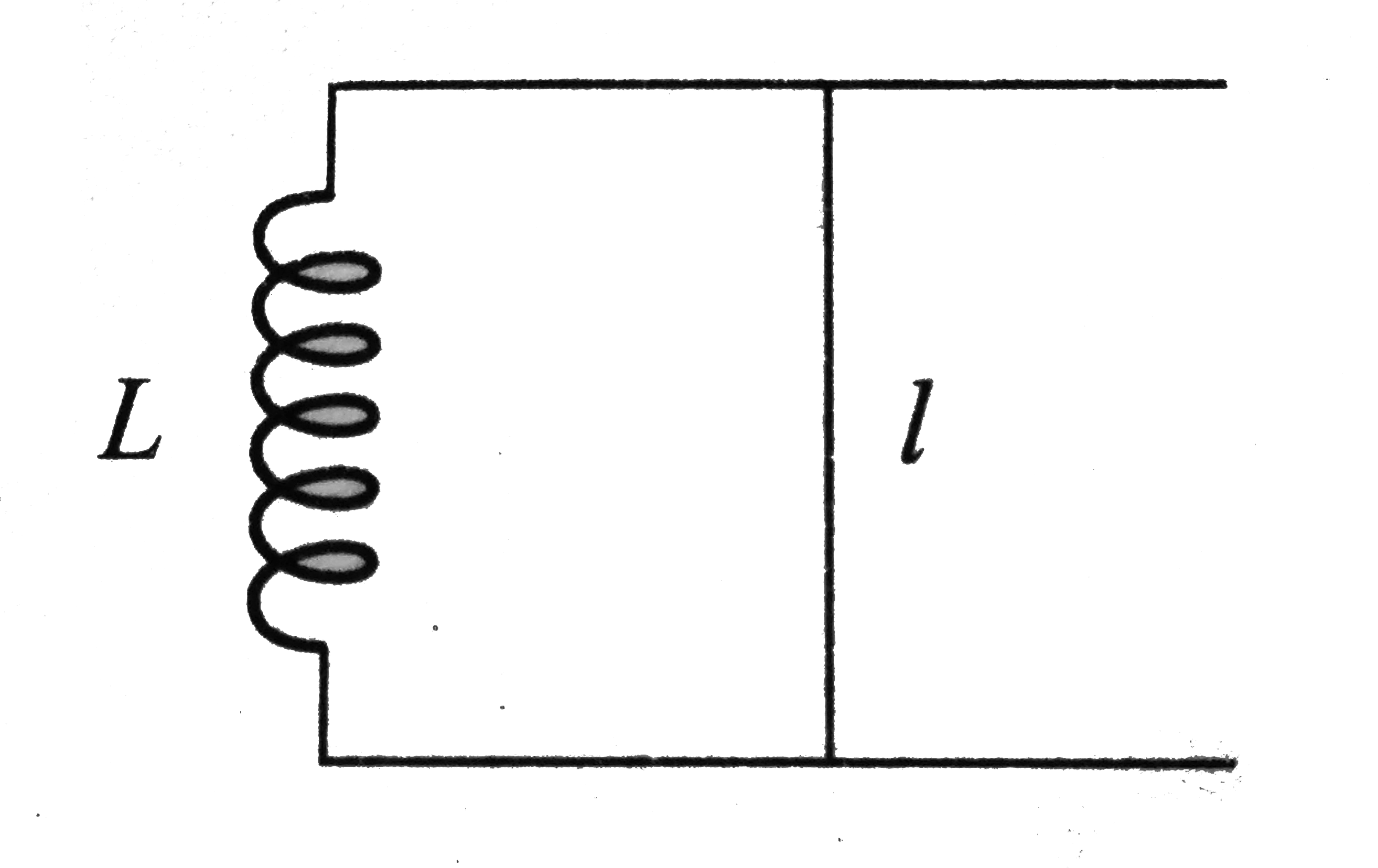
Two parallel resistanceless rails are co...

Two parallel resistanceless rails are connected by an inductor of inductance `L` at one end as shows in Fig. A magnetic field `B` exists in the space which is perendicular to the plane of the rails. Now a conductor of length `l` and mass `m` is placed transverse on the rail and given an inpulse `J` toward the rightward direction. Then choose the correct option (S).

A

Velocity of the conductor is half of the initial velocity after a displaacement of the conductor `d = sqrt((3J^(2)L)/(4B^(2)l^(2)m))`

B

Current flowing through the inductor at the instant when velocity of the conductor is half of the initial velocity is `i = sqrt((3J^(2))/(4Lm))`

C

Velocity of the conductor is half of the initial velocity after a displacement of the conductor `d = sqrt((3J^(2)L)/(B^(2)l^(2)m))`

D

Current flowing through the inductor at the instant when velocity of the conductor is half of the initial velocity is `i = sqrt((3j^(2))/(mL))`

Text Solution

Verified by Experts

The correct Answer is:

A, B

`L(di)/(dt) = B nu l rArr int di = (Bl)/(L) int nu dt rArr I = (Bl)/(L) x` (i)
`F = ma rArr - iBl = m nu (d nu)/(dx)`
`rArr -(B^(2)l^(2)x)/(L) = mnu (d nu)/(dx) rArr -(B^(2)l^(2))/(L) underset(0) overset(d) int x dx = underset(nu _(0)) overset(nu_(0)//2)int nu dnu`
`rArr -(B^(2)l^(2)d^(2))/(L) = (- 3 nu_(0)^(2))/(8), nu_(0) = (J)/(m)`
`rArr d = sqrt((3J^(2)L)/(4B^(2)l^(2)m))`
Put `x = d` in (i), `i = (Bl)/(L) sqrt((3J^(2)L)/(4B^(2)l^(2)m)) = sqrt((3J^(2))/(4Lm))`
Promotional Banner

Topper's Solved these Questions

  • INDUCTANCE

    CENGAGE PHYSICS|Exercise Exercises (assertion-reasoning)|2 Videos
  • INDUCTANCE

    CENGAGE PHYSICS|Exercise Exercises (linked Compreshension)|36 Videos
  • INDUCTANCE

    CENGAGE PHYSICS|Exercise Exercises (single Correct )|65 Videos
  • HEATING EFFECT OF CURRENT

    CENGAGE PHYSICS|Exercise Thermal Power in Resistance Connected in Circuit|28 Videos
  • KINETIC THEORY

    CENGAGE PHYSICS|Exercise Question Bank|31 Videos

Similar Questions

Explore conceptually related problems

Figure shows a wire sliding on two parallel, conducting rails placed at a separation L . A magnetic field B exists in a direction perpendicular to the plane of the rails. What force is necessary to keep the wire moving at a constant velocity V ?

Figure shows a wire of resistance R sliding on two parallel, conducting fixed thick rails placed at a separation l. A magnetic fild B exist in a direction perpendicular to the plane of the rails. The wire is moving with a constant velocity v. Find current through the wire

A conducting rod MN of mass m and length 'l' is placed on parallel smooth conducting rails connected to an uncharged capacitor of capacitance C and a battery of emf epsilon as shown. A uniform magnetic field B is existing perpendicular to the plane of the rails. The steady state velocity acquired by the conducting rod MN after closing switch S is (neglect the resistance of the parallel rails and the conducting rod)

A conducting wire xy of lentgh l and mass m is sliding without friction on vertical conduction rails ab and cd as shown in figure. A uniform magnetic field B exists perpendicular to the plane of the rails, x moves with a constant velocity of

Consider parallel conducting rails separated by a distance l. There exists a uniform magnetic field B perpendicular to the plane of the rails as shown in Fig. Two conducting wires each of length l are placed so as to slide on parallel conducting rails. One of the wires is given a velocity v_(0) parallel to the rails. Till steady state is achieved, loss in kinetic energy of the system is

Two long fixed parallel vertical conducting rails AB and CD are separated by a distance L. They are connected by resistance R and a capacitance C at two ends as shown in the figure. There is a uniform magnetic field B directed horizon- tally into the plane of the figure. A horizontal metallic bar of length L and mass m can slide without friction along the rails. The bar is released from rest at t = 0. Neglect resistance of bar and rails and also neglect the self inductance of the loop. (a) Find the maximum speed acquired by the bar after it is released. (b) Find the speed of the bar as a function of time t.

Two parallel long smooth conducting rails separated by a distance l are connected by a movable conducting connector of mass m . Terminals of the rails are connected by the resistor R and the capacitor C as shown in figure. A uniform magnetic field B perpendicular to the plane of the rail is switched on. The connector is dragged by a constant force F . Find the speed of the connector as a function of time if the force F is applied at t = 0 . Also find the terminal velocity of the connector.
