Home
Class 12
PHYSICS
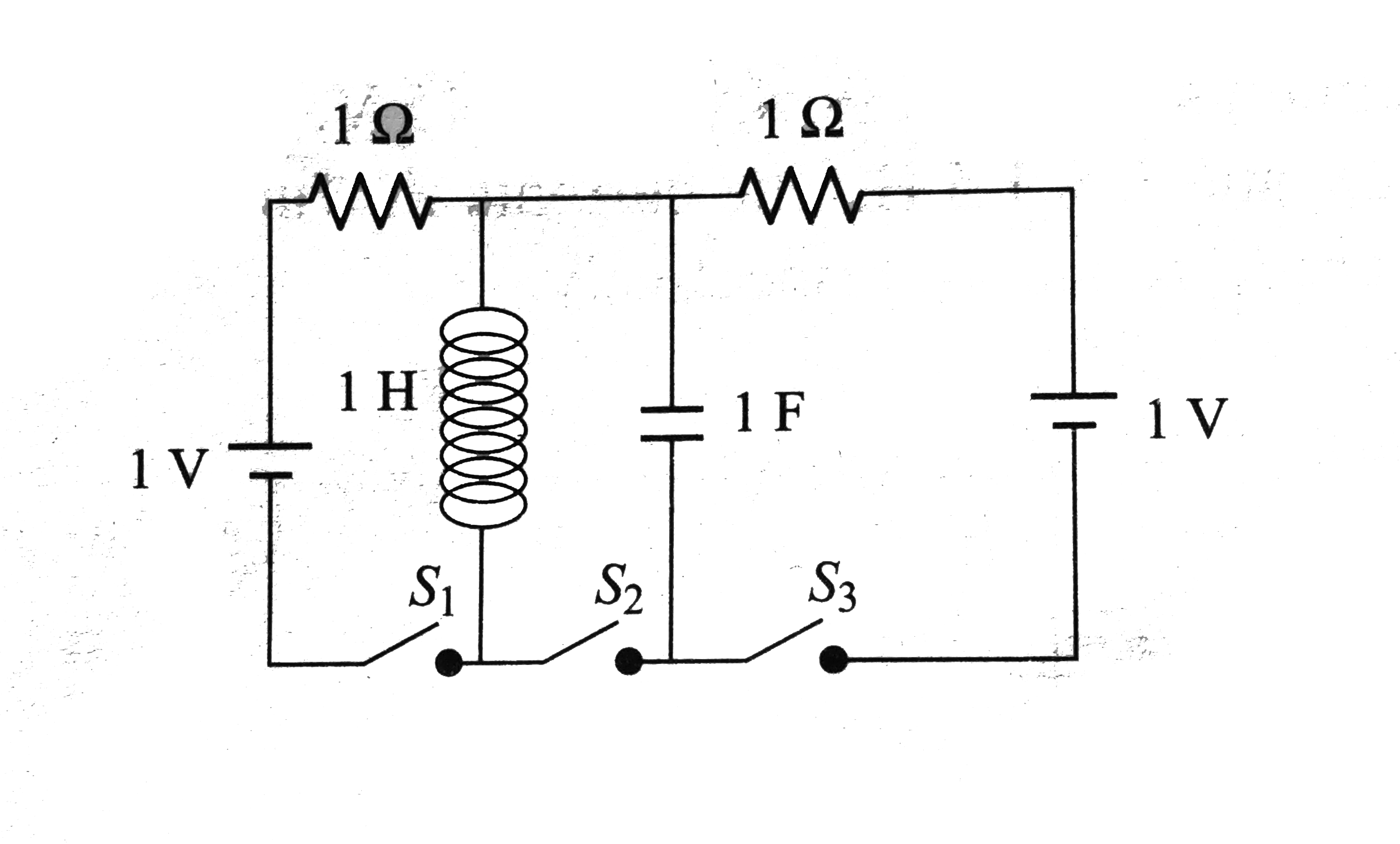
In the circuit shows (Fig.) switches S(1...

In the circuit shows (Fig.) switches `S_(1)` and `S_(3)` have been closed for `1 s` and `S_(2)` remained open. Just after `1 s`, switch `S_(2)` is closed and `S_(1)` and `S_(3)` are opened. Find after that instant `(t = 0)`:

the maximum current in the circuit containing inductor and capacitor (only `S_(2)` is closed)

A

`sqrt(3) (1 - (1)/(e))`

B

`sqrt(2) (1 - (1)/(e))`

C

`sqrt(3) (1 + (1)/(e))`

D

`sqrt(2) (1 + (1)/(e))`

Text Solution

Verified by Experts

The correct Answer is:
B

`S_(1)` and `S_(2)` are closed for `1 s`.
Charge on capacitor,
`q = CE (1 - e^(-t//RC)) = 1 - (1)/(e)` (i)
The current in inductor,
`I = (E)/(R ) (1 - e^(-t//RC)) = 1 - (1)/(e)`(ii)
Now `S_(1)` and `S_(3)` are opened and `S_(2)` is closed,
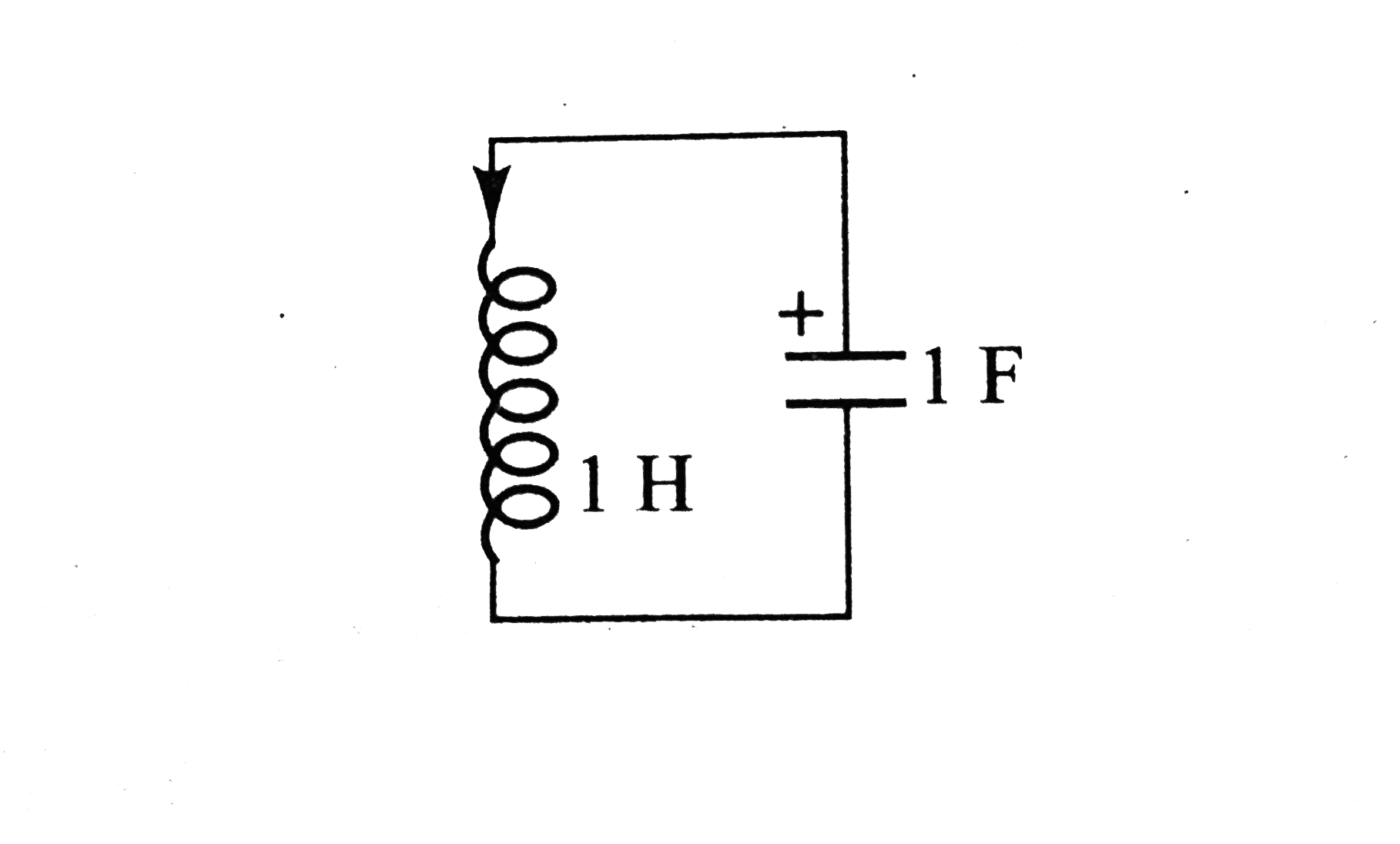
It is `LC` circuit,
`q = q_(max) sin (omegat + phi)` (iii)
`I = (q_(max)) omega cos(omegat + phi)` (iv)
As total energy (Magnetic + electrical) is constant
`(1)/(2) LI_(max)^(2) = (1)/(2)(q_(max)^(2))/(C) = (1)/(2) LI^(2) + (1)/(2) (q^(2))/(C)` (v)
`q_(max) = sqrt(2) (1 - (1)/(e))` (vi)
`I_(max) = sqrt(2) (1 - (1)/(e))` (vii)
From (iii) at `t = 0`, we get
`(1 - (1)/(e)) = sqrt(2) (1 - (1)/(e)) sin phi rArr = (pi)/(4)` or `(3pi)/(4)`
After closing `S_(2)`, circuit will be as shows. Direction of current shows that charge on capacitor will be decreaseing. Hence `phi = 3 pi//4`
`q = sqrt(2)(1 - (1)/(e)) sin(omegat + (3pi)/(4))`
where, `omega = (1)/(sqrt(LC)) = 1`
`q = sqrt(2) (1 - (1)/(e))sin(t + (3pi)/(4))`
Promotional Banner

Topper's Solved these Questions

  • INDUCTANCE

    CENGAGE PHYSICS|Exercise Exercises (integer)|8 Videos
  • INDUCTANCE

    CENGAGE PHYSICS|Exercise Archives (fills In The Blanks)|3 Videos
  • INDUCTANCE

    CENGAGE PHYSICS|Exercise Exercises (assertion-reasoning)|2 Videos
  • HEATING EFFECT OF CURRENT

    CENGAGE PHYSICS|Exercise Thermal Power in Resistance Connected in Circuit|28 Videos
  • KINETIC THEORY

    CENGAGE PHYSICS|Exercise Question Bank|31 Videos

Similar Questions

Explore conceptually related problems

In the circuit shows (Fig.) switches S_(1) and S_(3) have been closed for 1 s and S_(2) remained open. Just after 1 s , switch S_(2) is closed and S_(1) and S_(3) are opened. Find after that instant (t = 0) : the maximum charge on the capacitor

In the circuit shows (Fig.) switches S_(1) and S_(3) have been closed for 1 s and S_(2) remained open. Just after 1 s , switch S_(2) is closed and S_(1) and S_(3) are opened. Find after that instant (t = 0) : the charge on the upper plate of the capacitor as a funtion of time

In the circuit shown switches S_(1) and S_(2) have been closed for 1 sec and S_(2) remained open.Just after 1 second is over switch S_(2) is closed and S_(1),S_(3) are opened.Find after that instant The charge on the upper plate of the capacitor as function of time taking the instant of switching on of S_(2) and switching off all time switches to be t=0 is q=x xx10^(-2)cos (t+pi/4) .Findout value of x .

In the circuit shown in the figure, if switches S_(1) and S_(2) have been closed for a long time, then charge on the capacitor.

In a circuit S_(1) remains closed for a long time and S_(2) remain open. Now S_(2) is closed and S_(1) is opened. Find out the di//dt in the right loop just after the moment.

In the circuit shown in figure S_(1) is open and, S_(2) and S_(3) are closed. The circuit is in steady state. At time t = 0, switch S_(1) is closed and S_(2) and S_(3) are opened simultaneously. V = 100 "volt", R = 10 Omega, C = 100 muF, L = 0.03 H (a) Find the maximum charge that will appear on the capacitor at any time. (b) Find the time at which the charge on the capacitor will become zero for the first time.

In the circuit shown, S_(2) is closed first and is kept closed for a long time. Now S_(1) is closed. Just after that instant the current through S_(1) is

At t =0 switch S_1 is closed and remains closed for a long time and S_2 remains open. Now S_1 is opened and S_2 is closed. Find out Charge on the capacitor long after that moment.

CENGAGE PHYSICS-INDUCTANCE-Exercises (linked Compreshension)
  1. In the Figure shown i1=10e^(-2t) A, i2=4A and VC=3e^(-2t)V. Determine...

    Text Solution

    |

  2. In Fig i(1) = 10e^(-2t) A, i(2) = 4 A, and V(C) = 3e^(-2t) V. Th...

    Text Solution

    |

  3. In the circuit shows (Fig.) switches S(1) and S(3) have been closed fo...

    Text Solution

    |

  4. In the circuit shows (Fig.) switches S(1) and S(3) have been closed fo...

    Text Solution

    |

  5. In the circuit shows (Fig.) switches S(1) and S(3) have been closed fo...

    Text Solution

    |

  6. In the given (Fig.) all the symbols have their usual meanings. At t = ...

    Text Solution

    |

  7. In the given (Fig.) all the symbols have their usual meanings. At t = ...

    Text Solution

    |

  8. In the circuit shows in Fig E = 15 V, R(1) = 1Omega, R(2) = 1 Omega, R...

    Text Solution

    |

  9. In the circuit shows in Fig E = 15 V, R(1) = 1Omega, R(2) = 1 Omega, R...

    Text Solution

    |

  10. In the circuit shows in Fig E = 15 V, R(1) = 1Omega, R(2) = 1 Omega, R...

    Text Solution

    |

  11. In the given at t = 0, switch S is closed. The current through th...

    Text Solution

    |

  12. In the given at t = 0, switch S is closed. The energy stored in t...

    Text Solution

    |

  13. In the given at t = 0, switch S is closed. The energy stored in t...

    Text Solution

    |

  14. In Fig. there is a frame consisting of two square loops having resist...

    Text Solution

    |

  15. In Fig. there is a frame consisting of two square loops having resist...

    Text Solution

    |

  16. In Fig. there is a frame consisting of two square loops having resist...

    Text Solution

    |

  17. there in no current part of this circuit for time t lt o. Switch S is ...

    Text Solution

    |

  18. there in no current part of this circuit for time t lt o. Switch S is ...

    Text Solution

    |

  19. there in no current part of this circuit for time t lt o. Switch S is ...

    Text Solution

    |

  20. Two capacitors of capacitance C and 3C are charged to potential differ...

    Text Solution

    |

