Home
Class 12
PHYSICS
A point charges Q is moving in a circula...

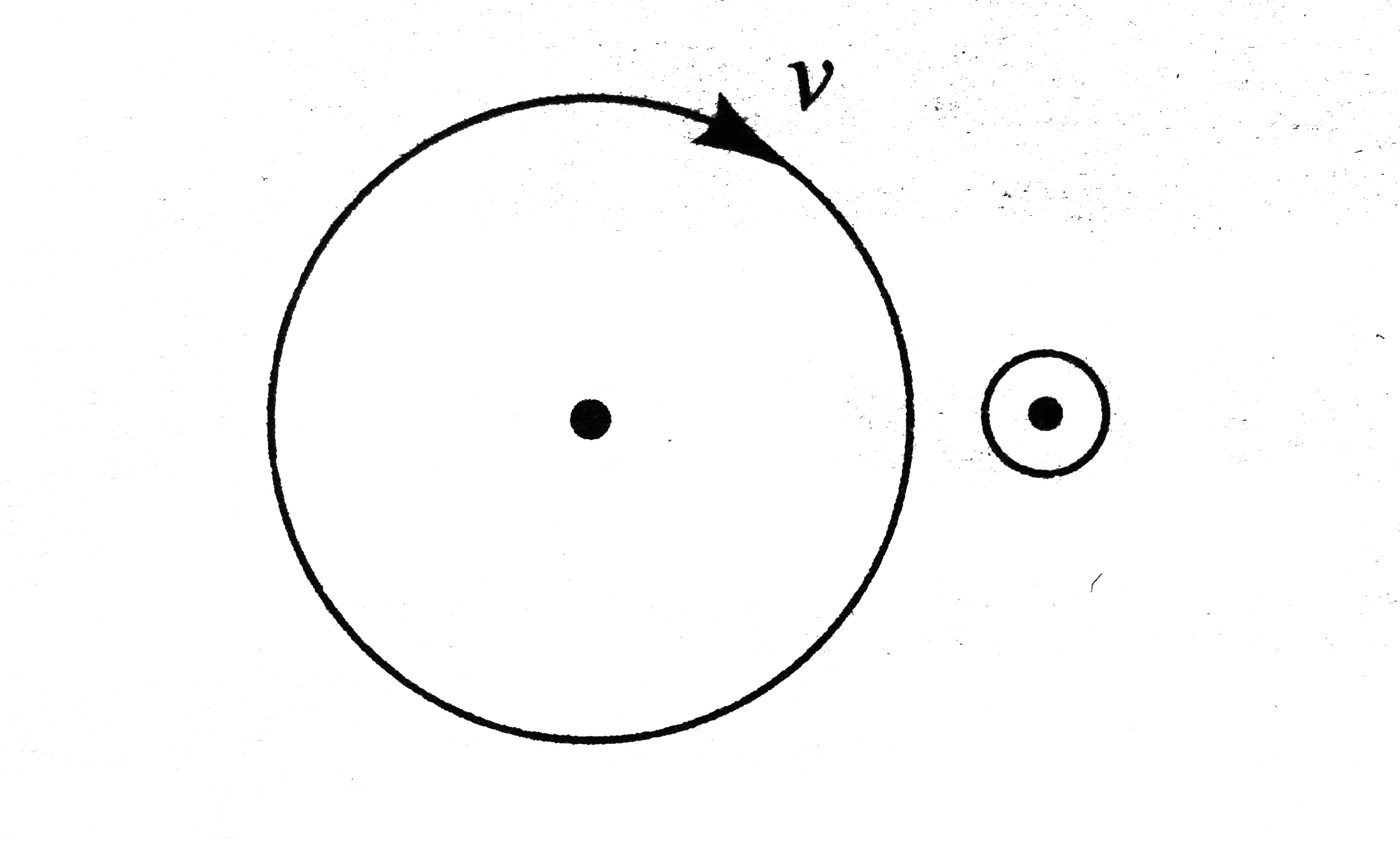
A point charges Q is moving in a circular orbit of radius R in the x-y plane with an angular velocity `omega`. This can be considered as equivalent to a loop carrying a steady current `(Q omega)/(2 pi)`. S uniform magnetic field along the positive z-axis is now switched on, which increases at a constant rate from 0 to B in one second. Assume that the radius of hte orbit remains constant. The application of hte magnetic field induces an emf in the orbit. The induced emf is defined as the work done by an induced electric field in moving a unit positive charge around a closed loop. It si known that, for an orbiting charge, the magnetic dipole moment is proportional to the angular momentum with a porportionality constant `lambda`.
The charge in the magnetic dipole moment associated with the orbit. at the end of the time interval of hte magnetic field charge, is

A

`-gamma BQR^(2)`

B

`-gamma(BQR^(2))/(2)`

C

`gamma(BQR^(2))/(2)`

D

`gammaBQR^(2)`

Text Solution

Verified by Experts

The correct Answer is:
B

`DeltaL = int tau dt`
`= Q((R )/(2)B) R(1) = (QR^(2)B)/(2)`, in magnitudein magnitude
`Delta mu = gamma DeltaL`
`= - gamma (BQR^(2))/(2)` (taking into account the direction)
Promotional Banner

Topper's Solved these Questions

  • INDUCTANCE

    CENGAGE PHYSICS|Exercise Archives (integer)|2 Videos
  • INDUCTANCE

    CENGAGE PHYSICS|Exercise Subective Type|2 Videos
  • INDUCTANCE

    CENGAGE PHYSICS|Exercise Archives (multiple Correct)|3 Videos
  • HEATING EFFECT OF CURRENT

    CENGAGE PHYSICS|Exercise Thermal Power in Resistance Connected in Circuit|28 Videos
  • KINETIC THEORY

    CENGAGE PHYSICS|Exercise Question Bank|31 Videos

Similar Questions

Explore conceptually related problems

A point charges Q is moving in a circular orbit of radius R in the x-y plane with an angular velocity omega . This can be considered as equivalent to a loop carrying a steady current (Q omega)/(2 pi) . S uniform magnetic field along the positive z-axis is now switched on, which increases at a constant rate from 0 to B in one second. Assume that the radius of hte orbit remains constant. The application of hte magnetic field induces an emf in the orbit. The induced emf is defined as the work done by an induced electric field in moving a unit positive charge around a closed loop. It si known that, for an orbiting charge, the magnetic dipole moment is proportional to the angular momentum with a porportionality constant lambda . The magnitude of the induced electric field in the orbit at any instant of time during the time interval of the mangnetic field change is

A particle moving along a circule path of radius 'r' with uniform angular velocity omega . Its angular acceleration is

The magnetic momenrt of a circular orbit of radius 'r' carrying a charge 'q' and rotating with velocity v is given by .

A particle of charge q and mass m moves in a circular orbit of radius r with angular speed omega . The ratio of the magnitude of its magnetic moment to that of its angular momentum depends on

An electron of charge e , revolves round in an orbit of radius r with a uniform angular velocity omega . The magnetic dipole moment of the electron in the orbit is

A particle of the charged q and mass m moves in a circular orbit of radius r with angular speed omega . The ratio of the magnitude of its magnetic moment to that of its angular momentum depends on

A particle of charge q and mass m moves in a circular orbit or radius r with angular speed omega . The ratio of the magnitude of its magnetic moment to that of its angular momentum depends on

