Home
Class 12
PHYSICS
In the series curcuit of fig, suppose R=...

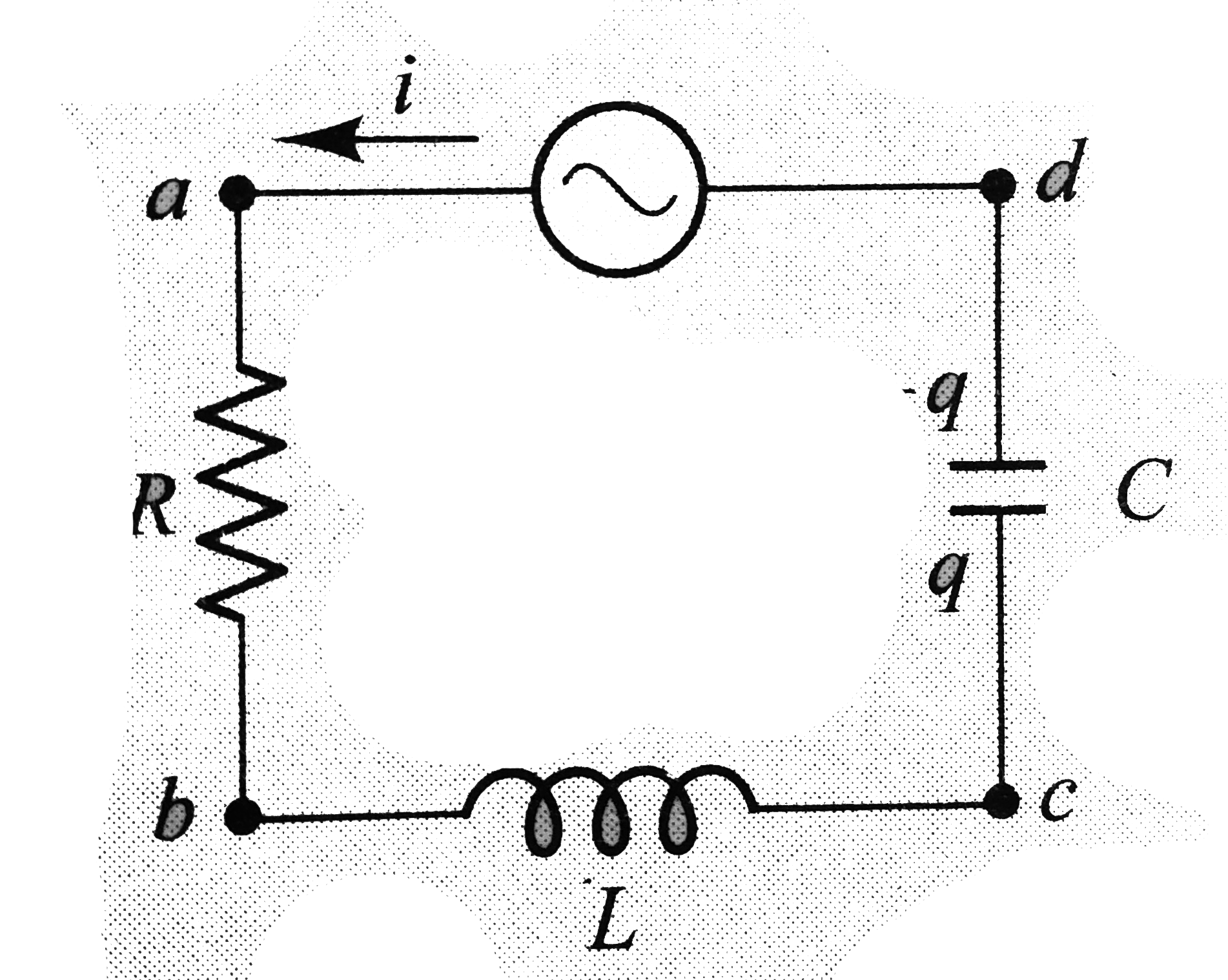
In the series curcuit of fig, suppose `R=300 Omega,L=60mH,C=0.50(mu)F`, source amplitude is `E_(0)=50V and omega=10000 rad s^(-1)`. Find the reactances `X_(L) and X_(C)`, the impedance Z, the current amplitude `I_(0)`, the phase angle `phi`, and the voltage amplitude across each circuit element.
.

Text Solution

Verified by Experts

The inducitive and capacitive reactances are
`X_(L)=(1)/(omega C)=(1)/((10,000 rad s^(-1))(0.50xx10^(-6)F))=200 Omega`
The impedances Z of the circuit is
`Z=sqrt(R^(2)+(X_(L)-X_(C))^(2))`
`=sqrt((300 Omega)^(2)+(600 Omega-200 Omega)^(2))=500 Omega`
With source voltage amplitude `E_(0)=50V`, The current amplitude
is `I_(0)=(E_(0))/(Z)=(50V)/(500Omega)=0.10A`
the phase angle `phi` is
`phi=tan^(-1)(X_(C)-X_(L))/(R )=tan^(-1)(-(400 Omega)/(300 Omega))=-53^(@)`
The voltage amplitudes `V_(R0), L_(L0), and V_(C0)` across the resister, inductor, and capacitor, respectively are
`V_(R0)=I_(0)R=(0.10A)(300 Omega)=30V`
`V_(L0)=I_(0)X_(L)=(0.10A)(200 Omega)=20V`
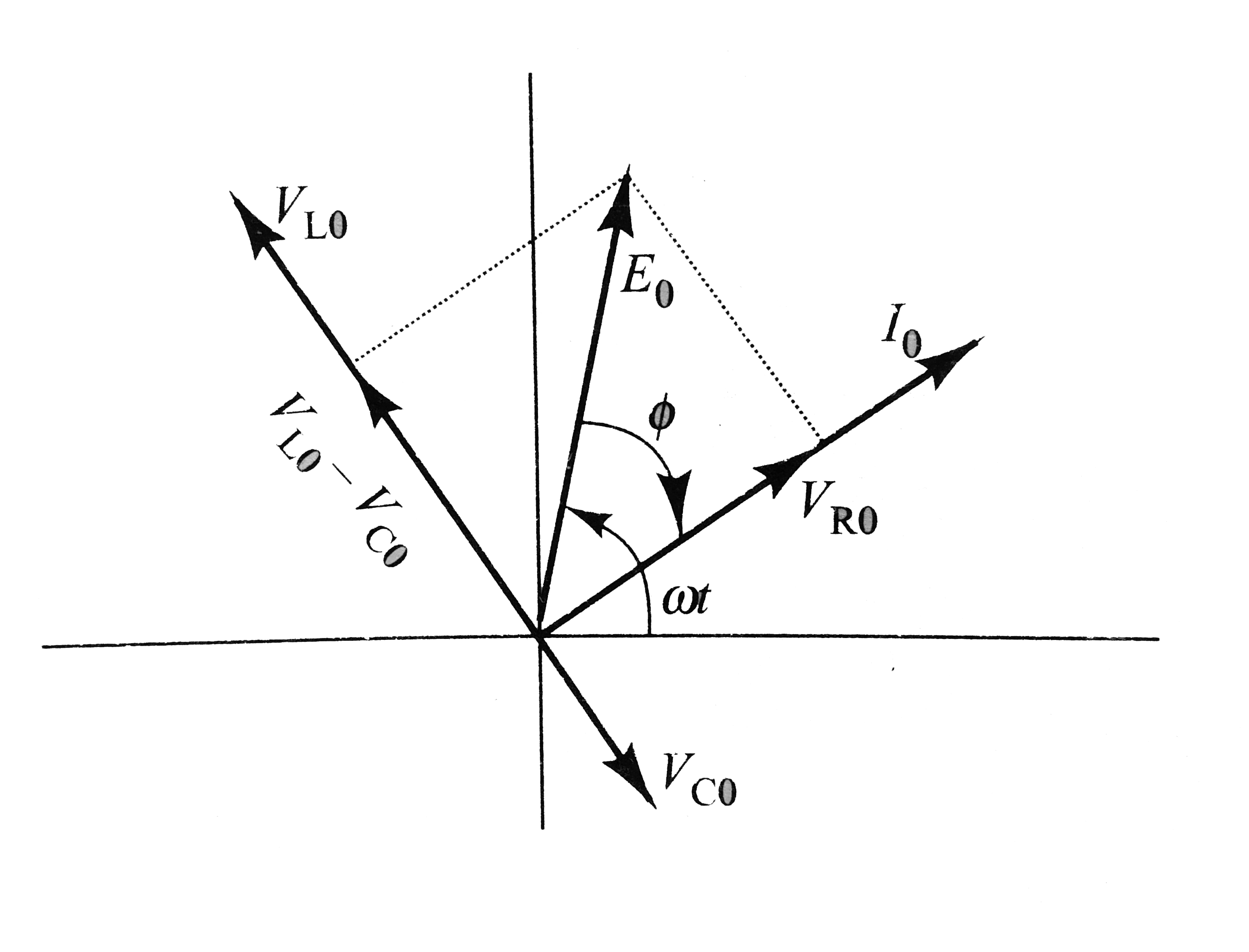
Note that `X_(L)gtX_(C)` and hebce the voltage amplitude across the inductor is greater than that across the capacitor and `phi` is negative. The value `phi=-53^(@)` means that the voltage leads the currents by `53^(@)`, this is like the situation shown in fig.
Note that the source voltage amplitude across the separate circuit elements (that is , 50V pi 30V+60V+0V`)
.
Promotional Banner

Topper's Solved these Questions

  • ALTERNATING CURRENT

    CENGAGE PHYSICS|Exercise Solved Examples|6 Videos
  • ALTERNATING CURRENT

    CENGAGE PHYSICS|Exercise Exercise 5.1|15 Videos
  • OSCILLATIONS

    CENGAGE PHYSICS|Exercise QUESTION BANK|39 Videos
  • ATOMIC PHYSICS

    CENGAGE PHYSICS|Exercise ddp.4.3|15 Videos

Similar Questions

Explore conceptually related problems

For a series RLC circuit R=X_(L)=2X_(C) . The impedance of the current and phase different (between) V and i will be

A series circuit consisting of a capacitor with capacitance C=22 mu F and a coil with active resistance R=20 Omega and iniductance L=0.35 H is connected to a source of alternating voltage with amplitude V_(m)=180 V and frequency omega=314 s^(-1) . Find : (a) the current amplitude in the circuit, (b) the phase difference between the current and the external voltage , (c) the amplitudes of voltage across the capacitor and the coil.

" In a series circuit "R=300Omega,L=0.9H,C=2.0 mu F" and "omega=1000rad/sec" ,The impendence of the circuit is "

In a series circuit R=300Omega, L=0.9H, C=2.0 muF and omega=1000rad//sec . The impedence of the circuit is

In a series RC circuit with an AC source, R = 300 Omega, C = 25 muF, epsilon_0 50 V and v = 50/((Pi) Hz . Find the peak current and the average power dissipated in the circuit.

In a series RC circuit, R = 30 ohm, C = 0.25 mu F , V = 100 V, omega = 10000 rad//s . Find the current in the circuit and calculate the voltage across the resistor and capacitor. Is the algebraic sum of these voltages more than the source voltage ? If yes, resolve the paradox.

An LCR series circuit is under resonance. If I_(m) is current amplitude, V_(m) is voltage amplitude, R is the resistance, Z is the impedance, X_(L) is the inductive reactance and X_(C ) is the capacitive reactance, then

A series circuit consisting of a capacitor X_(C) =80 Omega and a coil with active resistance R =300 Omega and inductance X_(L) =40 omega is connected to a source of alternating voltage with amplitude V_(0) =200 V Find (a) the current amplitude in the circuit (b) the phase difference between the current and voltage (c) the amplitudes of voltage across the capacitor and the coli .

Let R=200 Omega , C= 15.0 muF , L=230 mH , f_d = 60.0 Hz, and E_m =36.0 V . (These parameters are those used in the earlier sample problems). (a) What is the current amplitude I ?

CENGAGE PHYSICS-ALTERNATING CURRENT-QUESTION BANK
  1. In the series curcuit of fig, suppose R=300 Omega,L=60mH,C=0.50(mu)F, ...

    Text Solution

    |

  2. If the rms value of current i=3+4 sin (omega t+pi / 3) is x ampere, th...

    Text Solution

    |

  3. If the current in an A C circuit is given by i=2 sqrt(2) sin (pi t +pi...

    Text Solution

    |

  4. In the given figure, if i(1)=3 sin omega t and i(2)=4 cos omega t, the...

    Text Solution

    |

  5. A periodic voltage V varies with time t as shown in the figure. T is t...

    Text Solution

    |

  6. The effective value of current i=2 sin 100 pi+2 sin (100 pi t + 30^(ci...

    Text Solution

    |

  7. The voitage time (V-t) graph for triangular wave having peak value V(0...

    Text Solution

    |

  8. One cycle of an altemating curreat is shown in the graph. The rms vatu...

    Text Solution

    |

  9. In an AC circuit, a capacitor of capacitance C=(25)/(pi) mu F and a re...

    Text Solution

    |

  10. The secondary coil of an ideal step down transformer is delivering 500...

    Text Solution

    |

  11. An electrical device draws 2 KW power from (AC) mains (voltage 223 V m...

    Text Solution

    |

  12. A power transformer is used to step-up an slternating emf of 220 V tol...

    Text Solution

    |

  13. An inductor coil, a capacitor and an AC source of rms voltage 24V are ...

    Text Solution

    |

  14. In the circuit shown, switch is connected to position 1 for a very lon...

    Text Solution

    |

  15. The self inductance of a choke coil is 10mH. When it is connected to a...

    Text Solution

    |

  16. In an L C oscillator circait, L=10 (mH), C=40 mu (F). If initially at ...

    Text Solution

    |

  17. In a series CR circuit shown in the figure, the applied voltuge is 10 ...

    Text Solution

    |

  18. In the circuit shown, the rms value of the voltage across the capacito...

    Text Solution

    |

  19. In the series L C R circuit as shown in the figure, the heat developed...

    Text Solution

    |

  20. Maximum power loss (in watt) in the given circuit is '(##CENKSRPHYJE...

    Text Solution

    |

  21. As given in the figure, n series circuit coanected across a 200 V 60 H...

    Text Solution

    |