Home
Class 11
PHYSICS
A source of sound and detector are arran...


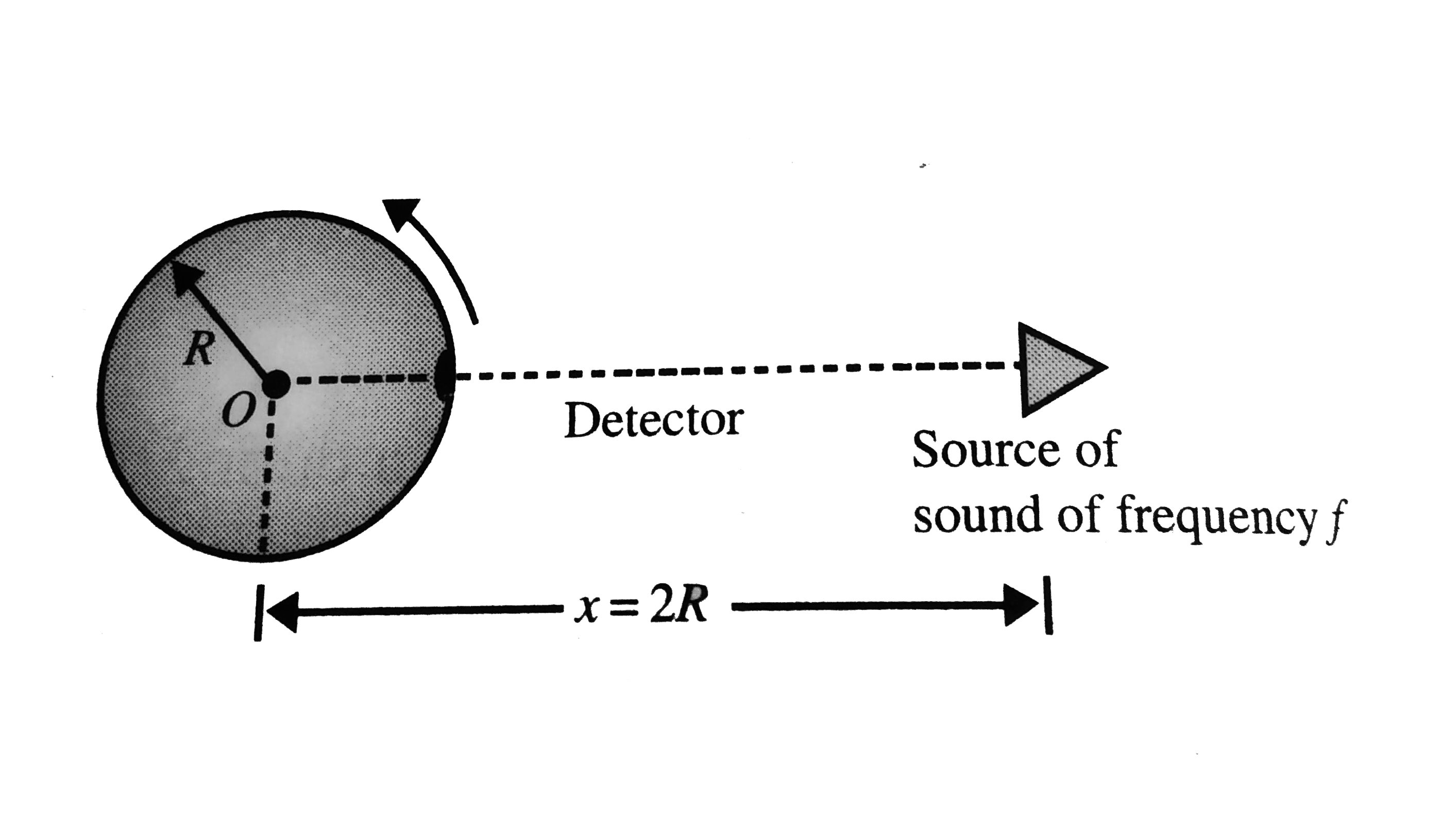
A source of sound and detector are arranged as shown in Fig. The detector is moving along a circle with constant angular speed `omega`. It start from the shown location in anticlockwise direction at `t=0`
(Take velocity of sound in air as v)
Find the time interval between minimum and maximum frequency as received by the detector.

A

`(pi)/((3omega))`

B

`(5pi)/((3omega))`

C

`(4pi)/((3omega))`

D

`(pi)/(omega)`

Text Solution

Verified by Experts

The correct Answer is:
C


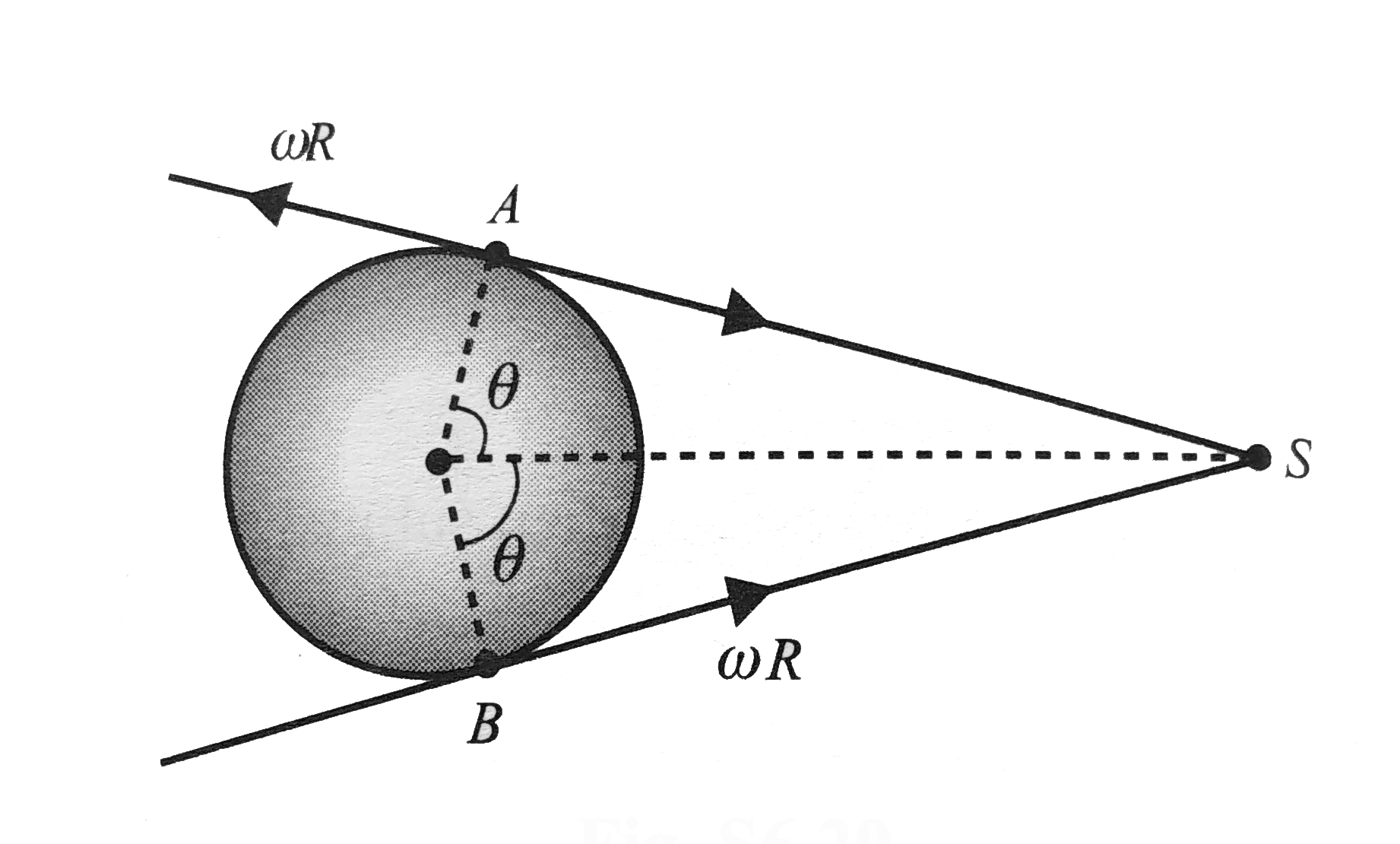
The instant at which the detector hears maximum and minimum frequencies are shown in Fig. A corresponds to minimum frequency while B corresponds to maximum frequency
`costheta=(R )/(2R)=(1)/(2)`
`impliestheta=(pi)/(3)`
Let the detector reaches A in time `t_0` (measured from the starting instant). then
`theta=omegat_0`
`implies(pi)/(3)=omegat_0`
`impliest_0=(pi)/(3omega)`
let the detector reaches B in time `t_(01)` (measured from A). Then,
`2pi-2theta=omegaxxt_(01)`
`impliest_(01)=(4pi)/(3omega)`
The time taken after which the detector hears the maximum frequency for the first time is
`t_0+t_(01)=(5pi)/(3omega)`
The interval between maximum and minimum frequencies as received by the detector for the first time is
`t_(01)=(4pi)/(3omega)`
Promotional Banner

Topper's Solved these Questions

  • SOUND WAVES AND DOPPLER EFFECT

    CENGAGE PHYSICS|Exercise Integer|16 Videos
  • SOUND WAVES AND DOPPLER EFFECT

    CENGAGE PHYSICS|Exercise Assertion-Reasoning|24 Videos
  • RIGID BODY DYNAMICS 2

    CENGAGE PHYSICS|Exercise Interger|2 Videos
  • SUPERPOSITION AND STANDING WAVES

    CENGAGE PHYSICS|Exercise Comprehension Type|5 Videos

Similar Questions

Explore conceptually related problems

A source of sound and detector are arranged as shown in Fig. The detector is moving along a circle with constant angular speed omega . It start from the shown location in anticlockwise direction at t=0 (Take velocity of sound in air as v) Q. Find the time at which the detector will hear the maximum frequency for the first time.

A source of sound and detector are arranged as shown in Fig. The detector is moving along a circle with constant angular speed omega . It start from the shown location in anticlockwise direction at t=0 (Take velocity of sound in air as v) What is the frequency as received by detector, when it rotates by an angle (pi)/(2) ?

A source is moving on a circle of radius 3m with constant angular velocity omega = 5 rad s^(-1) . If the observer is at a distance 5 cm from the centre of the circle, the time interval between the maximum and minimum frequency received by the observer is

A source of sound and detector are moving as shown in Fig. at t=0 . Take velocity of sound wave to be v . For this situation mark out the correct statement(s).

A sound source capable of producing sound of variable frequencies is located at a distance of 1 m from a reflecting wall as shown in the figure. A detector D is lying at a point shown in the figure. The various distances are also indicated. If the speed of sound in air is 340" "ms^(-1) , find the frequencies of sound within the audible range, which will have maximum intensity at detector?

A source of sound of frequency 256 Hz is rotating in a circle of radius 3 m with angular speed of 20 rad/s. A listener is standing at rest along the line of centre of the circle. Under which position of the source of sound the listener will hear sound of (a) maximum frequency (b) minimum frequency (c) same frequency as the frequency of source.

A source S emitting sound of 300 Hz is fixed of block A which is attached to free end of a spring S_A as shown in the figure. The detector D fixed on block B attached to the free end of spring S_B detects this sound. The blocks A and B are simultaneously displaced towards each other through of 1.0 m and then left to vibrate. Find the maximum and minimum frequencies of sound detected by D if the vibrational frequency of each block is 2 Hz (velocity of sound is 340 m/s).

An electron is at P t = 0 It is circulating in anticlockwise direction with a constant angular speed omega along the shown circular path. Magnetic field at Q(CQ = 2R , where R is radius of the circular) will be recorded as zero at times)

(a) A source of sound S and a detector D are placed at some distance from one another. A big cardboard is placed near the detector and perpendicular to the line SD as shown in figure. It is gradually moved away and it is found that the intensity changes from a maximum to a minimum as the board is moved through a distance of 20 cm. Find the frequency of the sound emitted. Velocity of sound in are is 336 m//s. (b) A source emitting sound of frequency 180 Hz is placed in front of a wall at a distance of 2 m from it. A detector is also placed in front of the wall at the same distance from it. find the minimum distance between the source and the detector for which the detector detects a maximum of sound . Speed of sound in air = 360 m//s.

A sound source, detector and a cardboard are arranged as shown in figure. The wave is reflected from the cardboard at the line symmetry of source edetector. Initially the path difference between the reflected wave and the direct wave is one third of the wavelength of sound. Find the minimum distance by which the cardboard should be moved upwards so that both waves are in phase.

CENGAGE PHYSICS-SOUND WAVES AND DOPPLER EFFECT-Comprehension
  1. A source of sound and detector are arranged as shown in Fig. The detec...

    Text Solution

    |

  2. A source of sound and detector are arranged as shown in Fig. The detec...

    Text Solution

    |

  3. A source of sound and detector are arranged as shown in Fig. The detec...

    Text Solution

    |

  4. As shown if Fig. a vibrating tuning fork of frequency 512 Hz is moving...

    Text Solution

    |

  5. As shown if Fig. a vibrating tuning fork of frequency 512 Hz is moving...

    Text Solution

    |

  6. As shown if Fig. a vibrating tuning fork of frequency 512 Hz is moving...

    Text Solution

    |

  7. As shown if Fig. a vibrating tuning fork of frequency 512 Hz is moving...

    Text Solution

    |

  8. A source of sound with natural frequency f0=1800Hz moves uniformly alo...

    Text Solution

    |

  9. A source of sound with natural frequency f0=1800Hz moves uniformly alo...

    Text Solution

    |

  10. A source of sound and a detector are placed at the same place on groun...

    Text Solution

    |

  11. A source of sound and a detector are placed at the same place on groun...

    Text Solution

    |

  12. A source of sound and a detector are placed at the same place on groun...

    Text Solution

    |

  13. A railroad train is travelling at 30(m)/(s) in still air. The frequenc...

    Text Solution

    |

  14. A railroad train is travelling at 30(m)/(s) in still air. The frequenc...

    Text Solution

    |

  15. A source of sonic oscillation with frequency n0=600Hz moves away and a...

    Text Solution

    |

  16. A source of sonic oscillation with frequency n0=600Hz moves away and a...

    Text Solution

    |

  17. A source of sonic oscillation with frequency n0=600Hz moves away and a...

    Text Solution

    |

  18. A source S of acoustic wave of the frequency v0=1700Hz and a receiver ...

    Text Solution

    |

  19. A source S of acoustic wave of the frequency v0=1700Hz and a receiver ...

    Text Solution

    |

  20. A small source of sound vibrating frequency 500 Hz is rotated in a cir...

    Text Solution

    |

