Home
Class 11
PHYSICS
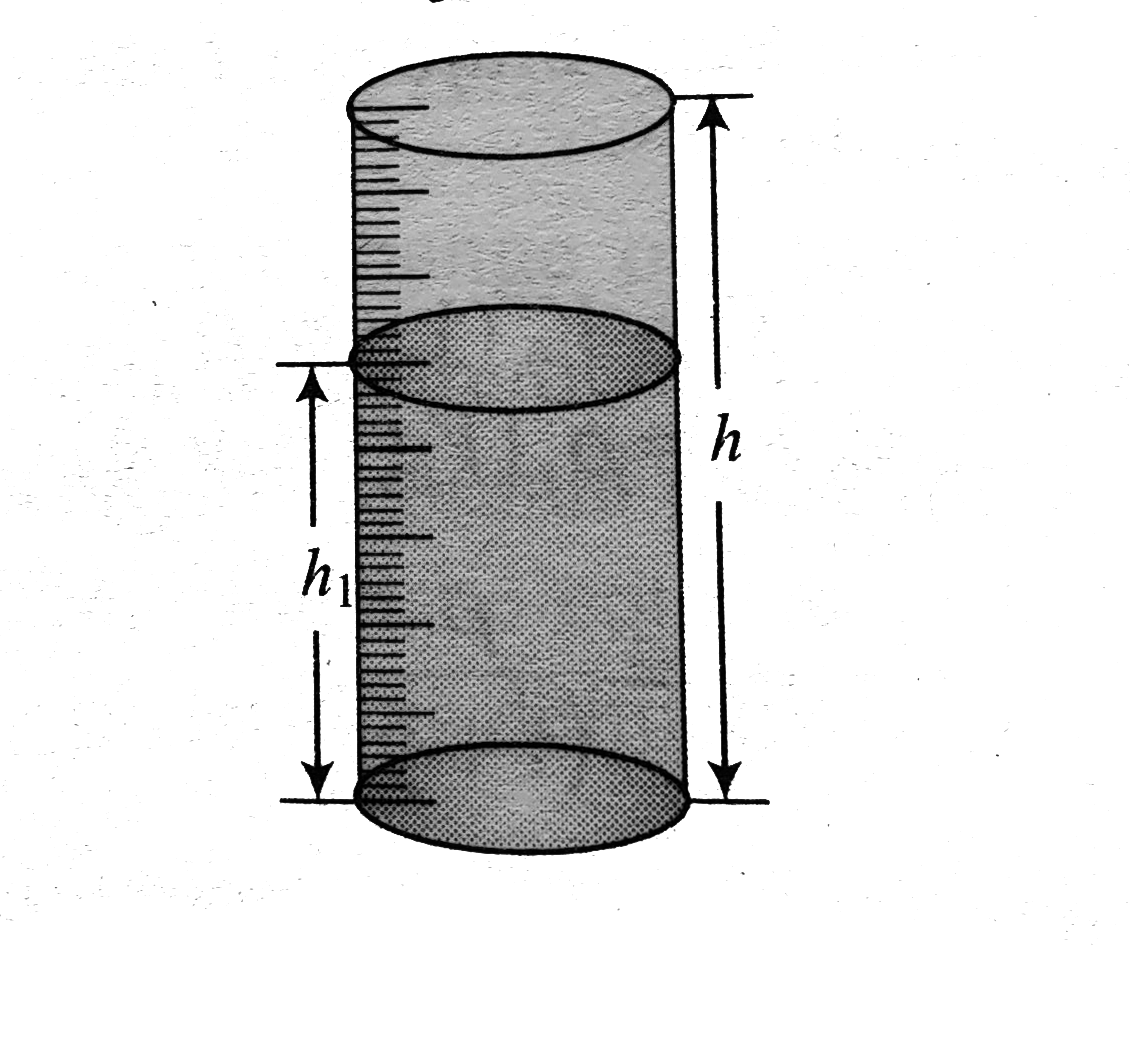
Consider a cylindrical container of cros...

Consider a cylindrical container of cross-section area A length h and having coefficient of linear expansion `alpha_(c)`. The container is filled by liquid of real expansion coefficient `gamma_(L)` up to height `h_(1)`. When temperature of the system is increased by `Deltatheta` then
(a). Find out the height, area and volume of cylindrical container and new volume of liquid.
(b). Find the height of liquid level when expansion of container is neglected.
(c). Find the relation between `gamma_(L)` and `alpha_(c)` for which volume of container above the liquid level
(i) increases
(ii). decreases
(iii). remains constant.
(d). On the surface of a cylindrical container a scale is attached for the measurement of level of liquid of liquid filled inside it. If we increase the temperature of the temperature of the system by `Deltatheta`, then
(i). Find height of liquid level as shown by the scale on the vessel. Neglect expansion of liquid.
(ii). Find the height of liquid level as shown by the scale on the vessel. Neglect expansion of container.

Text Solution

Verified by Experts

On increasing the temperature, the height area of cross section and volume of the cylinder will increase.
(a). New height `=h_(f)=h{1+alphaDeltatheta}`
New area of cross section `A_(f)=A{1+2alpha_(c)Deltatheta}`
New volume of container `V_(f)=Ah{1+3alpha(c)Deltatheta}`
New volume of liquid `V_(omega)=V_(0)(1+gamma_(L)Deltatheta)`
`V_(omega)=Ah_(1)(1+gamma_(L)Deltatheta)`
(b). The height of liquid level when expansion of container is neglected
`h_(f)=(V_(omega))/(A)=(Ah_(1)(1+Y_(L)Deltatheta))/(A)`
`impliesh_(f)=h_(1){1+gamma_(L)Deltatheta}`
(c). The initial volume of container above the liquid.
`DeltaV_(1)=Ah-Ah_(1)`
final volume of container above the liquid
`DeltaV_(2)=Ah(1+3alpha_(c)Deltatheta)-Ah_(1)(1+gamma_(L)Deltatheta)`
If volume of above container increases `DeltaV_(2)gtDeltaV_(1)`
`[Ah(1+3alpha_(c)Deltatheta)-Ah_(1)(1+gamma_(L)Deltatheta)]gt[Ah-Ah_(1)]`
Which gives `3halpha_(c)gth_(1)gamma_(L)`
Similarly, we can prove if the volume above container decreases, then `3halpha_(c)lth_(1)gamma_(L)` and for no change in volume 3 h `alpha_(c)=h_(1)gamma_(L)`
(d). The area of container will increase, the area of container at this temperature will be
`A_(f)=A{1+2alpha_(c)Deltatheta}`
As liquid does not expand the volume of the liquid wll be as initial volume `=Ah_(1)`
Hence height of the liquid column will be
`h_(1)^(`)=`(Ah_(1))/(A_(f))=(Ah_(1))/(A(1+2alpha_(c)Deltatheta))impliesh_(1)^(`)=`H_(1)(1-2alpha_(c)Deltatheta)`
. In this case we are neglecting the expansion of container. The volume of liquid at this temperature `
` `V_(omega^(`))`=`Ah_(1)(1+gamma_(L)Deltatheta)` `
` Hence height of the liquid in container is
`h_(f)`=`(V_(omega))/(A)`=`(Ah_(1)(1+gamma_(L)Deltatheta))/(A)` implies `h_(f)`=`h_(1)(1+gamma_(L)Deltatheta))/(A)`implies `h_(f)`=`h_(1)(1+gamma_(L)` `Deltatheta)`
Promotional Banner

Topper's Solved these Questions

  • CALORIMETRY

    CENGAGE PHYSICS|Exercise Exercise 1.1|23 Videos
  • CALORIMETRY

    CENGAGE PHYSICS|Exercise Exercise 1.2|22 Videos
  • BASIC MATHEMATICS

    CENGAGE PHYSICS|Exercise Exercise 2.6|20 Videos
  • CENTRE OF MASS

    CENGAGE PHYSICS|Exercise INTEGER_TYPE|1 Videos

Similar Questions

Explore conceptually related problems

A long cylindrical metal vessel of volume V and coefficient of linear expansion alpha contains a liquid. The level of liquid has not changed on heating. The coefficient of real expansion of the liquid is.

On heating a liquid of coefficient of cubical expansion gamma in a container having coefficient of linear expansion gamma//3 . The level of liquid in the container will

Ratio among linear expansion coefficient (c), area expansion coefficient (B) and volume expansion coefficient (Y) is

A liquid with coefficient of volume expansion gamma is filled in a container of a material having coefficient of linear expansion alpha . If the liquid overflows on heating, then

A solid cube is first floating in a liquid. The coefficient of linear expansion of cube is alpha and the coefficient of volume expansion of liquid is gamma . On increasing the temperature of (liquid + cube) system, the cube will sink if

A solid with coefficient of linear expansion aplha just floats in a liquid whose coefficient of volume expansion is gamma . If the system is heated, the solid will

A cube of coefficient of linear expansion alpah is floating in a bath containing a liquid of coefficeient of volume expansion gamma_(l) . When the temperature is raised by DeltaT , the depth upto which the cube is submerged in the liquid remains the same. Find relation between alpha and gamma_(l)

A cubical block of co-efficient of linear expansion alpha_s is submerged partially inside a liquid of co-efficient of volume expansion gamma_l . On increasing the temperature of the system by DeltaT , the height of the cube inside the liquid remains unchanged. Find the relation between alpha_s and gamma_l .
