Home
Class 11
PHYSICS
A composite block is made of slabs A,B,C...

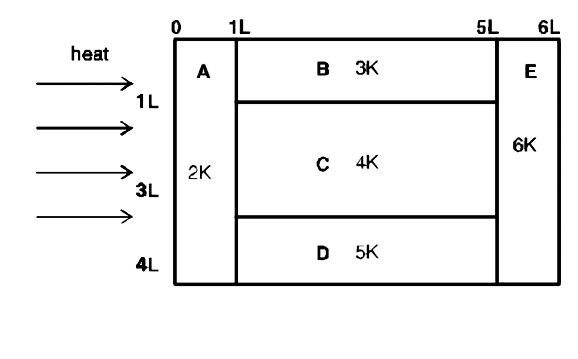
A composite block is made of slabs A,B,C,D and E of different thermal conductivities (given in terms of a constant K and sizes (given in terms of length, L) as shown in the figure. All slabs are of same width. Heat 'Q' flows only from left to right through the blocks. Then in steady state

A

Heat flow through slabs A and E is same

B

Heat flow through slab E is maximum

C

Temperature difference across slab E is smallest.

D

Heat flow through C= heat flow through B + heat flow through D.

Text Solution

Verified by Experts

The correct Answer is:

A, C, D

At steardy state, heat flow through `A` and `E` are same. So option `(a)` is correct and option `(b)` is incorrect.

c. `DeltaT=HxxR` , where `H` is heat currect. ltbr. `'H'` is same for `A` and `E` but `R` is smallest. So option `(c)` is corrcet
d. `H_(B)=(DeltaT)/(R_(B)),H_(C)=(DeltaT)/(R_(C))` and `H_(D)=(DeltaT)/(R_(D))` ,
From this option if, `H_(C)=H_(B)+H_(D)`
`implies (1)/(R_(C))=(1)/(R_(B))+(1)/(R_(D))`
`implies (4K(2Lb))/(4L)=(3K(Lb))/(4L)+(5K(Lb))/(4L)`
which is true. Here `b` is the wildth of slab.
Hence option `(d)` is also correct.
Promotional Banner

Topper's Solved these Questions

  • ARCHIVES 1 VOLUME 6

    CENGAGE PHYSICS|Exercise Assertion-Reasoning|1 Videos
  • ARCHIVES 1 VOLUME 6

    CENGAGE PHYSICS|Exercise Comprehension|3 Videos
  • ARCHIVES 1 VOLUME 6

    CENGAGE PHYSICS|Exercise Single Correct|54 Videos
  • ARCHIVES 2 VOLUME 6

    CENGAGE PHYSICS|Exercise Integer|4 Videos

Similar Questions

Explore conceptually related problems

The temperature of the two outer surfaces of a composite slab, consisting of two materials having coefficients of thermal conductivity K and 2K and thickness x and 4x respectively. Temperatures on the opposite faces of composite slab are T_(1) and T_(2) where T_(2)gtT_(1) , as shown in fig. what is the rate of flow of heat through the slab in a steady state?

A composite rod made of three rods of equal length and cross-section as shown in fig. The thermal conductivites of the materials of the rods are K//2 , 5K and K respectively. The end A and end B are at constant tempertures. All heat entering the face A goes out of the end B there being no loss of heat from the sides of the bar. The effective thermal conductivity of the bar is

Figure shows the cross section of a wall made of white pine of thickness L_(a) and brick of thickness L_(d) = = 2.0 L_(a) , sandwiching two layers of unknonw material with identical thicknesses and thermal conductivities. The thermal conductivity of the pine is k_(a) and that of the brick is k_(d) ( = 5.0k_(a)) . The face area A of the wall is unknown. Thermal conduction through the wall has reached the steady state, the only known interface temperatures are T_(1) = 25^(@)C, T_(2) = 20^(@)C , and T_(5 ) = - 10^(@)C . What is interface temperature T_(4) ?

Two bars of equal length and the same cross-sectional area but of different thermal conductivities, k_(1) and k_(2) , are joined end to end as shown in figure-4.36. One end of the composite bar is maintained at temperature T_(h) whereas the opposite end is held at T_(c) . If there are no heat losses from the sides of the bars, the temperature T_(j) of the junction is given by :

A composite cylinder is made of two materials having thermal conductivities K_(1) and K_(2) as shown. Temperature of the two flat faces of cylinder are maintained at T_(1) and T_(2) . For what ratio K_(1)//K_(2) the heat current throught the two materials will be same. Assume steady state and the rod is lagged (insulated from the curved surface).

One end of the rod of length l, thermal conductivity K and area of cross-section A is maintained at a constant temperature of 100^@C . At the other end large quantity of ice is kept at 0^@C . Due to temperature difference, heat flows from left end to right end of the rod. Due to this heat ice will start melting. Neglecting the radiation losses find the expression of rate of melting of ice. .
