Home
Class 11
PHYSICS
The figure below shows the variation of ...

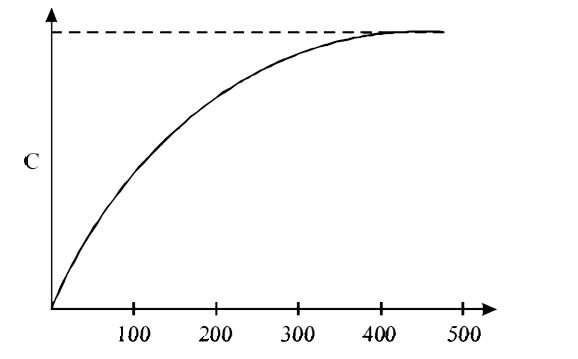
The figure below shows the variation of specific heat capacity (C) of a solid as a function of temperature (T). The temperature is increased continuously form 0 to 500K at a constant rate. Ignoring any volume change, the following statement (s) is (are) correct to a reasonable approximation.

A

the rate at which heat is absorbed in the range 0-100K varies linearly with temperature T.

B

heat absorbed in increasing the temperature from 0-100K is less than the heat required for increasing the temperature from 400-500K.

C

there is no change in the rate of heat absorption in range 400-500K.

D

the rate of heat absorption increases in the range 200-300K.

Text Solution

Verified by Experts

The correct Answer is:

A, B, C, D

Option `(a)` is correct because the graph between `(0-100K)` appears to be a straigh line upto a reasonable approximation.
Option `(b)` is correct because area under the curve in the temperature range `(0-100K.)`
Option (c) is correct because the graph of `C` versus `T` is constant in the temperature range `(400-500K)`
Option `(d)` is correct because in the temperature range `(200-300K)` specific heat capacity increases with temperature.
Promotional Banner

Topper's Solved these Questions

  • ARCHIVES 1 VOLUME 6

    CENGAGE PHYSICS|Exercise Assertion-Reasoning|1 Videos
  • ARCHIVES 1 VOLUME 6

    CENGAGE PHYSICS|Exercise Comprehension|3 Videos
  • ARCHIVES 1 VOLUME 6

    CENGAGE PHYSICS|Exercise Single Correct|54 Videos
  • ARCHIVES 2 VOLUME 6

    CENGAGE PHYSICS|Exercise Integer|4 Videos

Similar Questions

Explore conceptually related problems

The figure below shows the variation of specific heat capacity (C) of a solid as a function of temperature (T). The temperature is increased continuousely form 0 to 500K at a constant rate. Ignorign any volume change, the following statement (s) is (are) correct to a reasonable approximation.

The temperature change versus heat supplied curve is given for 1 kg of a solid block. Then which of the following statement(s) is/are correct:

Plots showing the variation of the rate constant (k) with temperature (T) are given below. The plot that follows the Arrhenius equation is

The specific heat of many solids at low temperatures varies with absolute temperature T according to the relation S=AT^(3) , where A is a constant. The heat energy required to raise the temperature of a mass m of such a solid from T = 0 to T = 20 K is

Electrical resistance of certain materials, known as superconductors, changes abruptly from a nonzero value of zero as their temperature is lowered below a critical temperature T_(C) (0) . An interesting property of super conductors is that their critical temperature becomes smaller than T_(C) (0) if they are placed in a magnetic field, i.e., the critical temperature T_(C) (B) is a function of the magnetic field strength B. The dependence of T_(C) (B) on B is shown in the figure. . In the graphs below, the resistance R of a superconductor is shown as a function of its temperature T for two different magnetic fields B_1 (solid line) and B_2 (dashed line). If B_2 is larget than B_1 which of the following graphs shows the correct variation of R with T in these fields?
