Home
Class 11
PHYSICS
A body A mass m(1) = 1 kg and body B of ...

A body A mass `m_(1) = 1 kg` and body B of mass `m_(2) = 4.1 kg`. The body A perform free vertical harmonic oscillations with the amplitude `1.6 cm` and frequency `25 Hz`. Neglecting the mass of the spring , find the maximum and m inimum value of force that the system exerts on the hearing surface.

Text Solution

Verified by Experts

The correct Answer is:
`(m_(1) + m_(2)) g - m_(1) omega^(2) A`

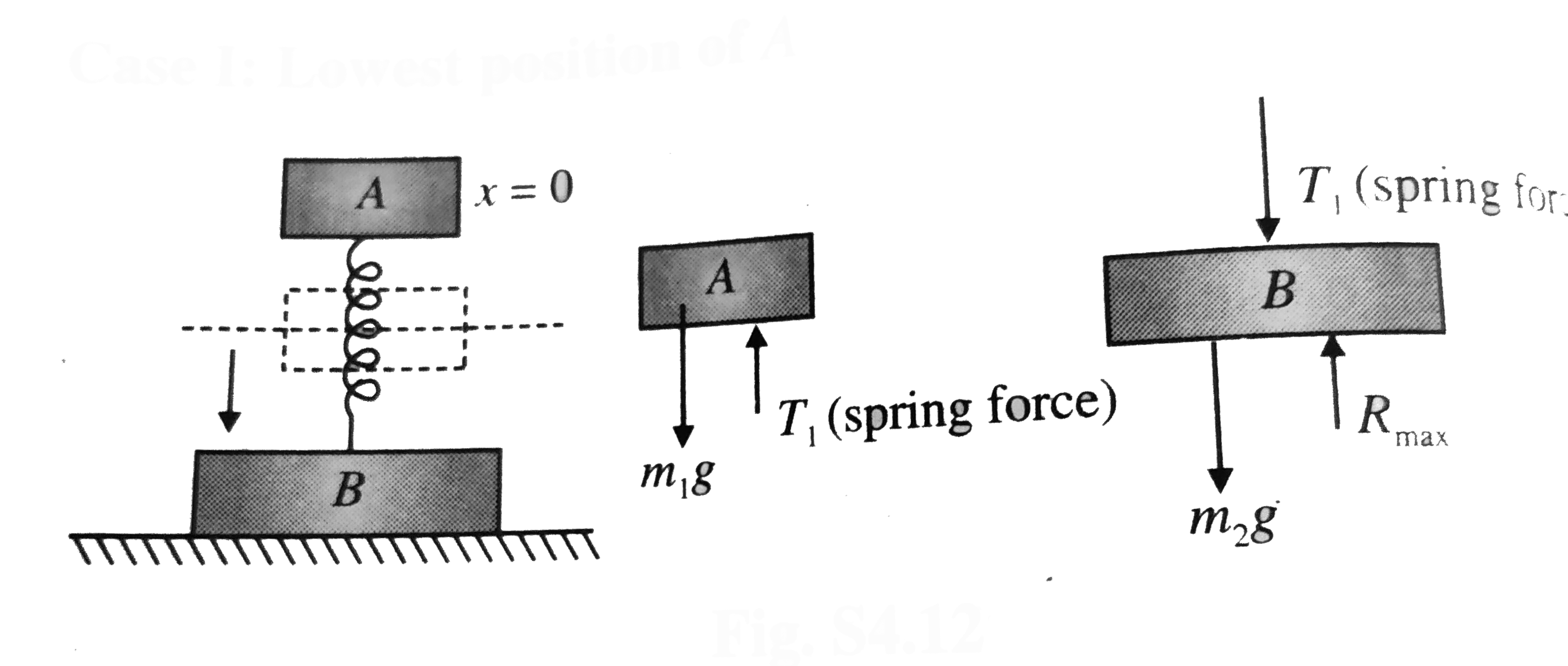
As A oscillates up and down , the normal reation berween B and the surface is maximum , where A is at position and it is minimum when A is at topmost position
Case I: Lowest position of A

Let `T_(1)` be the force in the compressed spring As B is at rest, `T_(1) - m_(2)g = R_(max)`
As acceleration of A is `omega^(2) A` towards mean position (up).
`T_(1) - m_(1)g = m_(1) omega^(2)`
Combining, ` R_(max) = (m_(1) + m_(2)) g + m_(2) omega^(2) A`
Case II: Topmost position of A

Let `T_(2)` be the tension in the elongated spring As B is at rest.
`T_(2) + R_(min) = m_(2) g`
Acceleration of A is `omega^(2) A` towards mean position (down).
`T_(2) - m_(1)g = m_(1) omega^(2) A`
Combining, we get `R_(min) = (m_(1) + m_(2)) g - m_(1) omega^(2) A`
Promotional Banner

Topper's Solved these Questions

  • LINEAR AND ANGULAR SIMPLE HARMONIC MOTION

    CENGAGE PHYSICS|Exercise Single Correct|107 Videos
  • LINEAR AND ANGULAR SIMPLE HARMONIC MOTION

    CENGAGE PHYSICS|Exercise Multiple Correct|35 Videos
  • LINEAR AND ANGULAR SIMPLE HARMONIC MOTION

    CENGAGE PHYSICS|Exercise Exercise 4.2|23 Videos
  • KINETIC THEORY OF GASES AND FIRST LAW OF THERMODYNAMICS

    CENGAGE PHYSICS|Exercise Interger|11 Videos
  • MISCELLANEOUS KINEMATICS

    CENGAGE PHYSICS|Exercise Interger type|3 Videos

Similar Questions

Explore conceptually related problems

A body A of mass m_(1)=1kg and a body B of mass m_(2)=4kg are attached to the ends of a spring. The body A performs vertical simple harmonic oscillations of amplitude a=1.6 cm and angular frequency omeg=25rads . Neglecting the mass of the sppring determine the maximum and minimum values of force the system exerts on the surface on which in rests. ["Take g"=10 m//s^(2)]

A body A of mass m_(1) and body B of mass m_(2) are interconnected by a massless spring as shown. The body A performs free vertical harmonic oscillations with the amplitude A and frequency f . The maximum value of f such that body B does not leave the surface is

Two bodies of masses m_1 and m_2(

A body A mass m_(1) exerts a force on another body B of mass m_(2) . If the acceleration of B be a_(2) , then the acceleration (in magnitude) of A is

A 0.5 kg body performs simple harmonic motion with a frequency of 2 Hz and an amplitude of 8 mm . Find the maximum velocity of the body, its maximum acceleration and the maximum restoring force to which the body is subjected.

A block of mass 0.5 kg hanging from a vertical spring executes simple harmonic motion of amplitude 0.1 m and time period 0.314s. Find the maximum fore exerted by the spring on the blockl.

A particle of mass 1 kg is moving in SHM with an amplitude 0.02 m and a frequency of 60 Hz. The maximum force (in N) acting on the particle is

A body of mass 2m is connected to another body of mass m as shown in figure. The mass 2m performs vertical S.H.M. Then find out the maximum amplitude of 2m such that mass m doesn't lift up from the ground.

A body of mass 1 kg suspended by a light vertical spring of spring constant 100 N/m executes SHM. Its angular frequency and frequency are

The scale of a spring balance reading from 0 to 10 kg is 0.25 m long. A body suspended from the balance oscillates vertically with a period of pi//10 second. The mass suspended is (neglect the mass of the spring)

CENGAGE PHYSICS-LINEAR AND ANGULAR SIMPLE HARMONIC MOTION-Subjective
  1. A rigid rod of mass m with a ball of mass M attached to the free end i...

    Text Solution

    |

  2. A rectangular tank having base 15 cm xx 20 cm is filled with water (de...

    Text Solution

    |

  3. A body A mass m(1) = 1 kg and body B of mass m(2) = 4.1 kg. The body A...

    Text Solution

    |

  4. In the arrangement shown in figure the sleeve M of mass m=0.20kg is f...

    Text Solution

    |

  5. A vertical pole of length l , density rho , area of cross section A fl...

    Text Solution

    |

  6. In the shown arrangement, both the spring are in their natural lengths...

    Text Solution

    |

  7. A uniform dise of mass m and radius R is connected with two light spri...

    Text Solution

    |

  8. Consider a liquid which fills a uniform U - tube uniform U- tube, as s...

    Text Solution

    |

  9. A particle of mass m is located in a unidimensional potential field wh...

    Text Solution

    |

  10. A particle of mass 2 kg is moving of a straight line under the actin f...

    Text Solution

    |

  11. A body of mass m hangs from a smooth fixed pulley P(1) by the inextens...

    Text Solution

    |

  12. A block of mass m connected with a smooth prismatic wedge of mass m is...

    Text Solution

    |

  13. A stepped pulley having mass m redius of gyration k is connected with ...

    Text Solution

    |

  14. A stepped dies of mass M and radius R is pivoted at its center C smoot...

    Text Solution

    |

  15. A disc of mass m hanged by a string is attached at P and a spring of s...

    Text Solution

    |

  16. A uniform cylinder of length (L) and mass (M) having cross sectional a...

    Text Solution

    |

  17. Disregading gravity, find the period of oscillation of the partical co...

    Text Solution

    |

  18. A smooth of mass m(1) is lying on a rigid horizontal string A bob of m...

    Text Solution

    |

  19. A smooth piston of mass m area of cross - section A is in equilibrium ...

    Text Solution

    |

  20. If velocity of a partical moving along a straight line changes sinuso...

    Text Solution

    |