Home
Class 11
PHYSICS
In the shown arrangement, both the sprin...

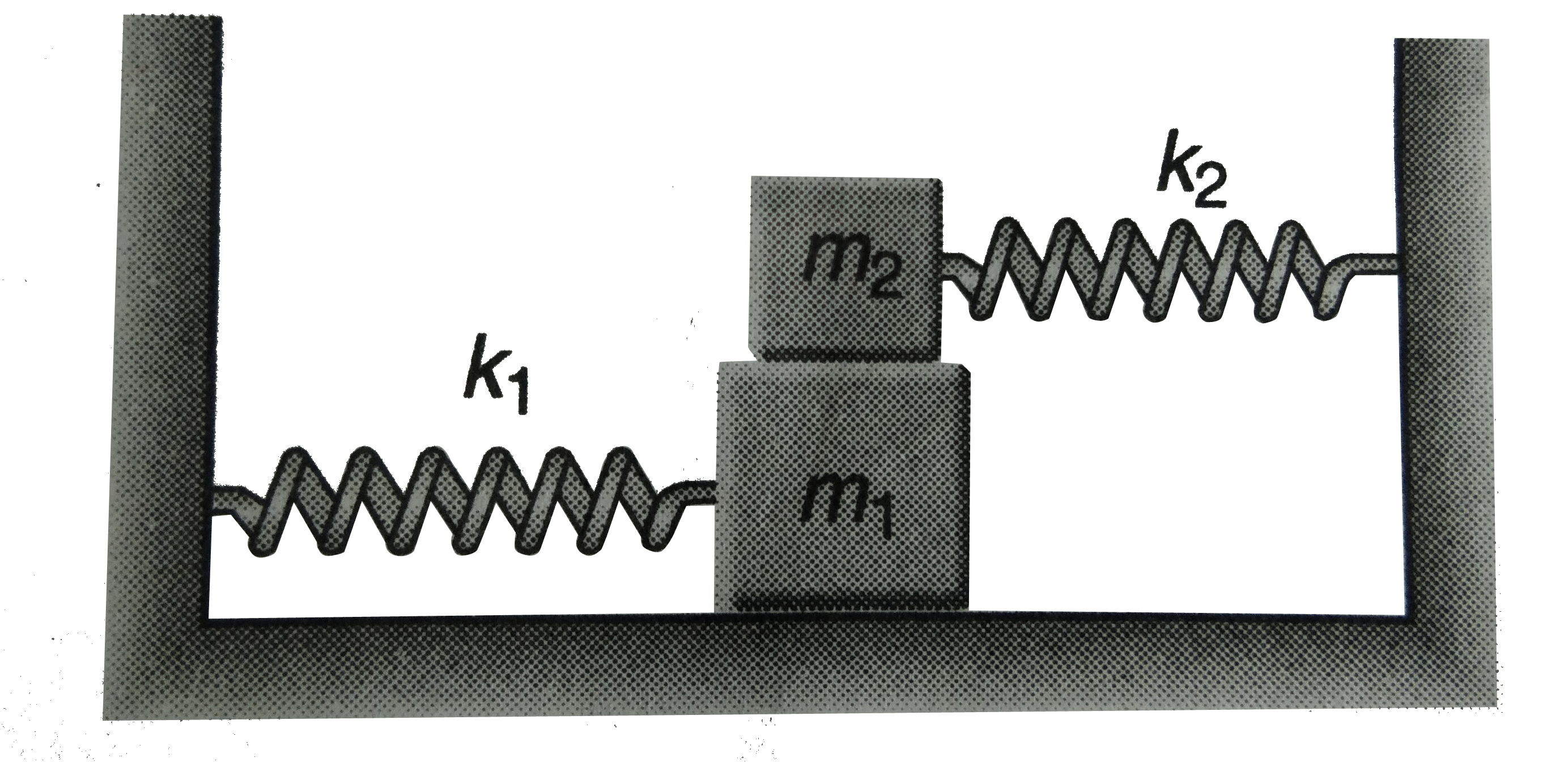
In the shown arrangement, both the spring are in their natural lengths. The coefficient of friction between `m_(2)` and `m_(1)` is `mu`. There is no friction between `m_(1)` and the surface. If the blocks are displaced slightly, they together perform simple harmonic motion. Obtain

(a) Frequency of such oscillations.
(b) The condition if the friction force on clock `m_(2)` is to act in the direction of its displacement from mean position.
( c) If the condition obtained in (b) is met, what can be maximum of their oscillations ?

Text Solution

Verified by Experts

The correct Answer is:
`(1)/(2 pi) sqrt((K_(1) + K_(2))/(m_(1) + m_(2)))`

a. For the oscillation of the blocks together, the equivalent, force constant equals `K_(1) + K_(2)` and hence the frequency
`A = (1)/(2 pi) sqrt((K_(1) + K_(2))/(m_(1) + m_(2)))`
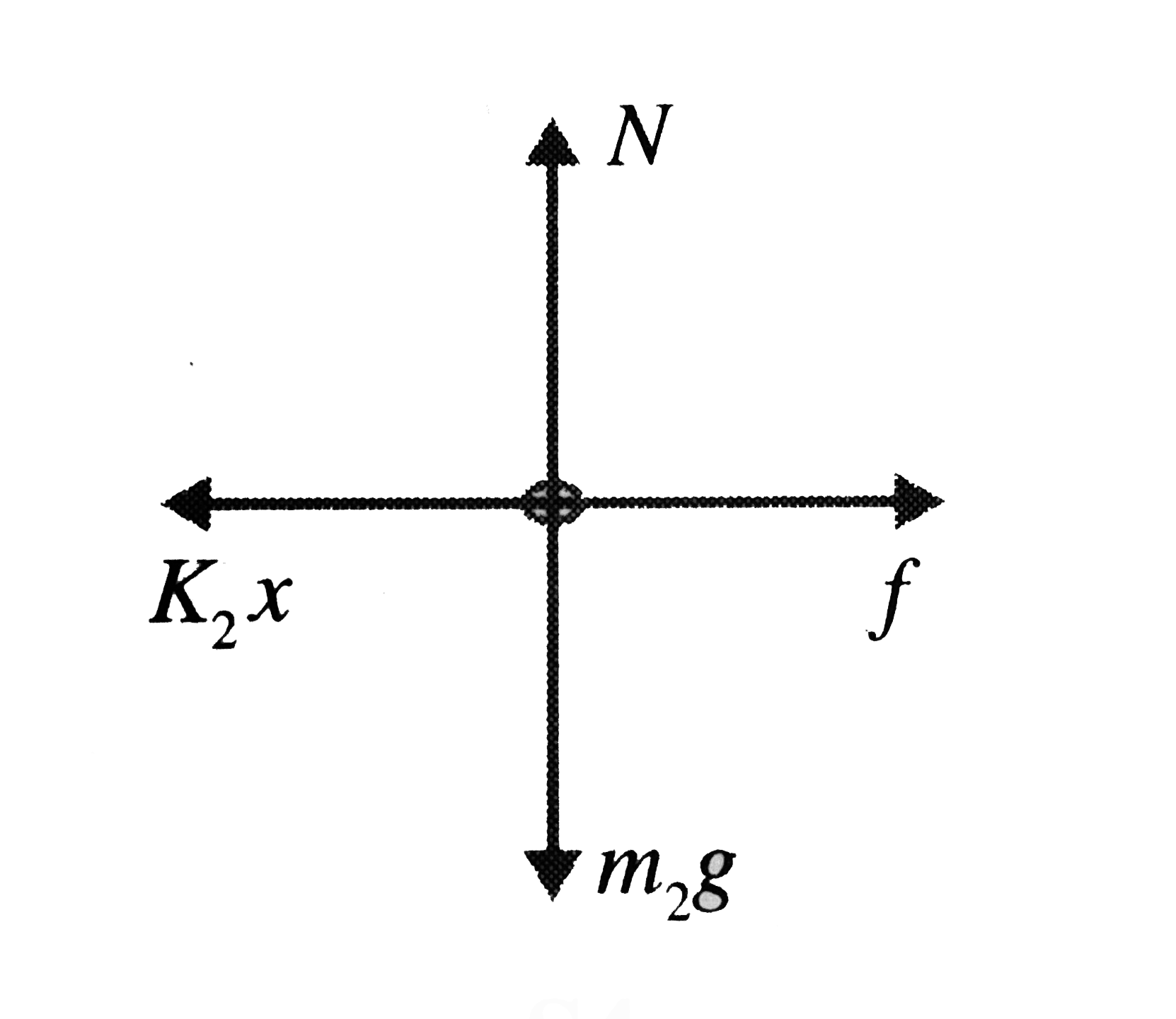
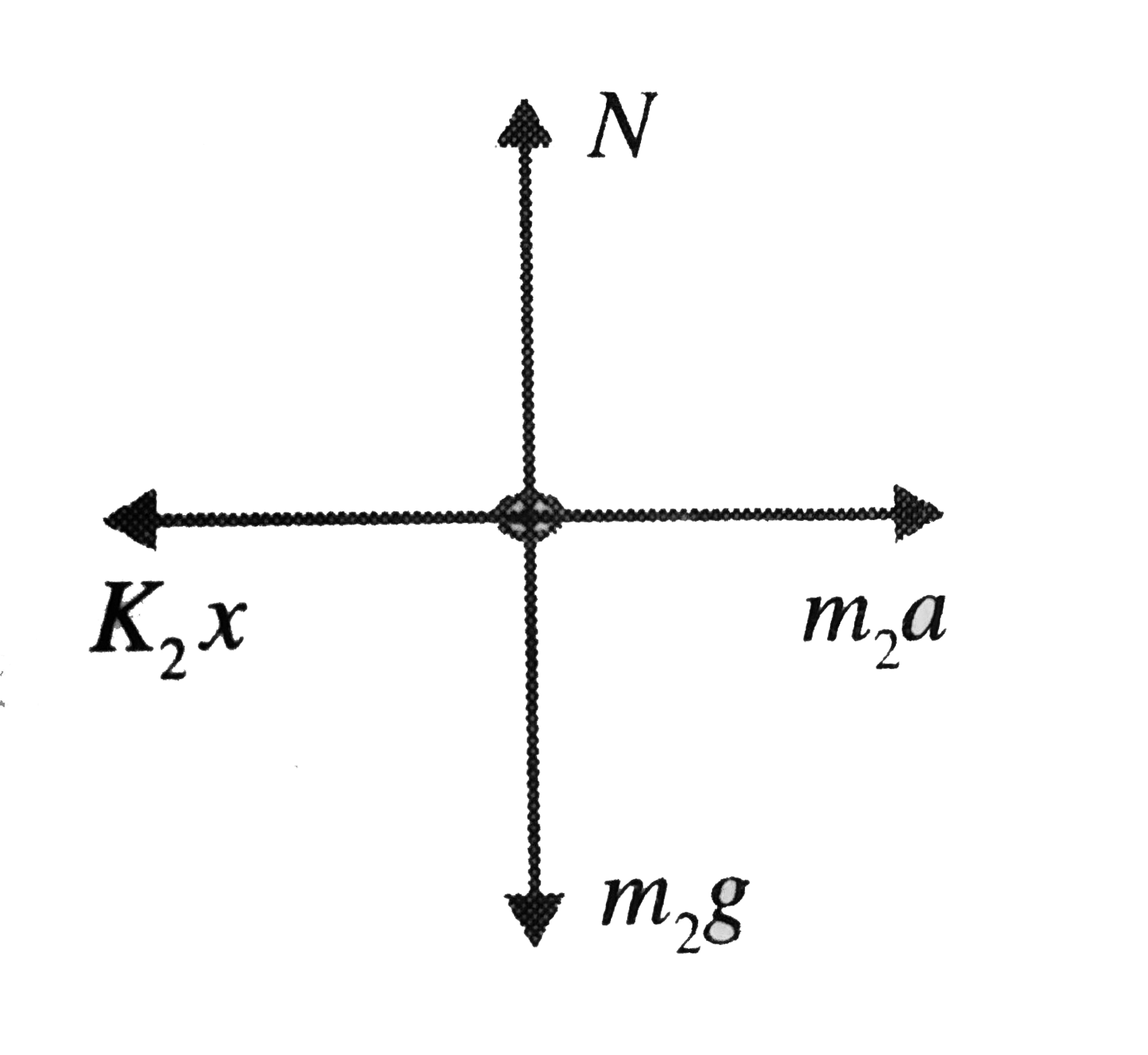
b. Assuming that the block `(m_(1) + m_(2))` are displaced towards right, the various forces (except the frictional force) on `m_(2)`, in the reference frame of `m_(1)` are shown in the following free body diagram.

where `a = ((K_(1) + K_(2)x)/(m_(1) + m_(2)))`
For the frictional force to act on `m_(2)` in the direction of its displacement
`K_(2)x gt m_(2) [(K_(1) + K_(2))/(m_(1) + m_(2))]x`
`m_(1) K_(2) + m_(2) K_(2) - m_(2) K_(2) gt 0`
`m_(1) K_(2) - m_(2) K_(1) gt 0`
`(m_(1))/(m_(2)) gt (K_(1))/(K_(2))`
The above inequality is in the desired condition.
c.
Assuming `(m_(1))/(m_(2)) gt (K_(1))/(K_(2))` the FBD of `m_(2)` with `m_(1)` and` m_(2)`
together displacement towardsright can be shown as

If A be the amplitude of oscillation of `m_(2) K_(2) A - f = m_(2) omega^(2) A` (for the exterme position)
`f = K_(2) A - m_(2) omega^(2) A implies f = A (K_(2) - m_(2) omega^(2))`
`f le mu m_(2) g implies mu m_(2) g ge A (K_(2) - m_(2) omega^(2))`
`A le (mu m_(2) g)/((K_(2) - m_(2) omega^(2))) implies A_(max) = ((mu m_(2) g)/((K_(2) - m_(2) omega^(2))))`
Here `omega^(2) =m ((K_(1) + K_(2)))/((m_(1) + m_(2))) , A_(max) = ((mu m_(2) g (m_(1) + m_(2)))/(m_(1) K_(2) - m_(2) K_(1)))`
Promotional Banner

Topper's Solved these Questions

  • LINEAR AND ANGULAR SIMPLE HARMONIC MOTION

    CENGAGE PHYSICS|Exercise Single Correct|107 Videos
  • LINEAR AND ANGULAR SIMPLE HARMONIC MOTION

    CENGAGE PHYSICS|Exercise Multiple Correct|35 Videos
  • LINEAR AND ANGULAR SIMPLE HARMONIC MOTION

    CENGAGE PHYSICS|Exercise Exercise 4.2|23 Videos
  • KINETIC THEORY OF GASES AND FIRST LAW OF THERMODYNAMICS

    CENGAGE PHYSICS|Exercise Interger|11 Videos
  • MISCELLANEOUS KINEMATICS

    CENGAGE PHYSICS|Exercise Interger type|3 Videos

Similar Questions

Explore conceptually related problems

(i) In the shown arrangement, both springs are relaxed. The coefficient of friction between m_(2) " and " m_(1) is mu . There is no friction between m_(1) and the horizontal surface. The blocks are displaced slightly and released. They move together without slipping on each other. (a) If the small displacement of blocks is x then find the magnitude of acceleration of m_(2) . What is time period of oscillations ? (b) Find the ratio (m_(1))/(m_(2)) so that the frictional force on m_(2) acts in the direction of its displacement from the mean position. (ii) Two small blocks of same mass m are connected to two identical springs as shown in fig. Both springs have stiffness K and they are in their natural length when the blocks are at point O. Both the blocks are pushed so that one of the springs get compressed by a distance a and the other by a//2 . Both the blocks are released from this position simultaneously. Find the time period of oscillations of the blocks if - (neglect the dimensions of the blocks) (a) Collisions between them are elastic. (b) Collisions between them are perfectly inelastic.

In the arrangement shown in figure, coefficient of friction between the two blocks is mu=1//2 . The force of friction acting between

The coefficient of friction between m_(2) and inclined plane is mu (shown in the figure). If (m_(1))/(m_(2))=sin theta then

The coefficient of friction between the block A of mass m & block B of mass 2m is mu . There is no friction between A & B is released from rest & there is no slipping between A & B then:

A mass m rests under the action of a force F as shown in the figure-2.158 on a horizontal surface. The coefficient of friction between the mass and the surface is mu . The force of friction between the mass and the surface is :

If coefficient of friction between both the block is mu- (1)/(2) . Find friction force acting between both block.

A pendulum of mass m and length L is connected to a spring as shown in figure. If the bob is displaced slightly from its mean position and released, it performs simple harmonic motion. The angular frequency of the oscillation of bob is

The coefficient of friction between block of mass m and 2m is mu=2tantheta . There is no friction between block of mass 2 m and inclined plane. The maximum amplitude of the two block system for which there is no relative motion between both the blocks is

The coefficient of friction between the block A of mass m and the triangular wedge B of mass M is mu . There in no friction between the wedge and the plane if the system (block A+ wedge B) is released so that there is no stiding between A and B find the inclination theta

Calculate angle of friction between wedge and block system is at rest M coefficient of friction between wedge and block.

CENGAGE PHYSICS-LINEAR AND ANGULAR SIMPLE HARMONIC MOTION-Subjective
  1. A rectangular tank having base 15 cm xx 20 cm is filled with water (de...

    Text Solution

    |

  2. A body A mass m(1) = 1 kg and body B of mass m(2) = 4.1 kg. The body A...

    Text Solution

    |

  3. In the arrangement shown in figure the sleeve M of mass m=0.20kg is f...

    Text Solution

    |

  4. A vertical pole of length l , density rho , area of cross section A fl...

    Text Solution

    |

  5. In the shown arrangement, both the spring are in their natural lengths...

    Text Solution

    |

  6. A uniform dise of mass m and radius R is connected with two light spri...

    Text Solution

    |

  7. Consider a liquid which fills a uniform U - tube uniform U- tube, as s...

    Text Solution

    |

  8. A particle of mass m is located in a unidimensional potential field wh...

    Text Solution

    |

  9. A particle of mass 2 kg is moving of a straight line under the actin f...

    Text Solution

    |

  10. A body of mass m hangs from a smooth fixed pulley P(1) by the inextens...

    Text Solution

    |

  11. A block of mass m connected with a smooth prismatic wedge of mass m is...

    Text Solution

    |

  12. A stepped pulley having mass m redius of gyration k is connected with ...

    Text Solution

    |

  13. A stepped dies of mass M and radius R is pivoted at its center C smoot...

    Text Solution

    |

  14. A disc of mass m hanged by a string is attached at P and a spring of s...

    Text Solution

    |

  15. A uniform cylinder of length (L) and mass (M) having cross sectional a...

    Text Solution

    |

  16. Disregading gravity, find the period of oscillation of the partical co...

    Text Solution

    |

  17. A smooth of mass m(1) is lying on a rigid horizontal string A bob of m...

    Text Solution

    |

  18. A smooth piston of mass m area of cross - section A is in equilibrium ...

    Text Solution

    |

  19. If velocity of a partical moving along a straight line changes sinuso...

    Text Solution

    |

  20. In the figure shown, mass 2m connected with a spring of force constant...

    Text Solution

    |