Home
Class 11
PHYSICS
The variation of velocity of a particle ...


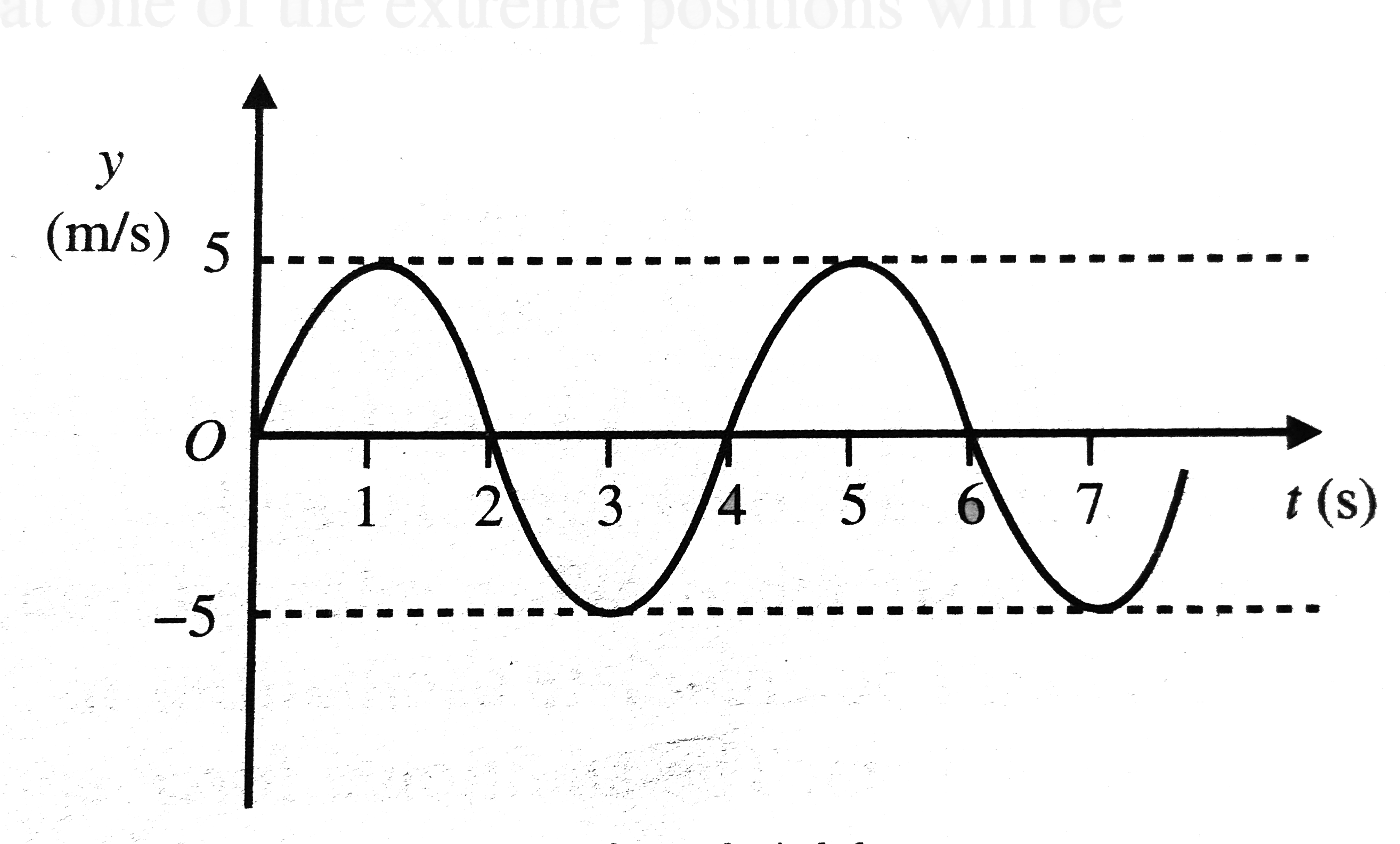
The variation of velocity of a particle executing SHM with time is shown is fig. The velocity of the particle when a phase change of `(pi)/(6)` takes place from the instant it is at one of the extreme positions will be

A

`3.53(m)/(s)`

B

`2.5(m)/(s)`

C

`4.330(m)/(s)`

D

none of these

Text Solution

Verified by Experts

The correct Answer is:

B

From the graph `T=(5-1)=4s`
(distance between the two adjacent shown in the figure)
and `v_(max)=5(m)/(s)`,`omegaA=5(m)/(s)`
`((2pi)/(T))A=5impliesA=(5T)/(2pi)=(5xx4)/(2pi)=(10)/(pi)` m
Also `omega=(2pi)/(4)=(pi)/(2)(rad)/(s)`
The equation of velocity can be written as
`v=5sin(((pi)/(2)t))(m)/(s)`
At extreme position, `v=0`, `sin(((pi)/(2)t))=0` or `t=2s`
Phase of the particle velocity at that insstant corresponding to the above equation `=pi`
Therefore, when a phase change of `(pi)/(5)` takes place, the resulting phase`=pi+(pi)/(6)`
`v=5sin((pi+(pi)/(6)))=-5sin((pi)/(6))=-5((1)/(2))`
`=2.5(m)/(s)` (numerically)
`(dy)/(dt)=vimpliesdy=dt`
`dy=int5sin(((pit)/(2)))dt=(10)/(pi)[-co(s(pit)/(2))]+C`
Since at `t=0`, the particle is at the extreme position, there fore at `r=0`,`y=-(10)/(pi)`
`-(10)/(pi)=-(10)/(pi)costheta+CimpliesC=0`
`y=-(10)/(pi)cos((pit)/(2))`
Clearly a phase change of `(pi)/(6)` corresponds to a time difference of `(T)/(2pi)((pi)/(6))=(T)/(12)=(4)/(12)=(1)/(3)s`
`y=-(10)/(pi)cos((pi)/(6))=-(10)/(pi)((sqrt3)/(2))`
`=(5sqrt3)/(pi)m` (numerically)
Acceleration `a=(dv)/(dt)=(d)/(dt)(5sin(pit)/(2))=(5pi)/(2)(cospit)/(2)`
`a` at `t=(1)/(3)s=(5pi)/(2)cos((pi)/(6))=(5pisqrt3)/(4)(m)/(s^2)`
Maximum displacement `x_(max)=A=(10)/(pi)m`
and maximum accceleration, `a_(max)=omega^2A`
`=((pi)/(2))^2xx(10)/(pi)=(5pi)/(2)(m)/(s^2)`
Promotional Banner

Topper's Solved these Questions

  • LINEAR AND ANGULAR SIMPLE HARMONIC MOTION

    CENGAGE PHYSICS|Exercise Multiple Correct|35 Videos
  • LINEAR AND ANGULAR SIMPLE HARMONIC MOTION

    CENGAGE PHYSICS|Exercise Assertion Reasoning|6 Videos
  • LINEAR AND ANGULAR SIMPLE HARMONIC MOTION

    CENGAGE PHYSICS|Exercise Subjective|21 Videos
  • KINETIC THEORY OF GASES AND FIRST LAW OF THERMODYNAMICS

    CENGAGE PHYSICS|Exercise Interger|11 Videos
  • MISCELLANEOUS KINEMATICS

    CENGAGE PHYSICS|Exercise Interger type|3 Videos

Similar Questions

Explore conceptually related problems

Average velocity of a particle executing SHM in one complete vibration is :

Average velocity of a particle executing SHM in one complete vibration is :

The displacement - time graph of a particle executing SHM is as shown in the figure. The maximum velocity of the particle is

The position of a particle executing SHM is given by A sin(wt) Write the expression for the velocity of the particle.

The phase of a particle executing S.H.M is pi//2 when it has

The velocity of a particle performing S.H.M. at extreme position is

The acceleration-displacement graph of a particle executing SHM is as shown in the figure. The velocity of the particle at y = 0 is (take tan 14^(@) = 0.25)

Velocity-time graph of a particle executing SHM is shown in figure. Select the correct alternative(s).

A particle executing SHM with time period T and amplitude A. The mean velocity of the particle averaged over quarter oscillation, is

displacement versus time curve for a particle executing SHM is is as shown in figure. At what points the velocity of the particle is zero?

CENGAGE PHYSICS-LINEAR AND ANGULAR SIMPLE HARMONIC MOTION-Single Correct
  1. The diagram below shows a sinusoidal curve. The equation of the curve ...

    Text Solution

    |

  2. The following figure shows the displacement versus time graph for two ...

    Text Solution

    |

  3. The variation of velocity of a particle executing SHM with time is sho...

    Text Solution

    |

  4. In the previous problem, the displacement of the particle from the mea...

    Text Solution

    |

  5. In problem 9 , the acceleration of the particle is

    Text Solution

    |

  6. In problem 9 the acceleration of the particle is

    Text Solution

    |

  7. Figure. Shows the variation of force acting on a particle of mass 400 ...

    Text Solution

    |

  8. A block of mass 1kg hangs without vibrating at the end of a spring who...

    Text Solution

    |

  9. A vertical spring carries a 5kg body and is hanging in equilibrium an ...

    Text Solution

    |

  10. A particle performs SHM in a straight line. In the first second, start...

    Text Solution

    |

  11. A particle free to move along the (x - axis) hsd potential energy give...

    Text Solution

    |

  12. Two simple harmonic motion are represented by equations y(1) = 4 sin...

    Text Solution

    |

  13. The metallic bob of a simple pendulum has the relative density rho. Th...

    Text Solution

    |

  14. Two particles move parallel to x - axis about the origin with the same...

    Text Solution

    |

  15. The potential energy of a particle executing SHM along the x-axis is g...

    Text Solution

    |

  16. A particle executing SHM of amplitude a has displacement (a)/(2) at t=...

    Text Solution

    |

  17. A block of mass 4 kg hangs from a spring constant k=400(N)/(m). The bl...

    Text Solution

    |

  18. A body of mass 100 g attached to a spring executed SHM of period 2 s a...

    Text Solution

    |

  19. A particle executing SHM has velocities u and v and acceleration a and...

    Text Solution

    |

  20. Two particles are executing identical simple harmonic motions describe...

    Text Solution

    |
