Home
Class 11
PHYSICS
Two springs with negligible masses and f...


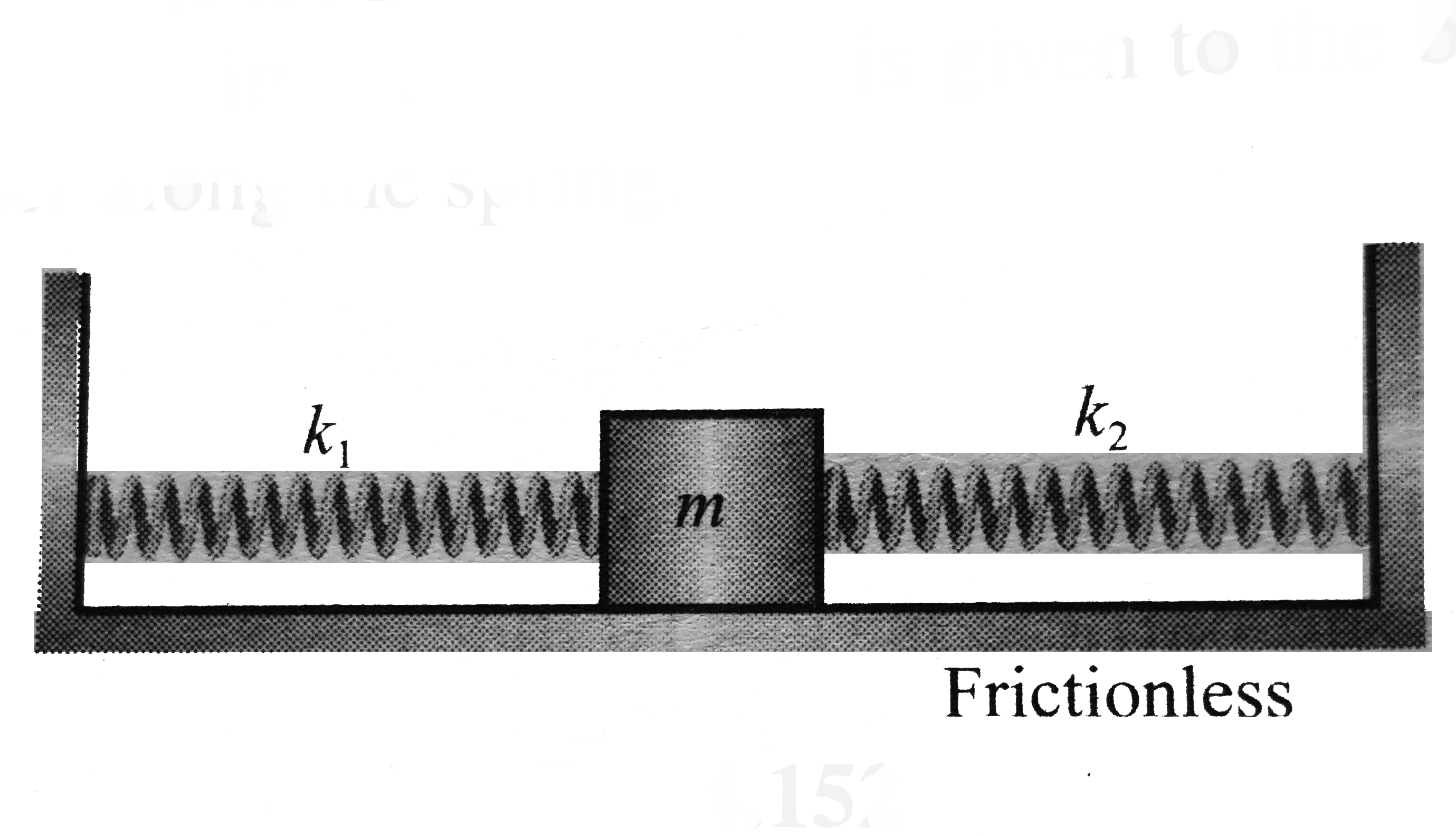
Two springs with negligible masses and force constants `k_1=200(N)/(m)` and `K_2=160(N)/(m)` are attached to the block of mass `m=10kg ` as shown in the fig. Initially the block is at rest, at the equilibrium position which both springs are neither stretched nor compressed. At time `t=0`, sharp impulse of `50Ns` is given to the block with a hammer along the spring.

A

Period of oscillations for the mass m is `(pi)/(6)`s.

B

Maximum velocity of the mass m during its oscillation is `10(m)/(s)`

C

Data are insufficient to determine maximum velocity.

D

Amplitude of oscillation is `0.83m`.

Text Solution

Verified by Experts

The correct Answer is:

D

`T=2pisqrt((m)/(K_1+K_2))=2pisqrt((10)/(360))=(pi)/(3)s`
the maximum velocity is always at equilibrium position since at any other point there will be a restoring force at temting to slow the mass.
`V_("mass")=("impulse")/("mass")=(50)/(10)=5(m)/(s)impliesomega=(2pi)/(T)=6(rad)/(s)`
`impliesA=`amplitude`=(V_(max))/(omega)=(5)/(6)=0.83m`
Promotional Banner

Topper's Solved these Questions

  • LINEAR AND ANGULAR SIMPLE HARMONIC MOTION

    CENGAGE PHYSICS|Exercise Multiple Correct|35 Videos
  • LINEAR AND ANGULAR SIMPLE HARMONIC MOTION

    CENGAGE PHYSICS|Exercise Assertion Reasoning|6 Videos
  • LINEAR AND ANGULAR SIMPLE HARMONIC MOTION

    CENGAGE PHYSICS|Exercise Subjective|21 Videos
  • KINETIC THEORY OF GASES AND FIRST LAW OF THERMODYNAMICS

    CENGAGE PHYSICS|Exercise Interger|11 Videos
  • MISCELLANEOUS KINEMATICS

    CENGAGE PHYSICS|Exercise Interger type|3 Videos

Similar Questions

Explore conceptually related problems

Two springs with negligible massess and force constant of k_(1)= 200 Nm^(-1) and k_(2)=160Nm^(-1) are attached to the block of mass m = 10kg as shown in the figure. Initially the block is at rest at the equilibrium position the block is at rest at the equilibrium position nor compressed. At time t=0, sharp impulse of 50 N-s is given to the block.

Two springs with negligible massess and force constant of k_(1)= 200 Nm^(-1) and k_(2)=160Nm^(-1) are attached to the block of mass m = 10kg as shown in the figure. Initially the block is at rest at the equilibrium position the block is at rest at the equilibrium position ir. Which both springs are neither stretched nor compressed. At time t = 0, sharp impulse of 50 N-s is given to the block in horizontal direction.

Two identical springs of spring constant k are attached to a block of mass m and to fixed supports as shown in figure. When the mass is displaced from equilibrium position by a distance x towards right, find the restoring force.

Two identical springs of spring constant k are attached to a block of mass m and to fixed supports as shown in the figure. The time period of oscillation is

Block of mass m=10kg is suspended by two springs vertically as shown in the diagram. The block is at rest initially. Find the acceleration of block just after cutting the right spring.

A block of mass m, lying on a smooth horizontal surface, is attached to a spring (of negligible mass) of spring constant k. The other end of the spring is fixed, as shown in the figure. The block is initally at rest in its equilibrium position. If now the block is pulled withe a constant force F, the maximum speed of the block is :

A block of mass m initially at rest is dropped from a height h on to a spring of force constant k . the maximum compression in the spring is x then

A spring is connected between two blocks as shown in the diagram. Initially the blocks are held stationary and suddenly they are released. Find the ratio of maximum kinetic energy with spring compressed the block of mass m to that of mass 2m.

CENGAGE PHYSICS-LINEAR AND ANGULAR SIMPLE HARMONIC MOTION-Single Correct
  1. The string of a simple pendulum replaced by a uniform rod of length L ...

    Text Solution

    |

  2. A uniform semicurcular ring having mass m and radius r is hanging at o...

    Text Solution

    |

  3. Two springs with negligible masses and force constants k1=200(N)/(m) a...

    Text Solution

    |

  4. A thin uniform vertical rod of mass m and length l pivoted at point O ...

    Text Solution

    |

  5. A particle executes SHM with time period 8 s. Initially, it is at its ...

    Text Solution

    |

  6. A particle executed S.H.M. starting from its mean position at t=0, If ...

    Text Solution

    |

  7. In a certain oscillatory system (particle is performing SHM), the ampl...

    Text Solution

    |

  8. A particle of mass m moving along x-axis has a potential energy U(x)=a...

    Text Solution

    |

  9. The instantaneous displacement x of a particle executing simple harmon...

    Text Solution

    |

  10. A simple harmonic motion along the x-axis has the following properties...

    Text Solution

    |

  11. A spring balance has a scale that can read from 0 to 50 kg. The length...

    Text Solution

    |

  12. A soil cylinder of mass M and radius R is connected to a spring as sho...

    Text Solution

    |

  13. A block A is connected to spring and performs simple harmonic motion w...

    Text Solution

    |

  14. A block of mass m is suspended from the ceiling of a stationary standi...

    Text Solution

    |

  15. A mass m attached to a spring of spring constant k is stretched a dist...

    Text Solution

    |

  16. A plank of mass 12 kg is supported by two identical springs as shown i...

    Text Solution

    |

  17. The time taken by a particle performing SHM on a straight line to pass...

    Text Solution

    |

  18. Two springs are made to oscillate simple harmonically due to the same ...

    Text Solution

    |

  19. A thin-walled tube of mass m and radius R has a rod of mass m and vry ...

    Text Solution

    |

  20. A thin uniform rod of mass 1 kg and length 12 cm is suspended by a wir...

    Text Solution

    |
