Home
Class 11
PHYSICS
A physical pendulum is positioned so tha...

A physical pendulum is positioned so that its centre of gravity is above the suspension point. When the pendulum is realsed it passes the point of stable equilibrium with an angular velocity `omega`. The period of small oscollations of the pendulum is

A

`(4pi)/(omega)`

B

`(2pi)/(omega)`

C

`(pi)/(omega)`

D

`(pi)/(2omega)`

Text Solution

Verified by Experts

The correct Answer is:
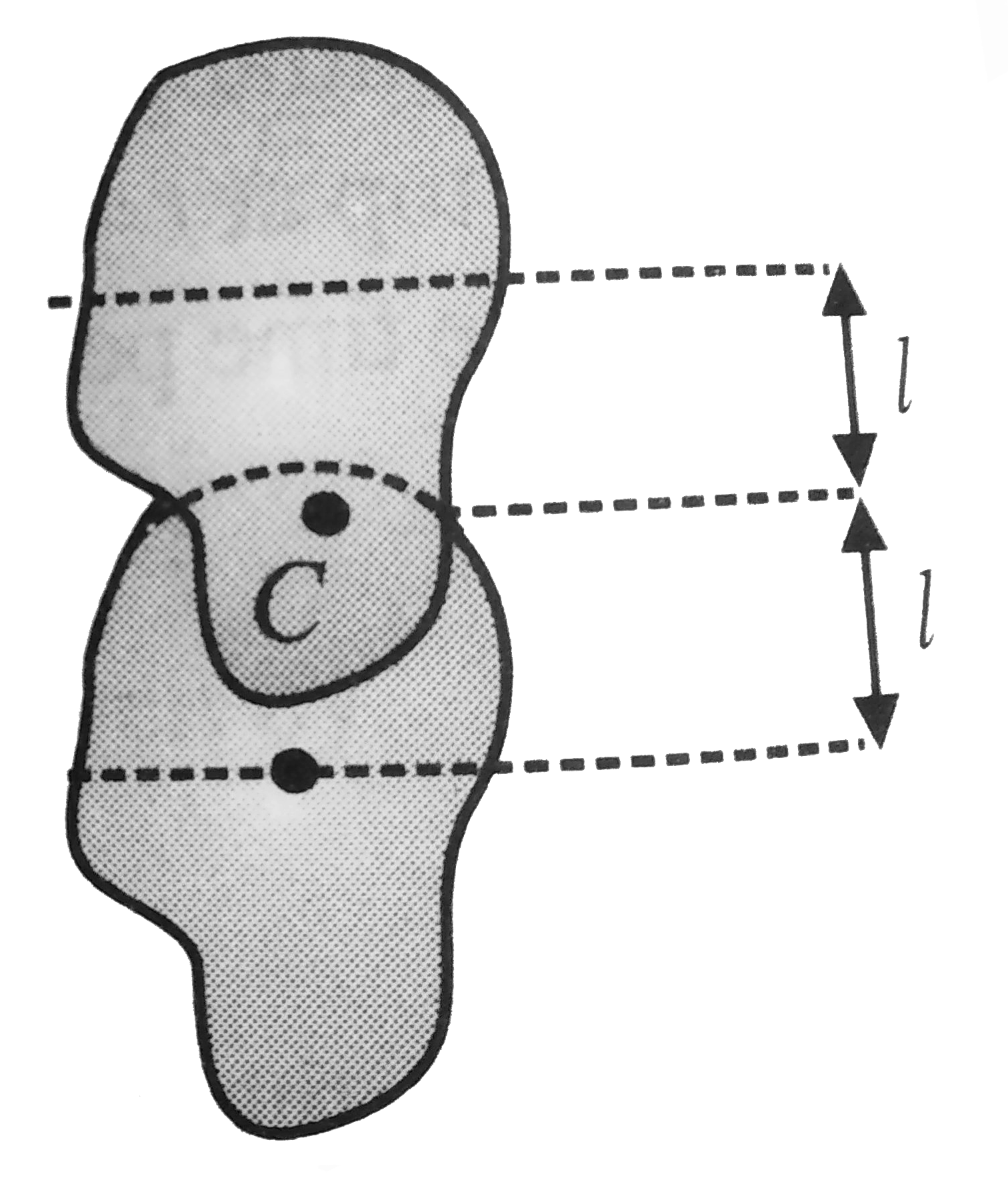
A


`(1)/(2)Iomega^2=mg(2l)implies(I)/(mgl)=(4)/(omega^2)`
`T=2pisqrt((I)/(mgl))=2pisqrt((4)/(omega^2))=(4pi)/(omega)`
Promotional Banner

Topper's Solved these Questions

  • LINEAR AND ANGULAR SIMPLE HARMONIC MOTION

    CENGAGE PHYSICS|Exercise Multiple Correct|35 Videos
  • LINEAR AND ANGULAR SIMPLE HARMONIC MOTION

    CENGAGE PHYSICS|Exercise Assertion Reasoning|6 Videos
  • LINEAR AND ANGULAR SIMPLE HARMONIC MOTION

    CENGAGE PHYSICS|Exercise Subjective|21 Videos
  • KINETIC THEORY OF GASES AND FIRST LAW OF THERMODYNAMICS

    CENGAGE PHYSICS|Exercise Interger|11 Videos
  • MISCELLANEOUS KINEMATICS

    CENGAGE PHYSICS|Exercise Interger type|3 Videos

Similar Questions

Explore conceptually related problems

A particle pendulum is positioned such that is centre of gravity is vertically above suspension point. From that position the pendulum started moving tward the stable equilibroum and passed it with an angular velocity omega . By neglecting the friction at point of suspension, the period of small oscillations of the pendulum is

When the point of suspendion of pendulum is moved, its period of oscillation

Two identical simple pendulums each of length 'l' are connected by a weightless spring as shown. In equilibrium, the pendulums are vertical and the spring is horizontal and undformed. The time period of small oscillations of the linked pendulums, when they are deflected form their equilibrium positive through equal displacements in the same vertical plane in the opposite directions and released, is

In physical pendulum, the time period for small oscillation is given by T=2pisqrt((I)/(Mgd)) where I is the moment of inertial of the body about an axis passing through a pivoted point O and perpendicular to the plane of oscillation and d is the separation point between centre of gravity and the pivoted point. In the physical pendulum a speacial point exists where if we concentrate the entire mass of body, the resulting simple pendulum (w.r.t. pivot point O) will have the same time period as that of physical pendulum This point is termed centre of oscillation. T=2pisqrt((I)/(Mgd))=2pisqrt((L)/(g)) Moreover, this point possesses two other important remarkable properties: Property I: Time period of physical pendulum about the centre of oscillation (if it would be pivoted) is same as in the original case. Property II: If an impulse is applied at the centre of oscillatioin in the plane of oscillation, the effect of this impulse at pivoted point is zero. Because of this property, this point is also known as the centre of percussion. From the given information answer the following question: Q. A uniform rod of mass M and length L is pivoted about point O as shown in Figgt It is slightly rotated from its mean position so that it performs angular simple harmonic motion. For this physical pendulum, determine the time period oscillation.

Two physical pendulums perform small oscillations about the same horizontal axis with frequencies omega_(1) and omega_(2) . Their moments of inertia relative to the given axis are equal to I_(1) and I_(2) respectively. In a state of stable equilibium the pendulums were fastened rigifly together. What will be the frequency of small oscillations of the compound pendulum ?

In physical pendulum, the time period for small oscillation is given by T=2pisqrt((I)/(Mgd)) where I is the moment of inertial of the body about an axis passing through a pivoted point O and perpendicular to the plane of oscillation and d is the separation point between centre of gravity and the pivoted point. In the physical pendulum a speacial point exists where if we concentrate the entire mass of body, the resulting simple pendulum (w.r.t. pivot point O) will have the same time period as that of physical pendulum This point is termed centre of oscillation. T=2pisqrt((I)/(Mgd))=2pisqrt((L)/(g)) Moreover, this point possesses two other important remarkable properties: Property I: Time period of physical pendulum about the centre of oscillation (if it would be pivoted) is same as in the original case. Property II: If an impulse is applied at the centre of oscillatioin in the plane of oscillation, the effect of this impulse at pivoted point is zero. Because of this property, this point is also known as the centre of percussion. From the given information answer the following question: Q. If an impulse J is applied at the centre of oscillation in the plane of oscillation, then angular velocity of the rod will be .

In physical pendulum, the time period for small oscillation is given by T=2pisqrt((I)/(Mgd)) where I is the moment of inertial of the body about an axis passing through a pivoted point O and perpendicular to the plane of oscillation and d is the separation point between centre of gravity and the pivoted point. In the physical pendulum a speacial point exists where if we concentrate the entire mass of body, the resulting simple pendulum (w.r.t. pivot point O) will have the same time period as that of physical pendulum This point is termed centre of oscillation. T=2pisqrt((I)/(Mgd))=2pisqrt((L)/(g)) Moreover, this point possesses two other important remarkable properties: Property I: Time period of physical pendulum about the centre of oscillation (if it would be pivoted) is same as in the original case. Property II: If an impulse is applied at the centre of oscillatioin in the plane of oscillation, the effect of this impulse at pivoted point is zero. Because of this property, this point is also known as the centre of percussion. From the given information answer the following question: Q. For the above question, locate the centre of oscillation.

Statement-1 : During the oscillation so f a simple pendulum, the direction of its acceleration at the mean position is directed towards the point of suspension and at exteme position is direction towards the mean position . Statement-2 : The directio of acceleration of a simple pendulum at an instant is decided by the tangential and radial components of weight at that instant.

CENGAGE PHYSICS-LINEAR AND ANGULAR SIMPLE HARMONIC MOTION-Single Correct
  1. A horizontal spring -block system of mass 2kg executes S.H.M when the ...

    Text Solution

    |

  2. A metre stick swinging in vertical plane about a fixed horizontal axis...

    Text Solution

    |

  3. A physical pendulum is positioned so that its centre of gravity is abo...

    Text Solution

    |

  4. A particle executing harmonic motion is having velocities v1 and v2 at...

    Text Solution

    |

  5. A wire is bent an an angle theta. A rod of mass m can slide along the ...

    Text Solution

    |

  6. A solid right circular cylinder of weight 10 kg and cross sectional ar...

    Text Solution

    |

  7. A block A of mass m is placed on a smooth horizontal platform P and be...

    Text Solution

    |

  8. A certain simple harmonic vibrator of mass 0.1 kg has a total energy o...

    Text Solution

    |

  9. A simple pendulum of length l and mass m is suspended in a car that is...

    Text Solution

    |

  10. One end of a spring of force constant K is fixed to a vertical wall an...

    Text Solution

    |

  11. A block P of mass m is placed on horizontal frictionless plane. A seco...

    Text Solution

    |

  12. A uniform stick of mass M and length L is pivoted its come its ends ar...

    Text Solution

    |

  13. A mass m is suspended from a spring of force constant k and just touch...

    Text Solution

    |

  14. A street car moves rectilinearly from station A to the next station B ...

    Text Solution

    |

  15. Two particle P and Q describe S.H.M. of same amplitude a same frequenc...

    Text Solution

    |

  16. The velocity v of a particle of mass is moving along a straight line c...

    Text Solution

    |

  17. The oscillations represented by curve 1 in the graph are expressed by ...

    Text Solution

    |

  18. Graph shows the x(t) curves for the three experiments involving a part...

    Text Solution

    |

  19. The acceleration of a particle moving along x-axis is a=-100x+50. It i...

    Text Solution

    |

  20. In the above question, the speed of the particle at origin will be:

    Text Solution

    |

