Home
Class 11
PHYSICS
STATEMENT-1 : In simple pendulum perform...

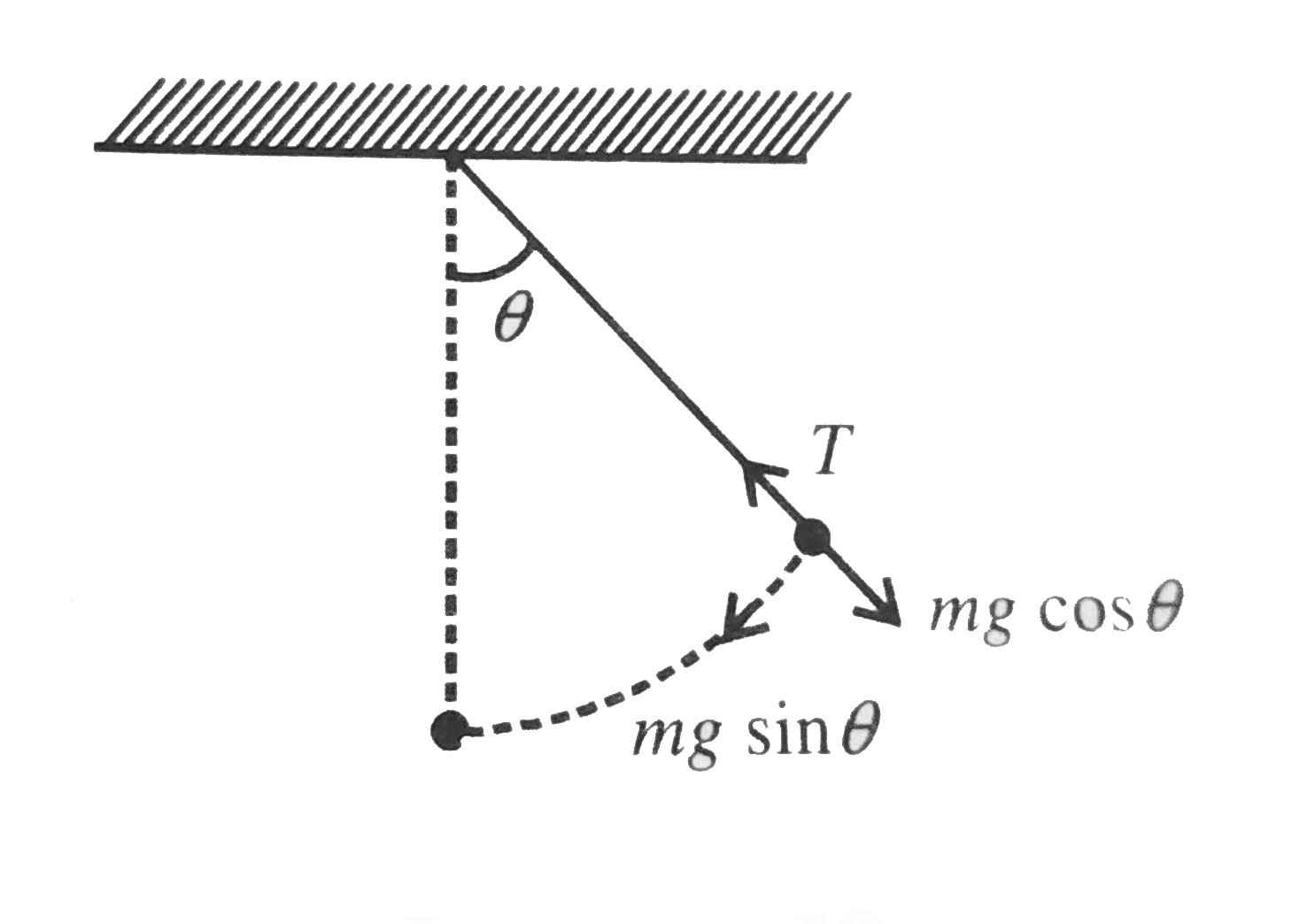
STATEMENT-1 : In simple pendulum performing `S.H.M`., net acceleration is always between tangential and radial acceleration except at lowest point.
STATEMETN-2 : At lowest point tangential acceleration is zero.

A

Statement I is true statement II is true, Statement II is a correct explanation for Statement I.

B

Statement I is true statement II is true, Statement II is NOT a correct explanation for Statement I.

C

Statement I is true, Statement II is false

D

Statement I is false, Statement II is true

Text Solution

Verified by Experts

The correct Answer is:
D


`T-mgcostheta=(mv^2)/(r )impliesmgsintheta=F_T`
Promotional Banner

Topper's Solved these Questions

  • LINEAR AND ANGULAR SIMPLE HARMONIC MOTION

    CENGAGE PHYSICS|Exercise Comprehension|33 Videos
  • LINEAR AND ANGULAR SIMPLE HARMONIC MOTION

    CENGAGE PHYSICS|Exercise Integer|10 Videos
  • LINEAR AND ANGULAR SIMPLE HARMONIC MOTION

    CENGAGE PHYSICS|Exercise Multiple Correct|35 Videos
  • KINETIC THEORY OF GASES AND FIRST LAW OF THERMODYNAMICS

    CENGAGE PHYSICS|Exercise Interger|11 Videos
  • MISCELLANEOUS KINEMATICS

    CENGAGE PHYSICS|Exercise Interger type|3 Videos

Similar Questions

Explore conceptually related problems

when a body performs a U.C .M Its tangential acceleration is

A particle is performing a U.C .M along a circular path of radius r, with a uniform speed v. Its tangential and radial acceleration are

Acceleration in circular motion|| Tangential acceleration|| Radial acceleration|| Shape OF path & net Acceleration

In previous problem, the tangential acceleration of a point on the rim is :

In a typical projectile motion, tangential acceleration at the topmost point P of the trajectory is

The acceleration of a particle performing S.H.M. at extreme position is

In a linear S.H.M., the acceleration of the particle is zero, when its velocity is

The graph between instantaneous velocity and acceleration of a particle performing S.H.M. is

A point starts from rest and moves along a circular path with a constant tangential acceleration. After one rotation, the ratio of its radial acceleration to its tangential acceleration will be equal to

A point mass moves along a circle of radius R with a constant angular acceleration alpha . How much time is needed after motion begins for the radial acceleration of the point mass to be equal to its tangential acceleration ?

