Home
Class 11
PHYSICS
In the figure shown, mass 2m connected w...

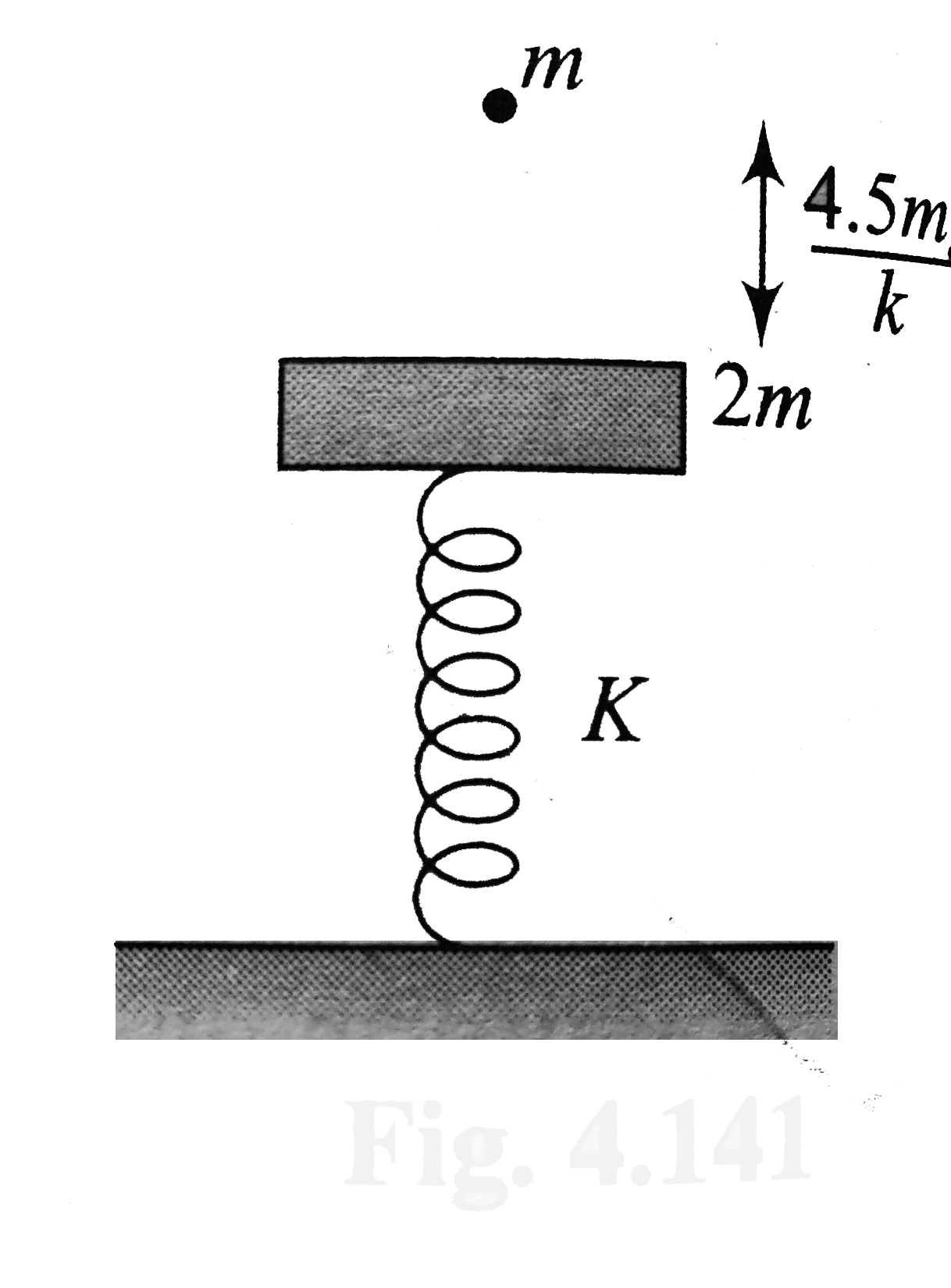
In the figure shown, mass `2m` connected with a spring of force constant `k` is at rest and in equilibrium. A particle of mass `m` is released from height `4.5 mg//k` from `2m` . The particle stick to the block. Neglecting the duration of collision find time from the release of `m` to the moment when the spring has maximum compression.

Text Solution

Verified by Experts
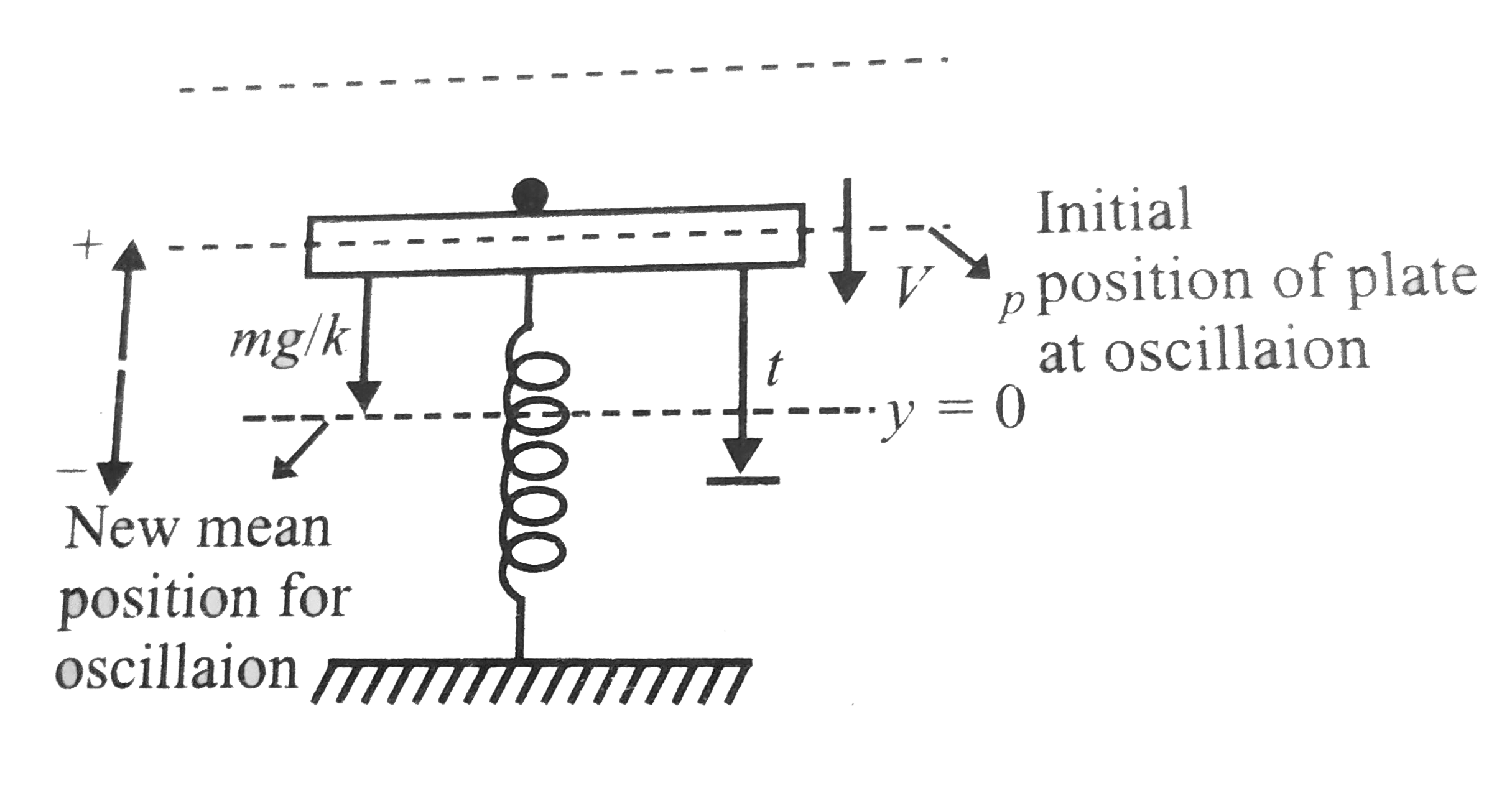

Velocity of the particle just before collision.
`u=sqrt(2gxx(4.5mg)/(K))impliesu=3gsqrt((m)/(K))`
Now it collides with the plate.
Now just after collision velocity `(V)` of the system of plate `+` particle'
`m u=3mVimpliesV=(u)/(3)=gsqrt((m)/(K))`
Now the system performs SHM with time period
`T=2pisqrt((3m)/(K))omega=sqrt((K)/(3m))` and mean position as `(mg)/(K)`
distance below the point of collision.
Let the equation of motion is
`y=Asin(omegat+phi)` .(i)
`v=(dy)/(dt)=Aomegacos(omegat+phi)` ..(ii)
At `t=0`,`y=(mg)/(K)` and `v=gsqrt((m)/(K))`
From eqs (i) and (ii) `(mg)/(K)=Asinphi` ..(iii)
`A=(2mg)/(K)` ..(iv)
From Eqs. (iii) and (iv), `phi=(5pi)/(K)` `y=(2mg)/(K)sin(sqrt((K)/(3m))t+(5pi)/(6))`
Hence equation of SHM should be
`y=-A=-(2mg)/(K)=(2mg)/(K)sin(sqrt((K)/(2m))t+(5pi)/(6))`
The plate will be at rest again when
`y=-A=-(2mg)/(K)=(2mg)/(K)sin(sqrt((K)/(3m))+(5pi)/(6))`
`impliessin(sqrt((K)/(3m))t+(5pi)/(6))=-1=sin(3pi)/(2)`
`impliessqrt((K)/(3m))t+(5pi)/(6)=(3pi)/(2)implies=(2pi)/(3)sqrt((3m)/(K)`
Promotional Banner

Topper's Solved these Questions

  • LINEAR AND ANGULAR SIMPLE HARMONIC MOTION

    CENGAGE PHYSICS|Exercise Subjective type|2 Videos
  • LINEAR AND ANGULAR SIMPLE HARMONIC MOTION

    CENGAGE PHYSICS|Exercise Multiple Correct Answer Type|6 Videos
  • LINEAR AND ANGULAR SIMPLE HARMONIC MOTION

    CENGAGE PHYSICS|Exercise Comprehension|33 Videos
  • KINETIC THEORY OF GASES AND FIRST LAW OF THERMODYNAMICS

    CENGAGE PHYSICS|Exercise Interger|11 Videos
  • MISCELLANEOUS KINEMATICS

    CENGAGE PHYSICS|Exercise Interger type|3 Videos

Similar Questions

Explore conceptually related problems

In the figure shown, mass 2m connected with a spring of force constant k is at rest and in equilibrium. A partical of mass m is released from height 4.5 mg//k from 2m . The partical stick to the block. Neglecting the duration of collision find time from the release of m to the moment when the spring has maximum compression.

In the figure shown mass 2m is at rest and in equilibrium. A particle of mass m is released from height (4.5mg)/(k) from palte. The particle sticks to the plate. Neglecting the duration of collision. Starting form the when the particles sticks to plate to the time when the spring is in maximum compression for the first time is 2pisqrt((m)/(ak)) then find a .

The block shown in figure is released from rest. Find out the speed of the block when the spring is compressed by 1 m

A block of mass m is released from a height h from the top of a smooth surface. There is an ideal spring of spring constant k at the bottom of the track. Find the maximum compression in the spring (Wedge is fixed)

A block of mass m length force a verical of spring constant k If the block is polled down by a distance of 2mg//k from its equilibrium position and released for the subsequent in the spring to maximum compressed in it mg//k

A 2 kg block is connected with two springs of force constants k_(1)=100 N//m and k_(2)=300 N//m as shown in figure. The block is released from rest with the springs unstretched. The acceleration of the block in its lowest postion is (g=10 m//s^(2))

A slab S of mass m released from a height h_(0) , from the top of a spring of force constant k . The maximum compression x of the spring is given by the equation.

A block of mass m suspended from a spring of spring constant k . Find the amplitude of S.H.M.

