Home
Class 11
PHYSICS
A block of mass m is tied to one end of ...


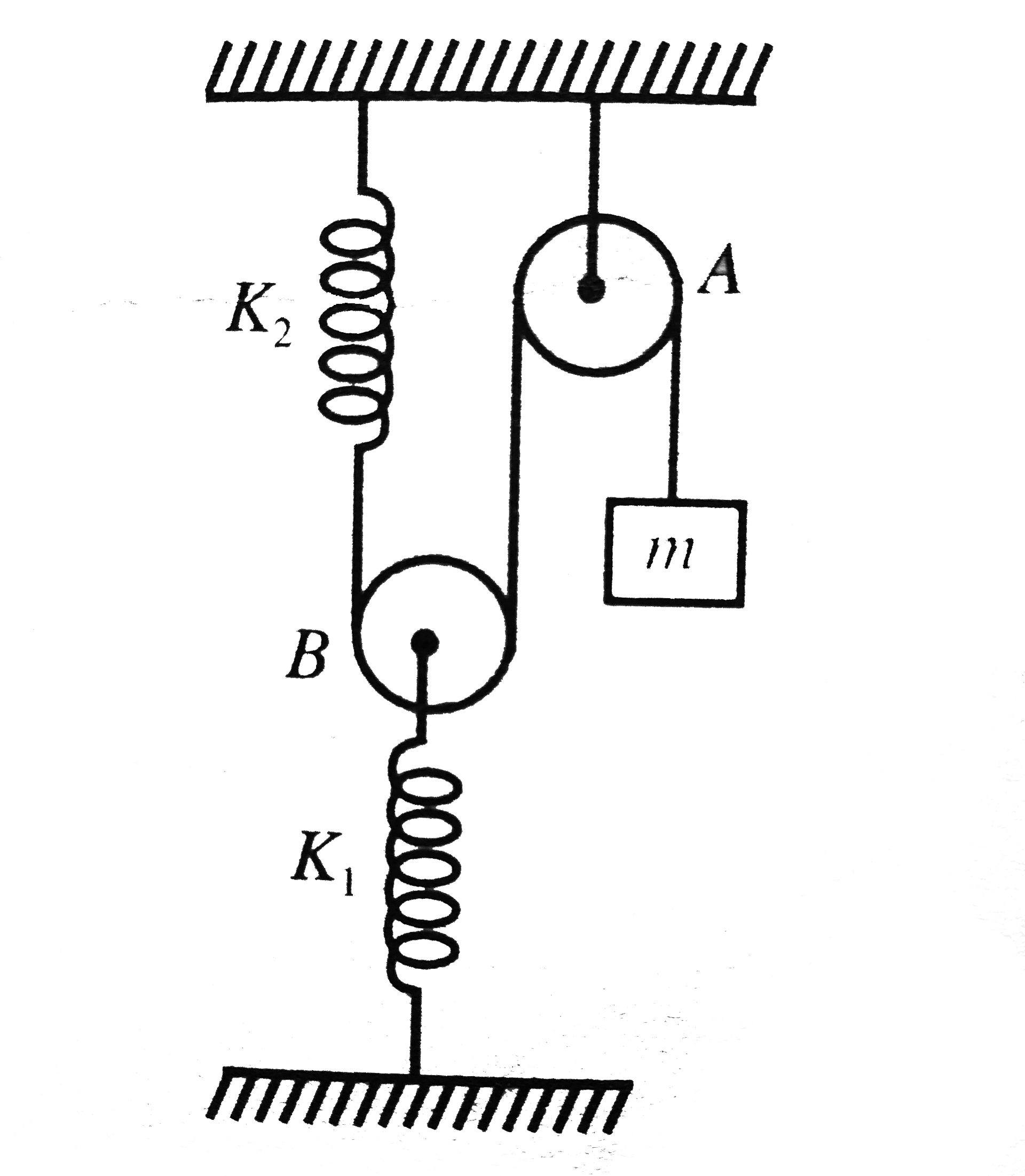
A block of mass `m` is tied to one end of a spring which passes over a smooth fixed pulley `A` and under a light smooth movable pulley `B`. The other end of the string is attached to the lower end of a spring of spring constant `K_2`. Find the period of small oscillation of mass `m` about its equilibrium position (in second). (Take `m=pi^2kg`,`K_2k=4K_1`,`K_1=17(N)/(m).`)

Text Solution

Verified by Experts
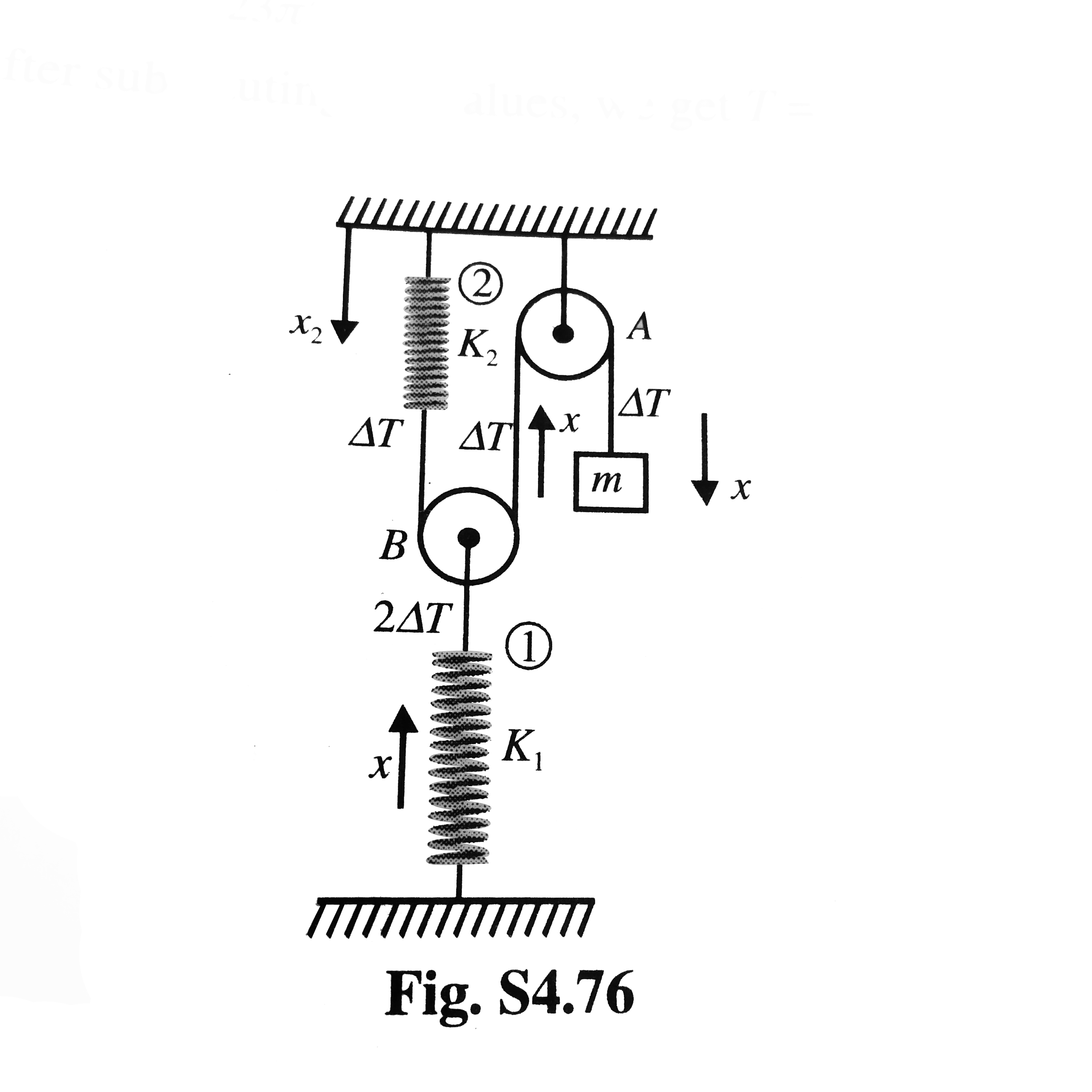

(1) Net sunstituting in the tension in string connecting the block will provide acceleration to the block. We can write
`triangleT=ma` .(i)
When the block `m` is displaced by a distance `x` beyond equilibrium position, the addition stretch of springs `1` and `2` are `x_1` and `x_2` respectively, we can write
`x_1=(x-x_2)/(2)impliesx=2x_1+x_2` .(ii)
At `triangleT=k_2x_2` and `2triangleT=k_1x_1` then `2(k_2x_2)=k_1x_1`
`impliesx_1=(2k_2x_2)/(k_1)` .(iii)
from eqs. (ii) and (iii) `x=2[(2k_2x_2)/(k_1)]+x^2=((4k_2+k_1))/(k_1)x_2`
`impliesx_2=(k_1x)/((k_1+4k_2))`
and `veca=(-k_1k_2)/((k_1+4k_2)m).x`i `impliesveca=(-k_1k_2)/((k_1+4k_2)m).x`
`omega^2==(k_1k_2)/((k_1+4k_2)m)`
Hence `R=(80)/(23pi^2)m`
After substituting the values, we get `T=1s`
Promotional Banner

Topper's Solved these Questions

  • LINEAR AND ANGULAR SIMPLE HARMONIC MOTION

    CENGAGE PHYSICS|Exercise Subjective type|2 Videos
  • LINEAR AND ANGULAR SIMPLE HARMONIC MOTION

    CENGAGE PHYSICS|Exercise Multiple Correct Answer Type|6 Videos
  • LINEAR AND ANGULAR SIMPLE HARMONIC MOTION

    CENGAGE PHYSICS|Exercise Comprehension|33 Videos
  • KINETIC THEORY OF GASES AND FIRST LAW OF THERMODYNAMICS

    CENGAGE PHYSICS|Exercise Interger|11 Videos
  • MISCELLANEOUS KINEMATICS

    CENGAGE PHYSICS|Exercise Interger type|3 Videos

Similar Questions

Explore conceptually related problems

A block of mass m is attached to one end of a light intextensible string passing over a smooth light pulled A and under another smooth light pulled B as shown in Fig. The other end of a springs is fixed to a ceiling. A and B are held by spring of force constant k_(1) and k_(2) . Find the period of small oscillations of system.

The period of oscillation of a mass M suspended from a spring of spring constant K is T. the time period of oscillation of combined blocks is

A block of mass m is attached to one end of a light inextensible string passing over a smooth light pulley B and under another smooth light pulley A as shown in the figure. The other end of the string is fixed to a ceiling. A and B are held by spring of spring constants k_(1) and k_(2) . Find angular frequency of small oscillations of small oscillations of the system.

A rod of length l and mass m , pivoted at one end, is held by a spring at its mid - point and a spring at far end. The spring have spring constant k . Find the frequency of small oscillations about the equilibrium position.

A load of mass M is attached to the bottom of a spring of mass 'M //3' and spring constant 'K'. If the system is set into oscillation, the time period of oscillation is

A massless rod rigidly fixed at O. A sting carrying a mass m at one end is attached to point A on the rod so that OA = a . At another point B(OB = b) of the rod, a horizontal spring of force constant k is attached as shown. Find the period of small vertical oscillations of mass m around its euqilibrium position.

On a smooth inclined plane, a body of mass M is attached between two springs. The other ends of the springs are fixed to firm supports. If each spring has force constant K , the period of oscillation of the body (assuming the springs as massless) is

An object of mass m, oscillating on the end of a spring with spring constant k has amplitude A. its maximum speed is

A light pulley is suspended at the lower end of a spring of constant k_(1) , as shown in figure. An inextensible string passes over the pulley. At one end of string a mass m is suspended, the other end of the string is attached to another spring of constant k_(2) . The other ends of both the springs are attached to rigid supports, as shown. Neglecting masses of springs and any friction, find the time period of small oscillations of mass m about equilibrium position.

