Home
Class 11
PHYSICS
In the arrangement shown if Fig. Pulleys...


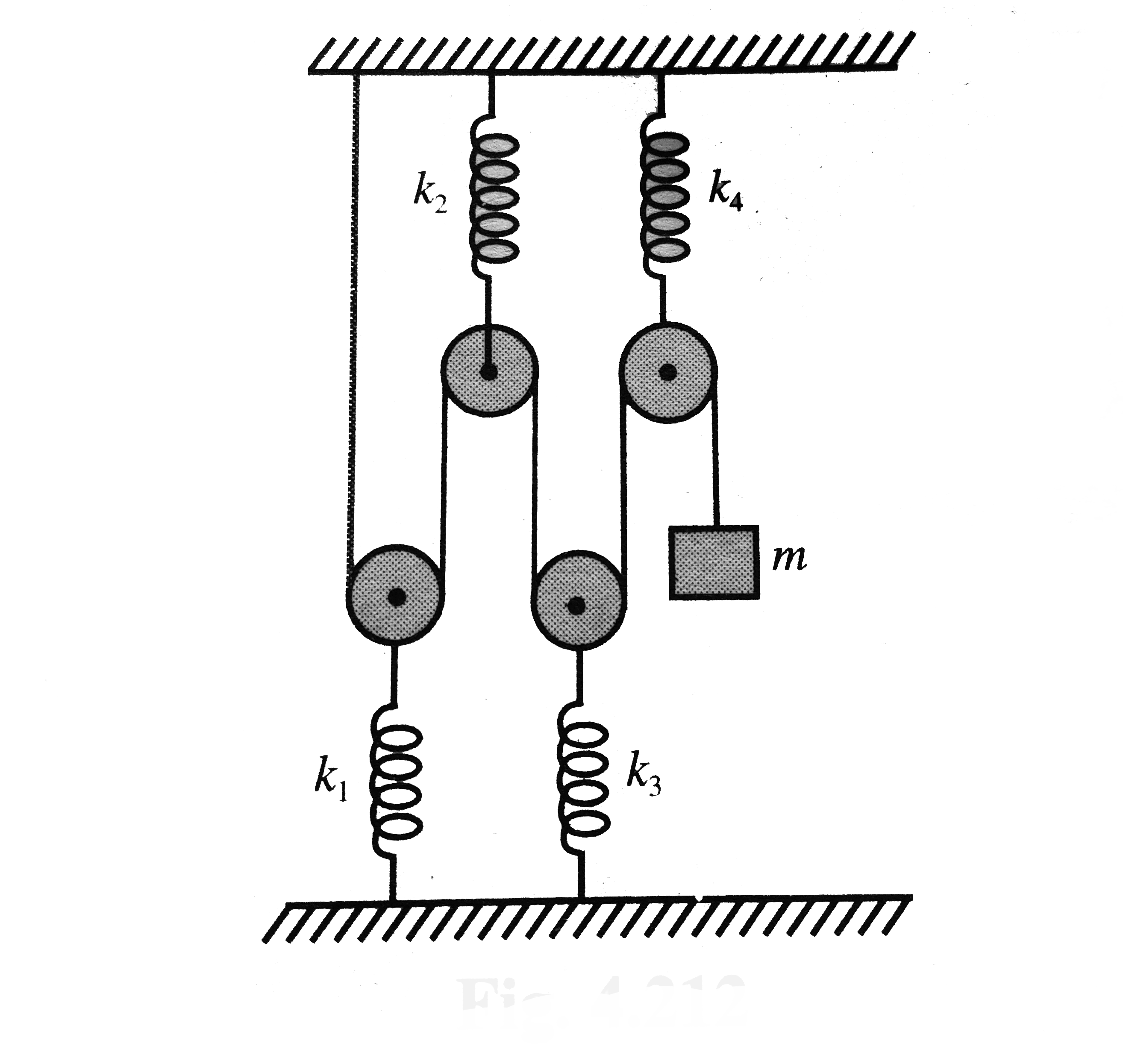
In the arrangement shown if Fig. Pulleys are small and light and spring are ideal and `K_1=25(pi^2)(N)/(m)`, `K_2=2K_1`,`K_3=` and `K_4=4K_1` are the force constant of the spring. Calculate the period of small vertical oscillation of block of mass `m=3kg`.

Text Solution

Verified by Experts

In static equilibrium of block, tension in the string is exactly equal to its weight. Let a vertically downward force `F` be applied on the block to pull it downwards. Equilibrium is again restored when tension in the string is increased by the same amount `F`. Hence, total tension in the string becomes equal to `(mg+F)` Strings are further elongated due to extra tension `F` in strings, tension in each spring increases by 2F. Hence increase in elongation of springs is `(2F)/(K_1)(2F)/(K_2)(2F)/(K_3)` and `(2F)/(K_4)`, respectively. According to geometry of the arrangement, downward displacement of the block from its equilibrium position is
`y=2((2F)/(K_1)+(2F)/(K_2)+(2F)/(K_3)+(2F)/(K_4))` ..(i)
If the block is released now, it starts to accelerate upeards due to extra tension `F` in the string. It means restoring force on the block is equal to `F`. From Eq. (i)
`F=(y)/(4m((1)/(K_1)+(1)/(K_2)+(1)/(K_3)+(1)/(K_4))`
Since acceleration of block is restoring and is directly proportional to displacement `y`, the block performs `SHM`.
Its period `T=2pisqrt(("displacement")/("acceleration"))`.
`T=2pisqrt(4m((1)/(K_1)+(1)/(K_2)+(1)/(K_3)+(1)/(K_4))`
`T=4pisqrt(m((1)/(K_1)+(1)/(K_2)+(1)/(K_3)+(1)/(K_4))`
After subsituting the values we get `T=2s`.
Promotional Banner

Topper's Solved these Questions

  • LINEAR AND ANGULAR SIMPLE HARMONIC MOTION

    CENGAGE PHYSICS|Exercise Subjective type|2 Videos
  • LINEAR AND ANGULAR SIMPLE HARMONIC MOTION

    CENGAGE PHYSICS|Exercise Multiple Correct Answer Type|6 Videos
  • LINEAR AND ANGULAR SIMPLE HARMONIC MOTION

    CENGAGE PHYSICS|Exercise Comprehension|33 Videos
  • KINETIC THEORY OF GASES AND FIRST LAW OF THERMODYNAMICS

    CENGAGE PHYSICS|Exercise Interger|11 Videos
  • MISCELLANEOUS KINEMATICS

    CENGAGE PHYSICS|Exercise Interger type|3 Videos

Similar Questions

Explore conceptually related problems

In the arrangement shown in figure, pulleys are light and spring are ideal. K_(1) , k_(2) , k_(3) and k_(4) are force constant of the spring. Calculate period of small vertical oscillations of block of mass m .

In the arrangement shown in the diagram, pulleys are small and springs are ideal. k_(1)=k_(2)=k_(3)=k_(4)=10Nm^(-1) are force constants of the springs and mass m=10kg. If the time period of small vertical oscillations of the block of mass m is given by 2pix seconds, then find the value of x.

Two springs are jonied and connected to a mass m as shown in figure. If the force constants of the two springs are k_(1) and k_(2) , shown that frequency of oscillation of mass m is

Two spring of force constants K and 2K are connected a mass m below The frequency of oscillation the mass is

Figure shows a system consisting of pulley having radius R, a spring of force constant k and a block of mass m. Find the period of its vertical oscillation.

A block of mass m is tied to one end of a spring which passes over a smooth fixed pulley A and under a light smooth movable pulley B . The other end of the string is attached to the lower end of a spring of spring constant K_2 . Find the period of small oscillation of mass m about its equilibrium position (in second). (Take m=pi^2kg , K_2k=4K_1 , K_1=17(N)/(m). )

Find the time period of oscillation of block of mass m. Spring, and pulley are ideal. Spring constant is k.

Two spring of spring constants k_(1) and k_(2) ar joined and are connected to a mass m as shown in the figure. Calculate the frequency of oscillation of mass m.
