Home
Class 11
PHYSICS
A pulse moving to the right along the x...

A pulse moving to the right along the x-axis is represented by the wave function
where x and y are measured in cedntimetres and t is measured in seconds. Find expression for the wave function at `t=0, t=1.0 s, and t=2.0 s` and plote the shape of pulse at these lines.

Text Solution

Verified by Experts
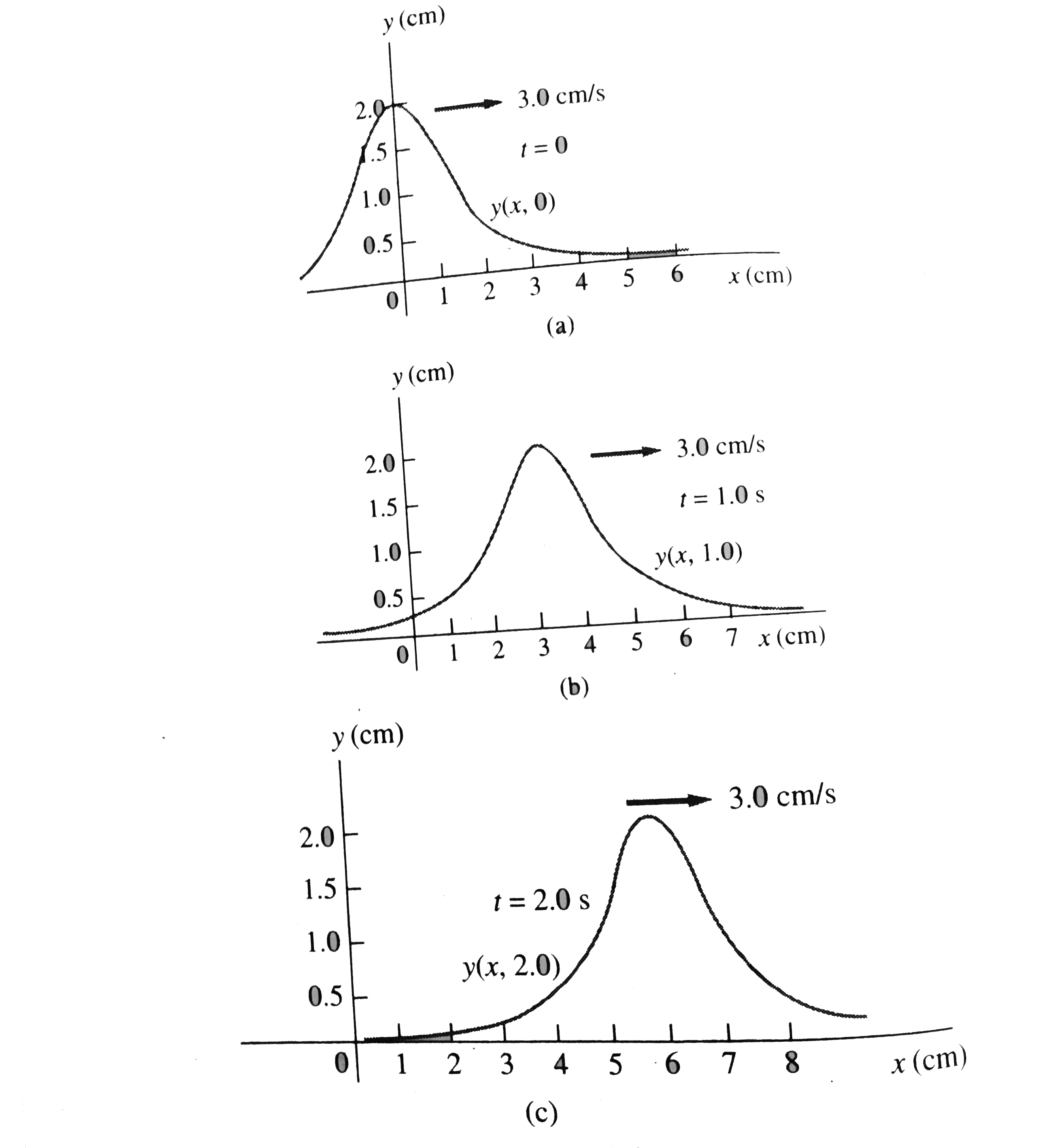
shows the pulse represented by this wave function at t=0. imagine this pulse moving to the right and maintaining its shape as suggested by (b) and (c ).

we categorize this example as a relatively simple analysis problem in which we interpret the mathmatical representation of a pulse.
The wave function is of the form `y=f(x-vt)`. Inspection of the expression for y(x,t) reveals that the wave speed is `v=3.0 cm//s`Furthermore, by letting `x-3.0t=0`, we find that the maximum value of y given by`A=2.0 cm`.
write the wave function expression at `t=0:`
`y(x,0)=(2)/(x^(2)+1)`
write the wave function expression at `t=2.0 s:`
`y(x,1.0)=(2)/(x-3.0)^(2)+1)`
write the wave function expression at `t=2.0 s:`
`y(x,2.0)=(2)/((X-6.0)^(2)+1)`
for each of these expressions we can have various values of x and plot the wave function. this procedure yields the wave function shown in the three parts of ,
these snapshots show that the pulses move to the right without changing its shape and that it has a constant speed of `3.0 cm//s`.
What if the wave function were
`y(x,t)=(4)/(x+3.0t)^(2)+1)`
How would that change the situation?
Answer: One new feature in this expression is the puls sign in the denominator rather than the minus sign. The new expression represents a pulse with the same shape as that in the previous figure, but moving to the left as time progress. Another new feature here is the numerator `4` rather than `2`. Therefore, the new expression represents a pulse with twice the height of that in figure.
Promotional Banner

Topper's Solved these Questions

  • TRAVELLING WAVES

    CENGAGE PHYSICS|Exercise Example|9 Videos
  • TRAVELLING WAVES

    CENGAGE PHYSICS|Exercise Exercise 5.1|9 Videos
  • TRANSMISSION OF HEAT

    CENGAGE PHYSICS|Exercise Single correct|9 Videos
  • VECTORS

    CENGAGE PHYSICS|Exercise Exercise Multiple Correct|5 Videos

Similar Questions

Explore conceptually related problems

A wave is represented by the equation, y = 0.1 sin (60 t + 2x) , where x and y are in metres and t is in seconds. This represents a wave

A wave pulse moving along the x axis is represented by the wave funcation y(x, t) = (2)/((x - 3t)^(2) + 1) where x and y are measured in cm and t is in seconds. (i) in which direction is the wave moving ? (ii) Find speed of the wave. (iii) Plot the waveform at t = 0, t = 2s .

A wave is represented by y=0.4cos(8t-(x)/(2)) where x and y are in metres and t in seconds. The frequency of the wave is

A transverse wave propagating along x-axis is represented by: y(x,t)=8.0sin(0.5pix-4pit-(pi)/(4)) Where x is in metres and t is in seconds. The speed of the wave is:

A particle moves along the positive branch of the curve with x governed by where x and y are measured in meters and t in seconds. At t = 2s, the velocity of the particle is

A particle moves along positive branch of the curve, y = x/2, where x = t^3/3 , x and y are measured in meters and t in seconds, then

A plane wave is represented by x=1.2 sin (3 14 t + 12.56 y) Where x and y are distances measured along in x and y direction in meters and t is time in seconds. This wave has

