Home
Class 11
PHYSICS
A wave on a string is described by y(x,t...

A wave on a string is described by `y(x,t)=A cos (kx-omegat)`. (a) Graph `y,v_(y)`, and `a_(y)` as function of x for time t=0. (b) consider the following points on the string: (i) x=0,(ii) x=pi//4k, (iii) x=pi//2k, (iv)x=3pi//4k, (v)x=pi//k, (vi)x=5pi//4k, (vii) x=3pi//2k, (viii) x=7pi//4k`. For a particle at each of these points at t=0, describes in words whether the particle is moving and in what direction, and whether the particle is speeding up, slowing down, or instantaneously not acceleraring.

Text Solution

Verified by Experts
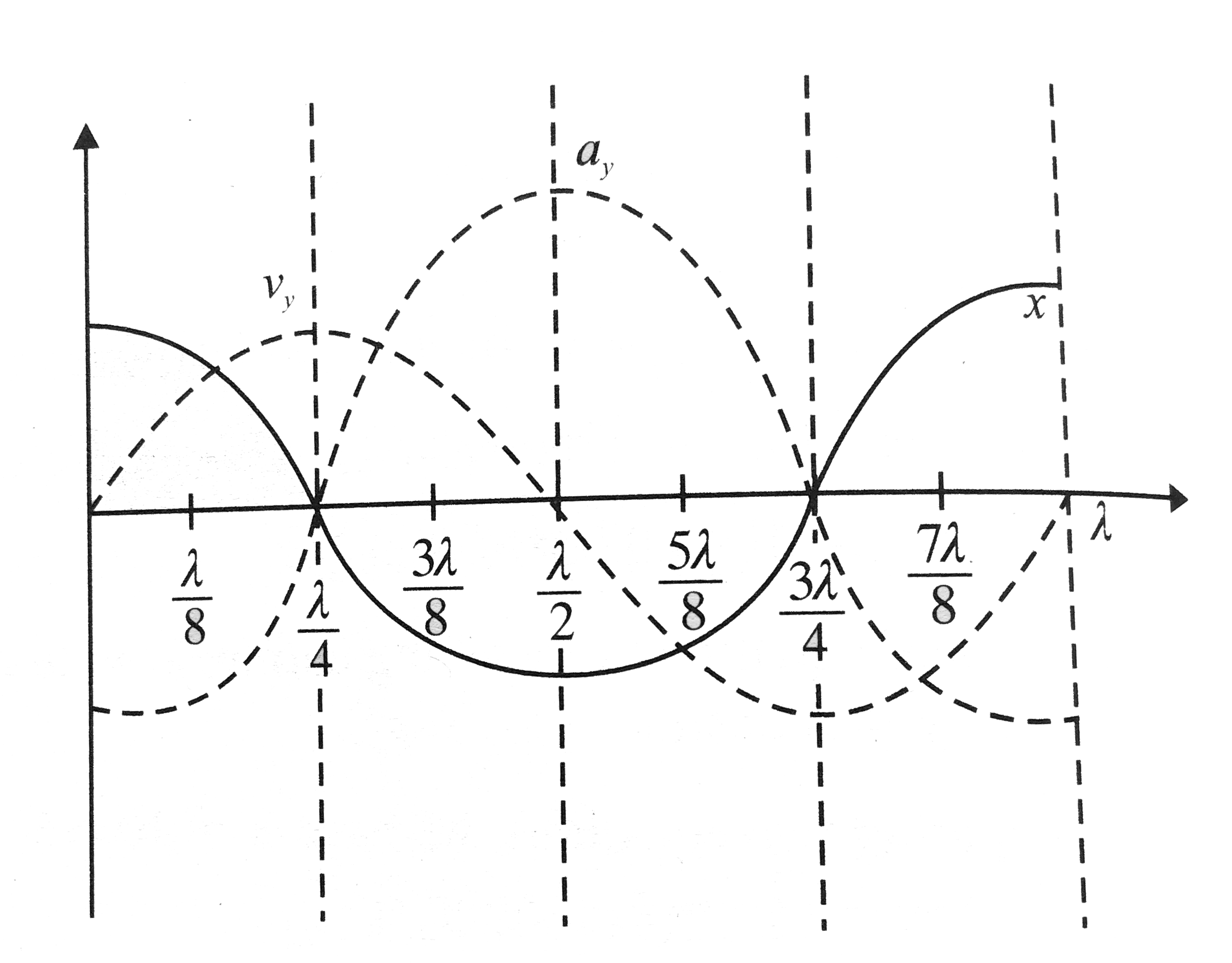
`y=A cos(kx-omegat)`
`v_(y)=(dy)/(dt)=Aomega sin(kx-omegat)`
`a_(y)=(dy_(y)/(dt)=-omega^(2) A cos(kx-omegat)=-omega^(2)y`
for `t=0`
`y=A cos(kx)=A cos((2pi)/(lambda)x)` ltbr) `v_(y)=Aomega sin(kx0=Aomega sin((2pi)/(lambda)x)`
`a_(y)=-omega^(2)A cos(kx)=-omega^(2)A cos((2pi)/(lambda))x)=-omega^(2)y`
(i) At `x=0:y=A, v_(y)=0`, `a_(y)=-omega^(2)A,` the particle is at positive extreme position. It is at rest and accelerating downward at maximum acceleration.
(ii) At `x=(pi)/(4k)=(pilambda)/(4(2pi))=(lambda)/(8)`
`y=A cos((2pi)/(lambda)(lambda)/(8))=(A)/sqrt(2)`, `v_(y)=(Aomega)/sqrt(2)`, `ay=(-omega^(2)A)/sqrt(2)`
the particle is above mean position, moving upward and slowing down. acceleration is in downward direction.
(iii) At`x=(pi)/(2k)=(pilambda)/(2(2pi))=(lambda)/(4)`
here` y=0`, `v_(y)omegaA`, `a_(y)=0`
the particle is at mean position and moving upwards wire maximum velocity. acceleration of particle is zero.
(iv). At `x=(3pi)/(4k)=(3pi)/(8)`
here `y=-(A)/sqrt(2)`, `v_(y)=(Aomega)/sqrt(2)`, `a_(y)=(omega^(2)A)/sqrt(2)`
the particle is below mean position, having velocity acceleration both in upward direction. thus particle speeding up.
(v).At `x=(pi)/(k)=(lambda)/(2)`
here `y=-A,v_(y)=0,a_(y)=omega^(2)A`
`the particle is at negative extreme position it instantaneously at rest and having acceleration in upward direction.
(vi) At `x=(5pi)/(4k)=(5pi)/(8)` ,
here `y=(-A)/sqrt(2)`, `v_(y)=-(Aw)/sqrt(2)`, `a_(y)=(w^(2)A)/sqrt(2)`
the particle is below mean position, moving downward and acceleration upward, thus slowing down.
(vii) At `x=(3pi)/(2k)=(3lambda)/(4)`
here `y=0, v_(y)=-Aomega`, `a_(y)=0`
The particle is at mean position and moving downward with maximum velocity. acceleration of particle is zero.
(viii). At `x=(7pi)/(4k)=(7lambda)/(8)`
here `y=(A)/sqrt(2)`, `v_(y)=(Aomega)/sqrt(2), a_(y)=-(omega^(2)A)/sqrt(2)`
the particle is above mean position, having velocity and acceleration both in downward direction. thus particle is speeding up.
Promotional Banner

Topper's Solved these Questions

  • TRAVELLING WAVES

    CENGAGE PHYSICS|Exercise Subjective|16 Videos
  • TRAVELLING WAVES

    CENGAGE PHYSICS|Exercise Single Correct|62 Videos
  • TRAVELLING WAVES

    CENGAGE PHYSICS|Exercise Exercise 5.1|9 Videos
  • TRANSMISSION OF HEAT

    CENGAGE PHYSICS|Exercise Single correct|9 Videos
  • VECTORS

    CENGAGE PHYSICS|Exercise Exercise Multiple Correct|5 Videos

Similar Questions

Explore conceptually related problems

A x and y co-ordinates of a particle are x=A sin (omega t) and y = A sin(omegat + pi//2) . Then, the motion of the particle is

The displacement of a particle is given by x = 3 sin ( 5 pi t) + 4 cos ( 5 pi t) . The amplitude of particle is

Find the general solution of each of the following equations : (i) sin3x=0 (ii) "sin"(3x)/(2)=0 (iii) (x+(pi)/(5))=0 (iv) cos2x=0 (v) "cos"(5x)/(2)=0 (vi) cos(x+(pi)/(10))=0 (vii) tan2x=0 (viii) tan(3x+(pi)/(6))=0 (ix) tan(2x-(pi)/(4))=0

Find the values of k so that the function fis continuous at the indicated point in f(x)={((k cos x)/(pi-2x),quad if x!=(pi)/(2)),(3 if x=(pi)/(2)) at x=(pi)/(2)

Find the value of k, if the functions are continuous at the points given against them : {:(f(x)=(x-pi/4)/(sin x-cosx)",","for" x nepi/4),(=k",","for" x=pi/4):}}at x=pi/4.

The angle of rotation of axes so that sqrt(3)x-y+1=0 transformed as y=k is (i) (pi)/(6)( ii) (pi)/(4)( iii) (pi)/(3)( iv) (pi)/(2)

What is the value of k if the area bounded by the curve y = sin kx, y= 0, x = pi//k, x = pi//(3k) is 3 sq units ?

If the area of the circle 4x^(2)+4y^(2)-8x+16y+k=0 is 9pi square units, then the value of k is

The solution(s) of the equation sin7x+cos2x=-2 is/are x=(2kpi)/7+(3pi)/(14),\ k in I (b) x=npi+pi/4\ k in I x=2npi+pi/2,\ k in I (d) none of these

CENGAGE PHYSICS-TRAVELLING WAVES-Exercise 5.2
  1. The equation of a travelling wave is given by y=+(b)/(a)sqrt(a^(2)-(...

    Text Solution

    |

  2. Does a travelling wave in one dimension represented by a function of ...

    Text Solution

    |

  3. A wave is propagating along the length of a string taken as positive x...

    Text Solution

    |

  4. Equation of a transverse wave travelling in a rope is given by y=5si...

    Text Solution

    |

  5. The length of the wire shown in figure between the pulley is 1.5 m and...

    Text Solution

    |

  6. The following equation gives the displacement u at time t for a partic...

    Text Solution

    |

  7. The equation of a travelling plane sound wave has the form y=60 cos (1...

    Text Solution

    |

  8. Spherical waves are emitted from a 1.0 W source in an isotropic non-ab...

    Text Solution

    |

  9. A wave travels out in all direction from a point source. Justify the e...

    Text Solution

    |

  10. For plane waves in the air of frequency 1000 Hz and the displace ampli...

    Text Solution

    |

  11. A heavy uniform rope is held vertically and is tensioned by clamping i...

    Text Solution

    |

  12. What is the phase difference between the particle 1 and 2 located as s...

    Text Solution

    |

  13. Show that (a)y=(x+vt)^(2),(b)y=(x+t)^(2),(c )y=(x-vt)^(2), and (d) y=2...

    Text Solution

    |

  14. For a travelling harmonic wave y=2.0 cos(10t-0.0080x+0.35), where x an...

    Text Solution

    |

  15. The shows two snapshots, each of a wave travelling along a partic...

    Text Solution

    |

  16. A circular loop of string rotates about its axis on a frictionless hor...

    Text Solution

    |

  17. A sinusoidal wave is propagating along a streched string that lies alo...

    Text Solution

    |

  18. A simple harmonic oscillator at the point x=0 genrates a wave on a rop...

    Text Solution

    |

  19. A piano wire with mass 3.00 g and length 80.0 cm is stretched with a t...

    Text Solution

    |

  20. A wave on a string is described by y(x,t)=A cos (kx-omegat). (a) Graph...

    Text Solution

    |

