Home
Class 11
PHYSICS
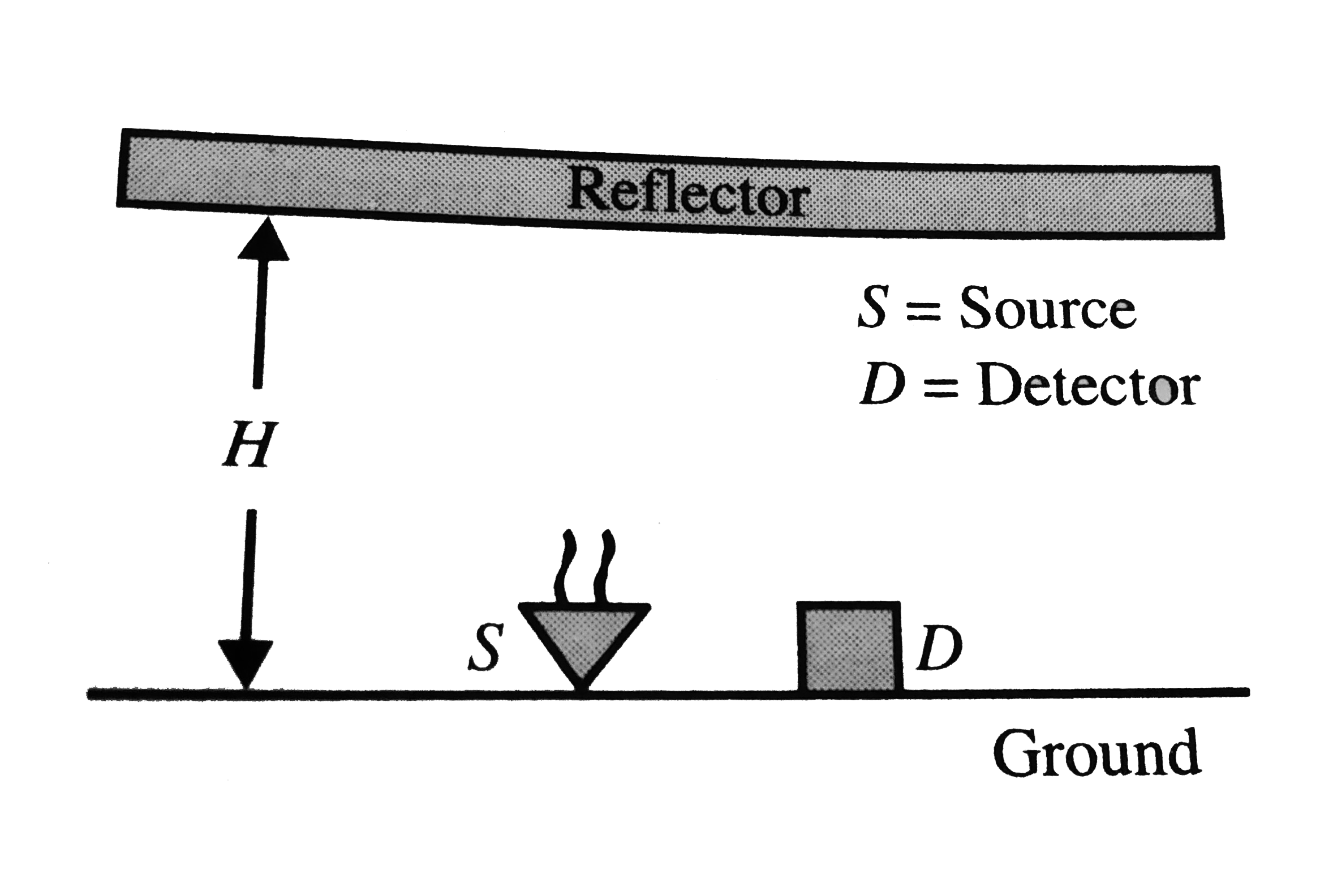
A source of sound and a detector are pla...


A source of sound and a detector are placed at the same place on ground At `t=0`, the source `S` is projected towards reflector with velocity `v_0` in vertical upward directon and reflector starts moving down with constant velocity `v_0` At `t-0`, the vertical separation between the reflector and source is `H((gtv_0^2)/(2g))`. The speed of sound in air is `v(gtgtv_0)`, Take `f_0` as the frequency of sound waves emitted by source. Based on above information answer the following questions.
Q. Frequency of sound waves emitted by source at `t=(v_0)/(2g)` is

A

`f_0`

B

`f_0[(v)/(v)+(v_0)/(2)]`

C

`f_0[((v-v_0)/(2))^(2)/(v)]`

D

`f_0[(((v-v_0)/(2))/(v+v_0))/(2)]`

Text Solution

Verified by Experts

The correct Answer is:

B

Actual frequency emitted by source does not depend upon the velocity of source but frequency heard may change due to relative motion between the observer and the source.
Promotional Banner

Topper's Solved these Questions

  • SOUND WAVES AND DOPPLER EFFECT

    CENGAGE PHYSICS|Exercise Integer|16 Videos
  • SOUND WAVES AND DOPPLER EFFECT

    CENGAGE PHYSICS|Exercise Assertion-Reasoning|24 Videos
  • RIGID BODY DYNAMICS 2

    CENGAGE PHYSICS|Exercise Interger|2 Videos
  • SUPERPOSITION AND STANDING WAVES

    CENGAGE PHYSICS|Exercise Comprehension Type|5 Videos

Similar Questions

Explore conceptually related problems

A source of sound and a detector are placed at the same place on ground At t=0 , the source S is projected towards reflector with velocity v_0 in vertical upward directon and reflector starts moving down with constant velocity v_0 At t-0 , the vertical separation between the reflector and source is H((gtv_0^2)/(2g)) . The speed of sound in air is v(gtgtv_0) , Take f_0 as the frequency of sound waves emitted by source. Based on above information answer the following questions. Q. Wavelength of sound waves as received by detector before reflection at t=(v_0)/(2g) is

A source of sound and a detector are placed at the same place on ground At t=0 , the source S is projected towards reflector with velocity v_0 in vertical upward directon and reflector starts moving down with constant velocity v_0 At t-0 , the vertical separation between the reflector and source is H((gtv_0^2)/(2g)) . The speed of sound in air is v(gtgtv_0) , Take f_0 as the frequency of sound waves emitted by source. Based on above information answer the following questions. Q. Frequency of sound received by detector after being reflected by reflector at t=(v_0)/(2g) is

At t = 0 source starts falling under gravity and a detector is projected upwards with a velocity 10m/s. For the vertical upward motion of detector

A wall is moving with constant velocity u towards a fixed source of sound of frequency f . The velocity of sound is v . The wavelength of the sound reflected by the wall is

A source of sound and detector are moving as shown in Fig. at t=0 . Take velocity of sound wave to be v . For this situation mark out the correct statement(s).

A source of sound is travelling towards a stationary observer. The frequency of sound heard by the observer is of three times the original frequency. The velocity of sound is v m / sec . The speed of source will be

A source of sound is travelling towards a stationary observer. The frequency of sound heard by the observer is 25 % more than the actual frequency. If the speed of sound is v , that of the source is

A detector is released from rest over a source of sound of frequency f_(0) = 10^(3) Hz . The frequency observed by the detector at time t is plotted in the graph. The speed of sound in air is (g = 10 m // s^(2) )

CENGAGE PHYSICS-SOUND WAVES AND DOPPLER EFFECT-Comprehension
  1. In the figure shown below, a source of sound having power 12xx10^-6W i...

    Text Solution

    |

  2. In the figure shown below, a source of sound having power 12xx10^-6W i...

    Text Solution

    |

  3. In the figure shown below, a source of sound having power 12xx10^-6W i...

    Text Solution

    |

  4. When a sound wave enters the ear, it sets the eardrum into oscillation...

    Text Solution

    |

  5. When a sound wave enters the ear, it sets the eardrum into oscillation...

    Text Solution

    |

  6. When a sound wave enters the ear, it sets the eardrum into oscillation...

    Text Solution

    |

  7. When a sound wave enters the ear, it sets the eardrum into oscillation...

    Text Solution

    |

  8. When a sound wave enters the ear, it sets the eardrum into oscillation...

    Text Solution

    |

  9. A source of sound and detector are arranged as shown in Fig. The detec...

    Text Solution

    |

  10. A source of sound and detector are arranged as shown in Fig. The detec...

    Text Solution

    |

  11. A source of sound and detector are arranged as shown in Fig. The detec...

    Text Solution

    |

  12. As shown if Fig. a vibrating tuning fork of frequency 512 Hz is moving...

    Text Solution

    |

  13. As shown if Fig. a vibrating tuning fork of frequency 512 Hz is moving...

    Text Solution

    |

  14. As shown if Fig. a vibrating tuning fork of frequency 512 Hz is moving...

    Text Solution

    |

  15. As shown if Fig. a vibrating tuning fork of frequency 512 Hz is moving...

    Text Solution

    |

  16. A source of sound with natural frequency f0=1800Hz moves uniformly alo...

    Text Solution

    |

  17. A source of sound with natural frequency f0=1800Hz moves uniformly alo...

    Text Solution

    |

  18. A source of sound and a detector are placed at the same place on groun...

    Text Solution

    |

  19. A source of sound and a detector are placed at the same place on groun...

    Text Solution

    |

  20. A source of sound and a detector are placed at the same place on groun...

    Text Solution

    |
