Home
Class 11
PHYSICS
Find the resultant amplitude and the pha...

Find the resultant amplitude and the phase difference between the resultant wave and the first wave , in the event the following waves interfere at a point , ` y_(1) = ( 3 cm) sin omega t`,
`y_(2) = ( 4 cm) sin (omega t + (pi)/( 2)), y_(3) = ( 5 cm ) sin ( omega t + pi)`

Text Solution

Verified by Experts
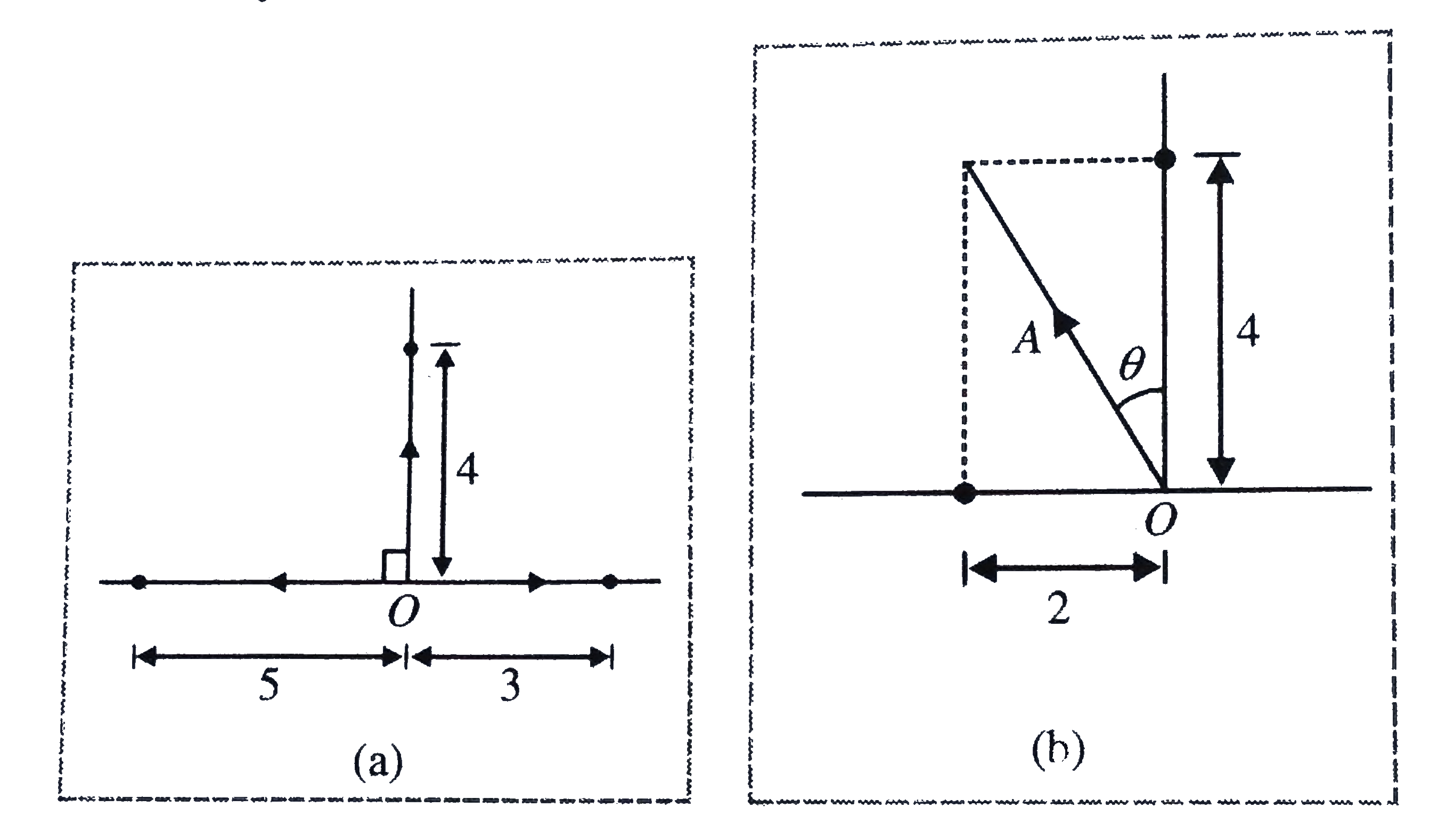
The amplitudes can be added vectorially , with angle between them as their phase difference .
All these are shown in Fig . S 7 .1(a). The resultant amplitude `'A'` due to the interference of three waves is evidently from Fig. S7.1(b) given by
`A = sqrt( 4^(2) + 2^(2)) = 2 sqrt(5) cm`
Also , `tan theta = (2)/(4) = (1)/(2)`
`theta = tan^(-1) ((1)/(2))`
Therefore , the resultant wave leads the first wave by an angle
`(pi)/(2) + tan^(-1) ((1)/(2))`
Promotional Banner

Topper's Solved these Questions

  • SUPERPOSITION AND STANDING WAVES

    CENGAGE PHYSICS|Exercise Exercise 7.2|32 Videos
  • SUPERPOSITION AND STANDING WAVES

    CENGAGE PHYSICS|Exercise Subjective|24 Videos
  • SOUND WAVES AND DOPPLER EFFECT

    CENGAGE PHYSICS|Exercise Integer|16 Videos
  • THERMODYNAMICS

    CENGAGE PHYSICS|Exercise 24|1 Videos

Similar Questions

Explore conceptually related problems

x_(1) = 3 sin omega t x_(2) = 5 sin (omega t + 53^(@)) x_(3) = - 10 cos omega t Find amplitude of resultant SHM.

Two wave are represented by equation y_(1) = a sin omega t and y_(2) = a cos omega t the first wave :-

Find the amplitude of the harmonic motion obtained by combining the motions x_(1) = (2.0 cm) sin omega t and x_(2) = (2.0 cm) sin (omega t + pi//3) .

Find the resultant amplitude of the following simple harmonic equations : x_(1) = 5sin omega t x_(2) = 5 sin (omega t + 53^(@)) x_(3) = - 10 cos omega t

Which two of the following waves are in the same phase? y= A sin (kx -omega t ) y=A sin (kx -omega t+pi ) y= A sin (kx -omegat+ pi //2) y=A sin (kx -omega t +2pi )

Determine resultant amplitude after super position of given four waves with help of phasor diagram. y_(1) = 15 sin omega t mm,y_(2) = 9 sin (omega t -pi//2) mm,y_(3)=7 sin (omega t +pi//2)mm & y_(4) = 13 sin omega t mm .

The resultant amplitude due to superposition of three simple harmonic motions x_(1) = 3sin omega t , x_(2) = 5sin (omega t + 37^(@)) and x_(3) = - 15cos omega t is

The displacements of two interfering light waves are y_(1) = 2sin omega t and y_(2) = 5sin (omega t+(pi)/(3)) the resultant amptitude is

Two waves are represented by the equations y_1=a sin omega t and y_2=a cos omegat . The first wave

If two independent waves are y_(1)=a_(1)sin omega_(1) and y_(2)=a_(2) sin omega_(2)t then

