Home
Class 11
PHYSICS
A source and a detector D of high frequ...

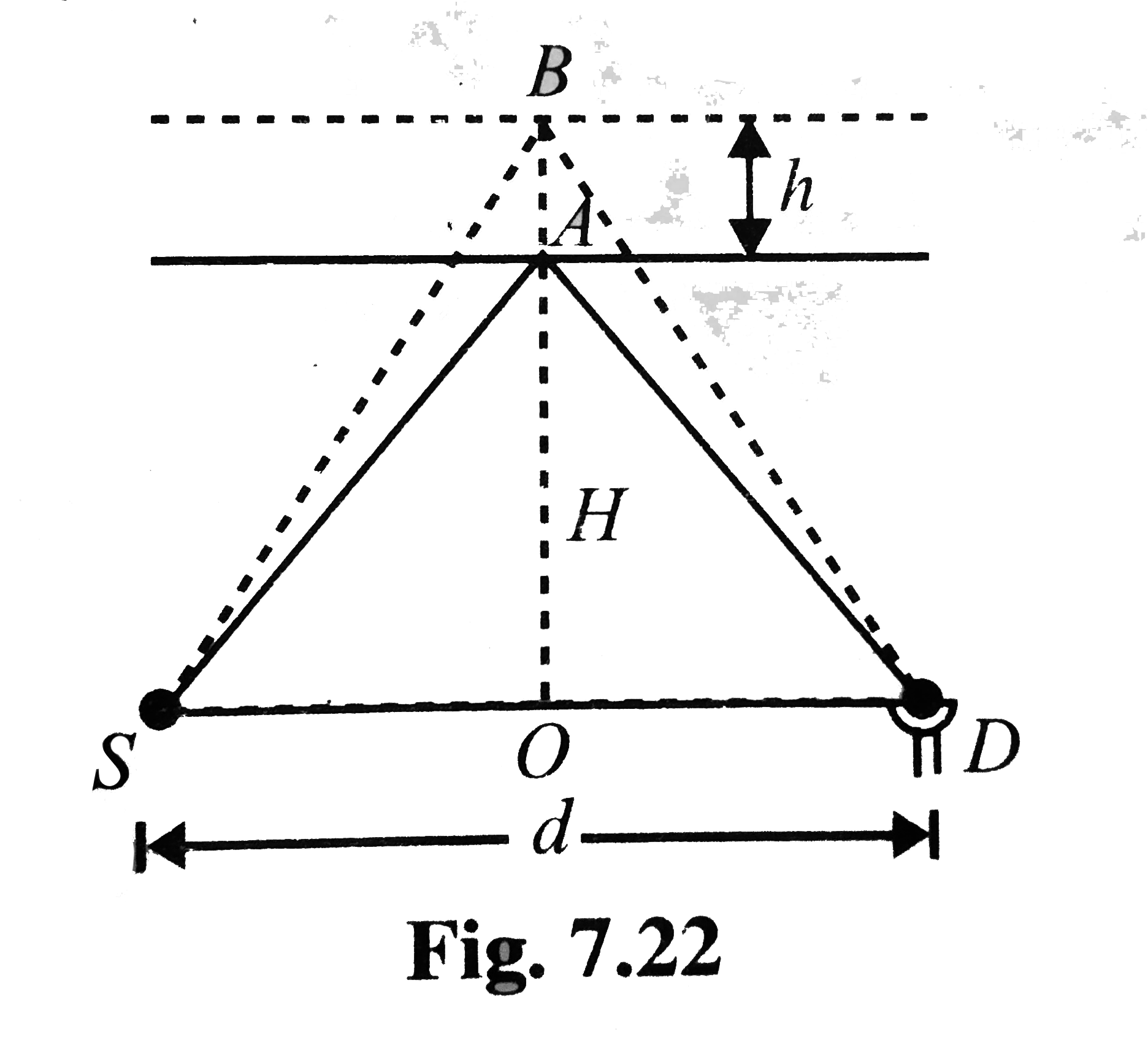
A source and a detector ` D` of high frequency waves are `a` distance `d` apart on the ground . Maximum signal is received at `D` when the reflecting layer is at a height `H`. When the layer rises a distance `h` , no signals is detected at `D` . Neglecting absorption in the atmosphere , find the relation between ` d , h , H`, and the wavelength `lambda` of the waves .

Text Solution

Verified by Experts

`(SA + AD) - SD = n lambda` for reinforcement at `D`
Against `(SB + BD) = n lambda + ( lambda)/( 2)` for total annulment at `D`
Subtracting , `(SB + BD) - (SA + AD) = (lambda)/(2)`
` 2( SB - SA) = (lambda)/( 2)`
or ` lambda = 2 sqrt( 4(H + h)^(2) + d^(2)) - 2 sqrt( 4H^(2) + d^(2))`
Promotional Banner

Topper's Solved these Questions

  • SUPERPOSITION AND STANDING WAVES

    CENGAGE PHYSICS|Exercise Exercise 7.2|32 Videos
  • SUPERPOSITION AND STANDING WAVES

    CENGAGE PHYSICS|Exercise Subjective|24 Videos
  • SOUND WAVES AND DOPPLER EFFECT

    CENGAGE PHYSICS|Exercise Integer|16 Videos
  • THERMODYNAMICS

    CENGAGE PHYSICS|Exercise 24|1 Videos

Similar Questions

Explore conceptually related problems

A source S and a detector D high frequency waves are a distance d apart on the ground. The direct wave from S is found to be in phase at D with the wave from S that is reflected from horizontal layer at an altitude H . The incident and reflected rayes make the same angle with the reflecting layer. When the layer rises a distance h , no signal is detected at D . Negle ct absorption in the atmosphere and find the relation between d,h, H and the wavelength lambda of the waves.

If g is same at a height h and at a depth d , then

Let g_(h) and g_(d) the acceleration due to gravity at height h above the earth s surface and at depth d below the earth surface respecitively if g_(n) = g_(d) then the releation between h and d is

When do the three germinal layers differentiate?

A source S and a detector D are placed at a distance d apart. A big cardboard is placed at a distance sqrt(2) d from the source and the detector as shown in figure. The source emits a wave of wavelength = d//2 which is received by the detector after reflection from the cardboard. It is found to be in phase with the direct wave received from the source. By what minimum distance should the cardboard be shifted away so that the reflected wave becomes out of phase with the direct wave?

The D-layer and E-layer disappear at night in earth's atmosphere? Why?
